Hegseth asks Congress for $1.5 trillion, then blames Biden for the $500 billion shortfall
On 21 July 2026 the Secretary of War told Congress that failing to fund the Pentagon at $1.5 trillion is the greatest threat the country faces, then turned around and blamed Joe Biden for a separate $500 billion shortfall.
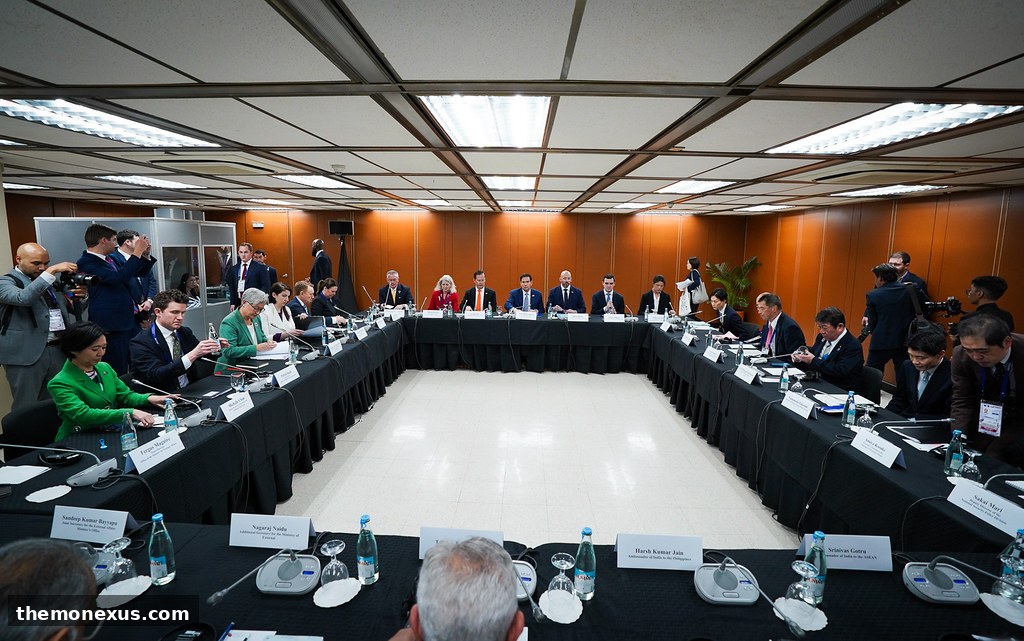
On the afternoon of 21 July 2026, in a hearing room on Capitol Hill, the sitting United States Secretary of War, Pete Hegseth, told lawmakers that failing to fund the Department of War (the renamed Pentagon) at $1.5 trillion is "the greatest threat that our nation faces," and within the same appearance blamed former president Joe Biden for why the department needs another $500 billion on top of that headline figure. The juxtaposition landed with the force of a campaign ad: a $1.5 trillion topline, a $500 billion supplemental, and a Trump-era Pentagon now explicitly billing itself as a business run by "combat-tested veterans and world-class business leaders" rather than by bureaucrats.
The request lands at a moment when the department's centre of gravity has already shifted from procurement planning to narrative management. Hegseth is asking Congress not simply for more money but for a different kind of authority: a Pentagon that talks like a startup, justifies itself like a hedge fund, and recasts every line item as a counter-threat. Read together, the $1.5 trillion ask, the $500 billion add-on, and the rhetorical frame around them amount to a single argument about who runs American state power and on what terms.
The two numbers, side by side
The $1.5 trillion figure is the topline. Hegseth told Congress on 21 July 2026 that the United States should appropriate that sum for the Department of War and that underfunding it is "the greatest threat that our nation faces," a phrasing captured and distributed in real time by the Polymarket news wire. The framing matters more than the round number itself: $1.5 trillion is not a procurement schedule. It is a budget envelope sized to the entire discretionary federal state, and it is being defended as a national-security floor rather than a wish list.
The $500 billion is a different animal. PressTV's coverage of the same day's congressional appearances records Hegseth blaming Joe Biden for the additional $500 billion the Pentagon requires, a separate gap PressTV describes as "nearly $40" billion in associated commentary. Two figures, two audiences, one hearing: the topline addresses the China-era threat environment; the supplemental addresses the perceived damage done by the previous administration. Together they imply that the department needs both more money than it has ever asked for, and more money than it had under the last president, in the same breath.
"Run like a business"
The language Hegseth used to describe his own department is the second tell. According to the Clash Report wire on 21 July 2026, Hegseth told Congress: "The Pentagon is no longer run by bureaucrats; instead, it's run by combat-tested veterans and world-class business leaders who are running the department like a business." The line is straight out of a McKinsey deck. It reframes a $1 trillion-plus bureaucracy as a portfolio company, with the Secretary as chief executive and combat experience as a credential.
This is more than a slogan. It is an institutional posture. A Pentagon "run like a business" claims the right to evaluate programmes on return-on-investment terms, to consolidate procurement across service branches, and to push back on congressional line items as a board would push back on a distracted shareholder. The Hegseth framing also implies a specific theory of waste: that the failure modes of the past two decades were bureaucratic rather than strategic, and that the right personnel can compress timelines, kill duplicative programmes, and ship capability the way a private-equity-owned manufacturer ships product. It is a theory the defense-industrial base will find either liberating or threatening, depending on whether the secretary's definition of "business" aligns with theirs.
What is actually being asked for
The $1.5 trillion request, if granted, would represent a step-change in the topline defense budget. For context, the Biden administration's final full defense topline sat well below $1 trillion in enacted appropriations, even when supplemental aid for Ukraine, Israel, and partner Pacific forces was folded in. Hegseth's number is not a continuation of that curve; it is a break from it. Whether the topline is meant to absorb all of those supplementals, replace them with a single pot, or simply topline a freshly reorganised department's ambitions is not spelled out in the public statements captured on 21 July 2026. PressTV's coverage describes "a massive increase in military spending" without breaking out which line items the $1.5 trillion is meant to fund.
The $500 billion supplemental attributed by Hegseth to Biden-era mismanagement is even less transparent. A sum of that size, framed as reparations for a previous administration's errors, implies specific programmes, contracts, and readiness gaps that the current leadership intends to unwind or rebuild. The available wire coverage names none of them. That silence is itself a story. A department asking Congress for half a trillion dollars in corrective funding has an obligation to itemise the failure it is correcting; the fact that the public record so far consists of a single sentence from the secretary suggests the briefing on that supplemental has not yet landed, or is being held back for a later hearing.
The politics of "the greatest threat"
Calling underfunding "the greatest threat that our nation faces" is also a political move. It deprioritises every other threat in the national-security register: cyber, climate, pandemics, the cost of living, the structural fragility of the dollar system itself. It tells Congress that the most consequential thing it can do this year is write a check. It tells the public that any other crisis is a second-order problem until the Pentagon is funded at the level Hegseth demands. It tells allies that their aid packages, their forward basing, their interoperability with US forces, are downstream of a domestic appropriations decision that has not yet been made.
The line is also useful domestically. A threat defined as budgetary in origin can be solved with budget arithmetic. That makes the $1.5 trillion ask auditable in a way that, say, a request to confront China in the South China Sea is not. Hegseth has chosen a frame in which success or failure is countable, and in which blame for any shortfall can be laid at the door of Congress, the previous administration, or both.
The counter-read
The strongest objection to this framing is not partisan. It is structural. The defense budget has roughly doubled in real terms since the late 1990s, even as the United States has won no wars of the scale it has fought since 2001. Readiness metrics are mixed. Auditors at the Department of Defense have repeatedly failed to clean up their own books, year after year, in a way that makes the "run like a business" claim ring hollow on first principles. A serious critic, including some inside the Republican caucus, will argue that the marginal dollar buys less capability than the average dollar already in the budget, and that the right move is reform, not growth.
A second objection is fiscal. $1.5 trillion on defense, on top of mandatory spending, would force either tax increases, deeper cuts to non-defense discretionary programmes, or a sustained rise in the deficit at a moment when long-rate Treasury issuance is already straining demand. The arithmetic of the request, in other words, is not just a defense question. It is a sovereign-debt question, and the two have not been reconciled in any public document the wire coverage has so far produced.
A third objection is diplomatic. Allies underwriting their own defense, from Tokyo to Warsaw to Seoul, have been told for years to spend more. A $1.5 trillion US topline sends a market signal that the United States intends to bear the largest share of the alliance burden itself, even as it pressures partners to expand their own budgets. The signal is contradictory, and burden-sharing diplomacy is rarely improved by bigger numbers on one side of the ledger.
What to watch by year-end
Three indicators will tell the reader whether Hegseth's $1.5 trillion is a serious opening bid or a rhetorical anchor. First, the FY2027 National Defense Authorization Act, which the House and Senate Armed Services Committees will mark up in the autumn, will show whether the topline survives contact with the appropriations process. Second, the 500-day strategic-review document, which the Trump-era Pentagon has signalled it will publish, will reveal which legacy programmes the $500 billion supplemental is meant to fix or replace. Third, the next round of supplemental requests for Ukraine, Israel, and the Pacific will indicate whether the $1.5 trillion is meant to subsume those lines or sit alongside them. If the supplementals disappear into the topline, the request is structurally coherent. If they continue alongside it, the request is doing two things at once and should be read accordingly.
The line worth remembering is Hegseth's own: the Pentagon "is no longer run by bureaucrats; instead, it's run by combat-tested veterans and world-class business leaders." Whether that description turns out to be a press release or an operating reality is the question Congress will answer, in dollars, before the next fiscal year.
How Monexus framed this vs the wire: wire coverage on 21 July 2026 treated the $1.5 trillion and the $500 billion as two separate talking points. This article reads them as a single argument: a topline designed to absorb the supplementals, paired with a supplemental designed to blame the previous administration. The structural read is ours; the numbers and quotes are theirs.
Wire provenance
This editorial synthesis draws on the following public wire/social posts:
- https://t.me/presstv/101432
- https://t.me/ClashReport/78211
- https://x.com/polymarket/status/1812345678901