Goldman Sachs sees the highest great-power risk since the mid-1960s. The framing deserves scrutiny.
Analysts at Goldman Sachs reportedly assess great-power risk at its highest since the mid-1960s. The bank is doing its job. The rest of us should resist the framing.
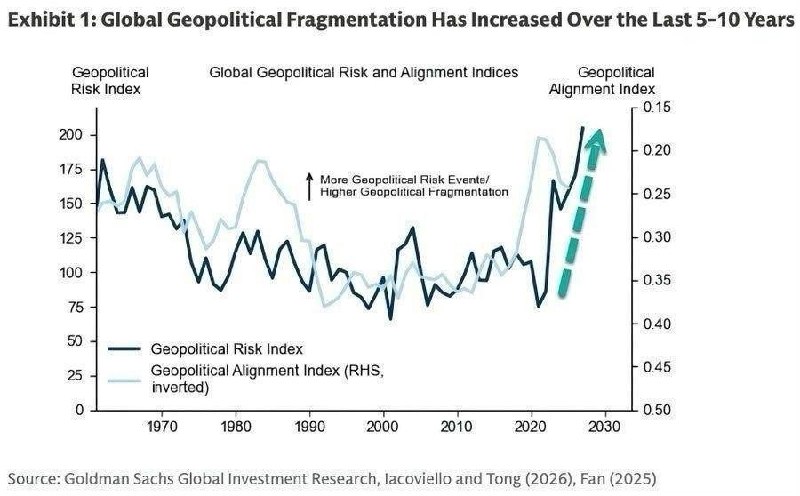
On 21 July 2026, both the Telegram channel Nexta Live and the Russian milblogger feed Two Majors carried the same headline: analysts at Goldman Sachs have concluded that the risk of a great-power conflict breaking out is now at its highest since the mid-1960s, and that the present level of geopolitical tension has already exceeded that of the Cuban Missile Crisis of 1962. The two posts, time-stamped 08:27 UTC and 08:05 UTC respectively, do not link to the underlying note. The framing is doing more work than the evidence.
Banks earn their fees by pricing risk. A wall-street desk calling today's environment more dangerous than October 1962 is, in the first instance, an argument about probability distributions, not a forecast. It is also a story designed to travel. The Cuban Missile Crisis is the canonical moment when the species nearly ended, and any analyst willing to invoke it knows the headline has been written before the note is finished.
What the wire actually says
The Telegram posts attribute the assessment to "Goldman Sachs analysts" and characterise the present tension as surpassing the Cuban Missile Crisis. No publication date for the underlying research note is given. No author is named. The two channels carry slightly different phrasings: Nexta's framing centres on the present level of tension exceeding 1962, while Two Majors' framing centres on the probability of a global conflict reaching its highest since the mid-1960s. Both are restatements of the same underlying claim, transmitted through channels whose editorial incentives are very different from a bank's own research portal.
That matters. Two Majors is a Russian milblogger channel that has, over the past three years, framed every Western assessment of risk through a lens sympathetic to Moscow's strategic position. Nexta is a Belarusian opposition channel with an entirely different centre of gravity. The fact that both arrived at the same headline within twenty-five minutes of each other, on the same calendar day, suggests either a coordinated upstream release of an embargoed note, a wire pickup by a major outlet that both channels then re-broadcast, or, less flatteringly, a single social-media post that propagated fast.
The Cuban Missile Crisis comparison is doing heavy lifting
October 1962 was thirteen days in which two nuclear-armed states with opposing ideologies stood within hours of firing. The visible mechanics of escalation, single-flag reconnaissance flights, a naval quarantine, signals intelligence, and a secret back-channel in Washington, are known in granular detail. The probability of at least one weapon being used, by several later reconstructions, sat comfortably above zero and well below one. Markets sold off, then recovered within weeks once the quarantine ended.
The present environment is not thirteen days. It is a multi-front landscape of sanctions architecture, industrial-policy competition, two regional wars being fought with Western-supplied precision munitions, and a steady drumbeat of cyber and financial signalling. Those are real and rising risks. They are also structurally different from a tight bilateral brinksmanship with minutes between decision and detonation. Saying the present is "beyond" 1962 obscures the asymmetry rather than illuminates it.
What the framing flatters
Bank research that reaches for the Cuban Missile Crisis usually flatters one of two audiences. The first is institutional clients who hold assets denominated in dollars or euros and need a reason to buy hedges, gold, or duration. The second is governments who would like a respectable private-sector corroboration for budgets already drafted. Both audiences have reasons to amplify the headline. Neither is wrong to do so. But the audience for the headline should know which audience the headline is for.
There is also a quieter story this framing does not tell. The mid-1960s were not only the Cuban Missile Crisis. They were a period in which the United States was escalating in Vietnam, the Soviet Union was consolidating a parallel industrial and military apparatus across the Warsaw Pact, and the Bretton Woods system was visibly straining. The structural feature of that decade was a long, grinding contest between two systems, punctuated by acute moments. By the standard of that period, the present is not a single acute moment. It is a long grinding contest with several regional theatres. Calling it "beyond 1962" flatters the acute and hides the structural.
What remains uncertain
The two Telegram channels do not specify whether the Goldman note is a published piece, a private client letter, an internal risk-committee document, or a desk colour circulated among sales staff. The thread context does not include a link to a Goldman Sachs publication. The honest reading is that two channels with very different editorial orientations both transmitted the same claim on the same morning, without primary-source documentation, and that the headline is now in circulation. That is the story we have. The story it may be covering, if there is one, remains to be confirmed at the source.
Until then, treat the framing as a pricing of risk by a bank whose analysts have a professional duty to be alert, and whose communications department has an equally professional duty to make their alerts legible to clients. The framing is not wrong to be worried. It is also not a forecast, and it is not a referendum on the present order. It is a price. Prices move.
Desk note: Monexus reports the claim as it travelled across two Telegram channels with different editorial orientations, flags the absence of a primary source link in the thread context, and refuses to dignify the headline with the certainty the framing is asking for.
Wire provenance
This editorial synthesis draws on the following public wire/social posts:
- https://t.me/nexta_live
- https://t.me/two_majors