A Manchester Invitation, and the Question It Opens
Andy Burnham's first 48 hours as prime minister cut electricity bills and dialed Donald Trump. The Manchester invitation is the more revealing move.
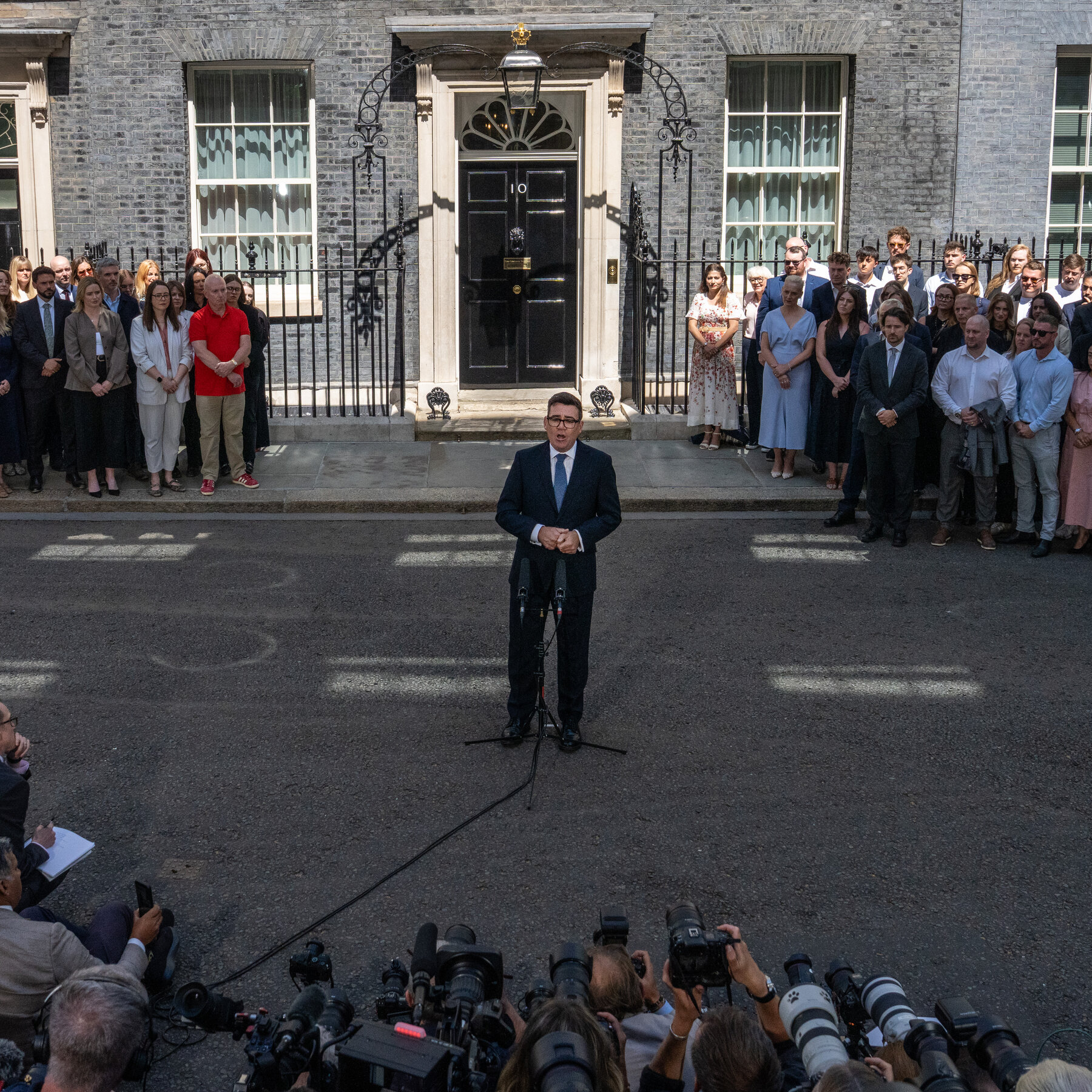
On his second day in Downing Street, the new British prime minister Andy Burnham did something unusual for a leader still learning the geometry of the Downing Street garden: he reached across the Atlantic, accepted a congratulatory phone call from Donald Trump, and invited the US president to Manchester.
By the morning of 21 July 2026, two facts sat on the record. The New York Times reported that Burnham had moved within hours of taking office to cut taxes on household electricity, framing the move as a direct answer to the cost-of-living crisis that defined his rise to the premiership. Separately, a Polymarket post on X captured the Manchester invitation as breaking news, with the platform's audience treating it as a live signal of how the new government intends to position itself internationally.
Read together, the two notes sketch a premiership that wants to be defined by domestic relief and transatlantic warmth at once. The electricity cut is a populist hammer; the Manchester invitation is something softer and stranger, an opening move in a relationship most British leaders treat as inherited rather than chosen.
What Burnham is actually buying with cheaper power
Cutting electricity taxes is not an abstract gesture. UK household energy bills have been the single most cited pressure point in British politics since 2022, and Burnham built his national profile on regional bills and bus routes before he built it on foreign policy. By moving on day one, he signals to voters who handed him the premiership that the arithmetic of the weekly shop, not the choreography of NATO, comes first.
The political logic is straightforward. Energy bills are visible, monthly, and unforgiving. A cut lands in the same pay cycle as the announcement, which makes it the rare policy that travels from Whitehall to a kitchen in Greater Manchester inside one news cycle. It also pre-empts the opposition's first attack line, which would otherwise have been a promise to do the same thing three months from now.
The Trump call, and what a Manchester invitation really signals
The congratulatory call from Trump, as reported by the Times, is the more telling half of the picture. Most new British prime ministers receive such calls. Few use them to issue a standing invitation to a city that doubles as the symbolic capital of the British working class.
Manchester is not a neutral venue. It is the city Burnham ran for a decade, the city whose identity he fused with his own, and the city that supplied the political muscle for his leap into national office. Inviting Trump there is not protocol. It is a performance: it tells the American president that this British government intends to do its diplomacy in the vernacular of red-wall towns rather than the polished courtyards of Lancaster House.
The invitation also reads as a hedge. A US president who visits Manchester rather than London is a US president who has been nudged into British domestic politics on terms that suit the host. It positions Burnham as the curator of the relationship rather than the recipient of one.
The relationship Washington actually wants
Trump's willingness to take the call is itself the news. US presidents do not need to be polite to new British prime ministers, and the early hours of any administration are precisely when an American president tests how much deference he can expect.
The fact that Trump wished Burnham well, per the Times' account, suggests a White House calculation that a Burnham government is worth keeping close. That calculation is not primarily about trade or defence; it is about whether the UK remains the kind of ally that performs alignment visibly, in joint statements, in energy policy, in posture toward Beijing. Burnham's Manchester invitation gives the White House a stage on which that performance can begin before any formal negotiation has started.
There is an alternative read: that Burnham is buying time. A warm personal channel with Trump lowers the temperature of disputes that would otherwise land as public confrontations, from the trade-cooperation file to the question of British posture on China. Warmth now is cheap; confrontation later is expensive.
What the sources do not yet say
Neither the Times report nor the Polymarket post specifies the date Trump accepted, the agenda for a Manchester visit, or which US officials accompanied the call. The framing of the electricity cut is also thinner than it looks: the report names the policy direction but does not detail the fiscal mechanism, the duration of the relief, or which households will feel it first. Any serious assessment of whether this is a real cut or a rebrand of an existing subsidy will have to wait for the Treasury's first fiscal statement under the new government.
What is already clear is the pattern. Day one was cost-of-living. Day two was the Atlantic. The question worth watching is whether day three is Europe, and whether Manchester turns out to be the venue where a British government tries to reset a relationship that has grown noisier with every White House change of tenant.
This piece draws on a single wire report and a market-sentiment post to read a premiership's first 48 hours. Where the reporting leaves the fiscal mechanics of the electricity cut unspecified, so does this article.
Wire provenance
This editorial synthesis draws on the following public wire/social posts:
- https://x.com/polymarket/status/