Kyiv's wartime command shuffle stalls, and the silence is the story
A reported dismissal of Commander-in-Chief Oleksandr Syrskyi was set for 20 July 2026. It did not land. The delay says more about wartime command politics than the original rumour did.
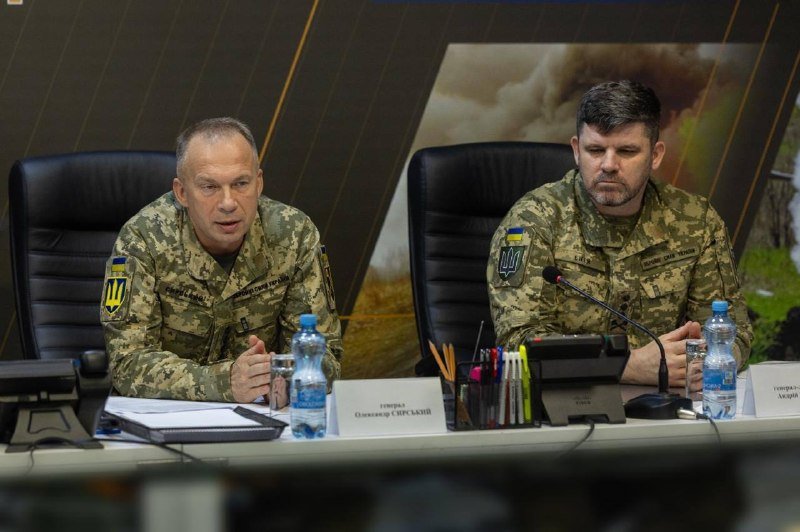
At 16:37 UTC on 20 July 2026, Ukrainian journalist Vitalii Hlahola, citing sources inside political circles, reported that a decision on dismissing Commander-in-Chief Oleksandr Syrskyi would not be made that day. Interviews were still being conducted, the sources said. Roughly ten minutes later, Syrskyi himself broke the framing of the past 48 hours in a single line: he was "surprised" by claims of a personal conflict with former Defence Minister Mykhailo Fedorov, and described the relationship as professional, if difficult on the issues. The two messages, sent within the same hour, sum up the strange shape of wartime Kyiv's personnel politics: a decision rumoured to be imminent, then not imminent, then publicly contradicted by the officer at its centre.
The story this publication is watching is not whether Syrskyi stays or goes. It is what the delay, the leak, and the public rebuttal reveal about how a wartime executive makes command decisions under pressure from above and below. Ukraine is the invaded party, the General Staff is fighting, and the political class is openly canvassing a change at the top. That is the frame. Everything else is theatre.
A leak, a denial, a calendar
Hlahola's initial reporting, distributed across Telegram channels including AMK Mapping and Noel Reports, framed 20 July 2026 as the day a decision would land. By mid-afternoon UTC, that deadline had slipped. The original formulation, that a dismissal decision had been delayed, is itself a tell: it presupposes a decision that is essentially drafted and only awaits signature. In a functioning chain of command, either the commander has the confidence of the political leadership or he does not. The middle state, in which a draft dismissal circulates among journalists and then quietly doesn't happen, is the worst of both worlds: it corrodes the authority of the officer in the field, while leaving the political leadership without the clean break a real change would require.
Syrskyi's response, relayed by Noel Reports at 16:48 UTC, is the more substantive story. He did not deny that questions about his tenure exist. He denied the personal frame: that the issue with Fedorov is animus rather than policy. That distinction matters. A professional disagreement about force structure, mobilisation tempo, or ministerial oversight is something a wartime government manages through procedure. A personal feud, leaking into the press on the eve of a removal vote, is something else entirely, and the public correction is a deliberate attempt to keep the conversation on institutional ground.
What the wire isn't telling you
The Western and Ukrainian wires that pick up these threads tend to flatten the story into "Zelenskyy mulls change at the top." That framing is true at the lowest possible resolution and misleading at every other. The substantive question is what a Syrskyi replacement is meant to fix. Reporting across Noel Reports and AMK Mapping points to friction with the former defence minister, who has been one of the more prominent reformers inside the wartime cabinet. If the friction is over the pace of digitisation, procurement transparency, or the relationship between the General Staff and the Ministry of Defence, then a personnel move without a parallel institutional reform is a reshuffle, not a fix. If the friction is over operational tempo, that is a question for the General Staff and the office of the president, not a minister who no longer holds the portfolio.
There is also the read, harder to source on the record but consistent with the pattern, that the leak itself was the message. Floating a dismissal, watching the political market react, then declining to act, is a tool of command as old as patronage itself. The risk for Kyiv is that this kind of calibration reads, from the outside, as indecision at the very moment Western capitals are deciding what kind of support to commit for 2027.
The institutional cost of an open question
A commander-in-chief operates on the confidence of his political principal, the trust of his officer corps, and the credibility of his name in the field. None of those currencies are improved by a week in which his removal is treated as a live option by political journalists and then publicly denied by the officer himself. Even if Syrskyi remains in post through the autumn, the precedent is set: the next dispute over force structure, the next contested casualty figure, the next procurement scandal, will carry the implicit threat of a relitigated tenure. That is not a stable equilibrium for a country fighting for its territorial integrity against a numerically larger aggressor.
The counter-reading is straightforward. A wartime leadership that visibly debates its senior appointments is, in one sense, healthier than a wartime leadership that rubber-stamps them. The original Soviet model of command, the one Russia still partly operates, does not allow this kind of public disagreement to surface at all; the cost is the catastrophic mistakes that get buried. If Kyiv's leak-and-deny cycle is the price of an actually contested personnel process, some Western military observers would argue it is a price worth paying. That argument has a limit. It works only if the process produces a decision. So far, on 20 July 2026, it has produced a delay and a denial.
What to watch next
The next markers are easy to name and hard to interpret. A formal presidential statement, either way, would resolve the open question. A second Hlahola byline that names a successor candidate would move the story back toward the original rumour. Continued silence past the next General Staff briefing cycle would, paradoxically, be the strongest signal that the political leadership has decided to keep Syrskyi but wants him to know it was close. The honest summary is that this publication cannot yet tell which of those three it is watching. The sources disagree; the principals have spoken only in fragments; and the one public statement, Syrskyi's own, was a denial of the personal frame rather than a confirmation of his tenure. In wartime Kyiv, that ambiguity is itself the news.
Desk note: Monexus framed this as a personnel-and-command question rather than a political-scandal story, prioritising the institutional reading over the personality frame the leaks initially pushed. Where the Ukrainian sources carry the reporting, we have let them carry it.
Wire provenance
This editorial synthesis draws on the following public wire/social posts:
- https://t.me/noel_reports
- https://t.me/AMK_Mapping
- https://t.me/noel_reports