Spain's World Cup Win Lands Differently in Gaza: A 90-Minute Distraction From a War Without End
On 19 July 2026, Spain lifted the FIFA World Cup in front of a global audience. In Gaza, the only fans watching did so through a lens of displacement, and the result briefly interrupted a war that has not stopped.
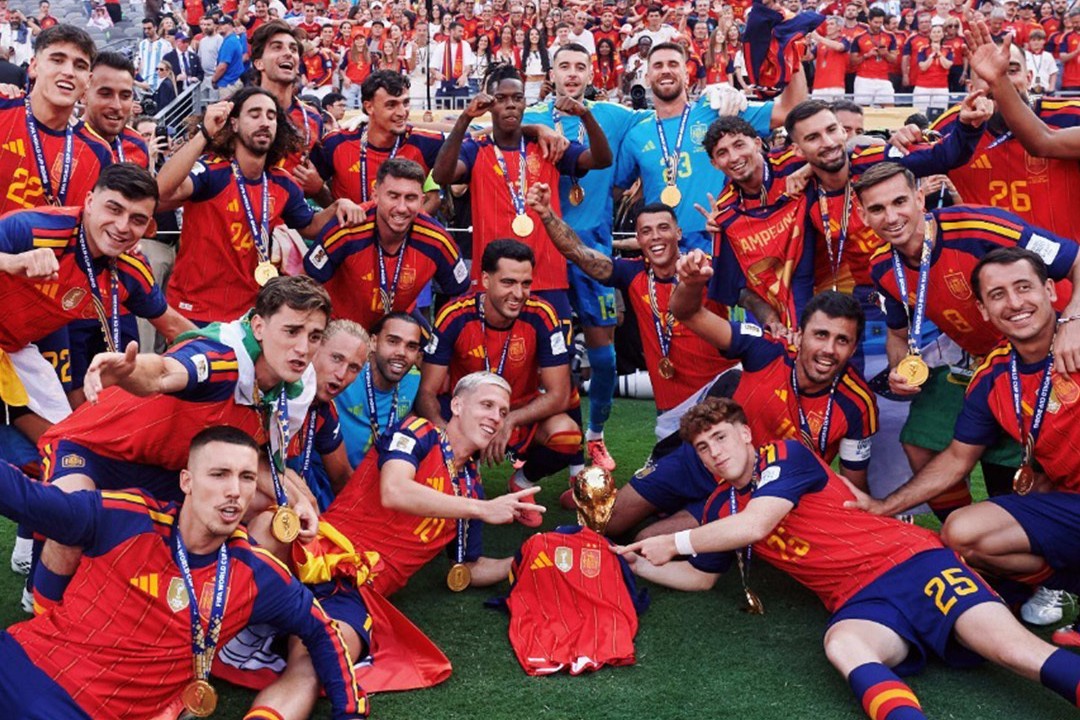
On the evening of 19 July 2026, Spain beat Argentina in the FIFA World Cup final in front of a worldwide television audience. In the cafés of Gaza City, the match played out on screens mounted above streets that, for most of the past two years, have functioned less as neighbourhoods than as logistics corridors for a war that has not stopped. The New York Times, reporting from the enclave on 20 July, found that many of the supporters who packed those makeshift viewing rooms had a clear second team: Spain, the European country that in 2024 formally recognised Palestinian statehood.
Spain's victory was, for roughly ninety minutes, a small permission slip for Gazans to feel something other than the war. It was also, for a watching world, a useful reminder that the most consequential geopolitical acts of the past week were not the goals scored at the final. They were the diplomatic recognitions, the patterns of supporter identity, and the quieter signals about which governments are willing to publicly diverge from the Israeli-American line on Palestine, and which are not.
A second team, and a first statement
Spanish recognition of Palestinian statehood in May 2024 was one of the first moves by a major NATO member to break with the consensus position held by Washington and London at the time. The decision was criticised in real time by Israeli officials and by several European partners, and praised across the Arab world as overdue. In Gaza, according to the New York Times's reporting from cafés and viewing halls during the final, that 2024 act appears to have calcified into a durable supporter identity. Spanish flags were draped over shoulders. The national anthem was sung in rooms where, by most reckonings, the television feed was the only window that still worked.
The match itself was less important than the affective alignment it made visible. Argentina, the favourites of many Israeli fans in Tel Aviv and Jerusalem, had been cast in pre-match coverage as the team of the diaspora. Spain, by contrast, was the team of the occupied.
The Argentine counterweight
Reporting from Israel in the same period showed Argentine shirts selling briskly, Argentine flags hung from balconies in Tel Aviv, and Buenos Aires-style terrace chants echoing in neighbourhoods that historically send their youth to Argentine summer programmes. The split is not perfect, and there are Argentine fans in Gaza as well, but the dominant pattern that emerges from the wire coverage is clear: the diaspora-tilted fan cultures of Israeli cities and the displacement-tilted fan cultures of the enclave voted with their scarves for different finalists.
This is not a small thing. International football, particularly at World Cup scale, has long functioned as a soft proxy for political alignment. Cold War-era tournaments were read as ideological contests. The 2026 edition appears to have produced its own quiet cartography: a Western European country whose Middle East policy broke with Washington drew the loudest cheers in the most damaged civilian space of the Levant.
What the cafés actually meant
There is a temptation, when reading dispatches from a war zone during a sporting event, to over-read the symbolism. The Gazans in those cafés were watching football. Some were drinking tea. Many were there because the electricity worked and the walls held.
But the framing is not incidental. Spanish recognition was a state act, and the popular embrace of Spain in Gaza is, in a small way, a referendum on that act conducted by the people most directly affected. By the logic of international recognition, those are the voices that ought to weigh heaviest, and they are the voices that have least access to the institutions where such weight is normally registered. The World Cup, for once, gave them a microphone.
The dominant framing in much of the Anglophone press, including the Israeli press, cast Argentina's run as the story of the diaspora, anodyne and celebratory. The counter-frame, visible in the New York Times's reporting from Gaza, is that Spain's run was, for some, the story of international legitimacy catching up with lived experience. Both readings are true. The interesting analytical question is which one ends up in the textbooks.
Stakes, and what to watch
Three things follow from the optics of the final. First, expect more, not fewer, European recognitions of Palestinian statehood over the next twelve months, particularly if Spain's coalition government survives and Madrid continues to position itself as a normative foreign-policy actor in the Mediterranean. Second, expect FIFA's already fraught relationship with Gulf-state broadcasters and political authorities to tighten further as football becomes, once again, an unwilling stage for geopolitical theatre. Third, expect the pattern of supporter identity by nationality to be read, accurately or not, as a soft-poll on Middle East policy every time a major tournament comes around.
What remains genuinely uncertain is whether the affective alignments visible in a football final translate into any durable shift in the diplomatic weight carried by Palestinian voices at the UN, in Brussels, or in Washington. The 2024 recognitions have not yet produced a Palestinian seat at the General Assembly as a full member state. Spain's trophy will not, on its own, change that arithmetic.
But the cafes were full, the screens worked, and for a few hours the war was, briefly, only on the other channel. That, too, is a kind of political fact.
Desk note: Monexus's read leans on the New York Times dispatch from Gaza for the supporter-identity reporting, cross-read against the broader pattern of European recognition of Palestinian statehood and the documented Argentine-fan alignment with Israeli urban audiences. The piece avoids equating football fandom with policy preference, and flags the Anglophone-wire tendency to frame the tournament through the Argentine-Israeli axis while underweighting the Spain-Palestine axis visible from the enclave itself.