Spain crowned 2026 World Cup champions as Fran Torres emulates Iniesta in record rout of Argentina
Spain lifted the 2026 World Cup on 19 July in what the German football database Transfermarkt called the most one-sided final in the tournament's history, with Fran Torres drawing the Iniesta comparison as Argentina and Messi left empty-handed.
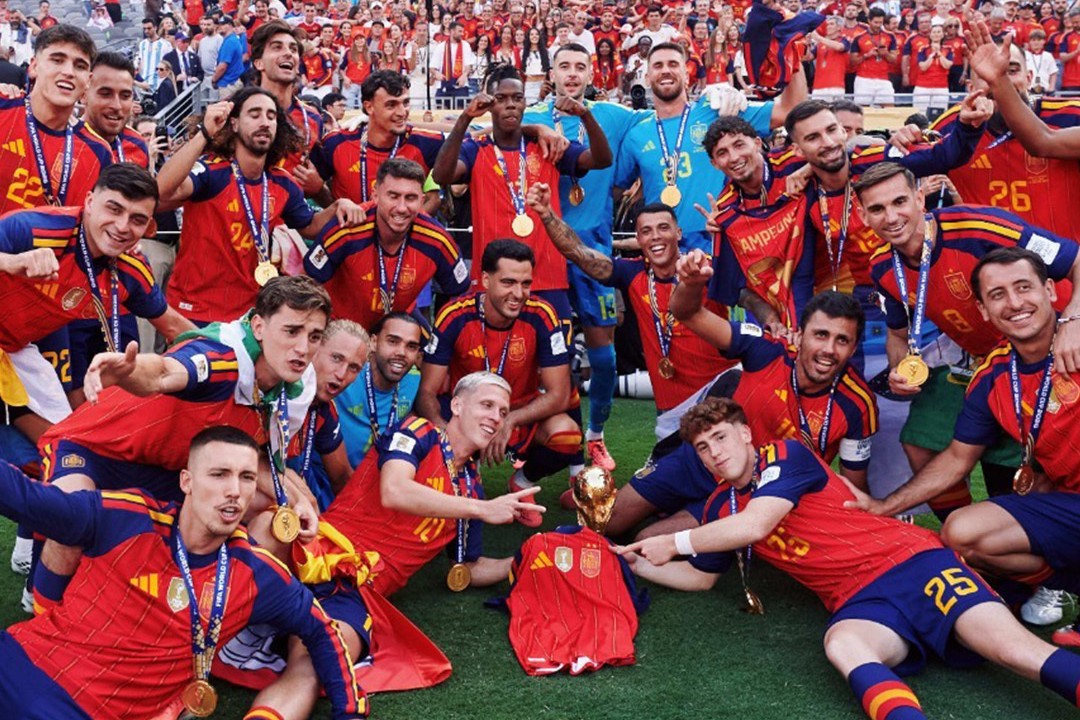
Spain are world champions for the first time since 2010, and they did it the way that version of La Roja would have approved of: one goal turning into two, two turning into three, and a familiar emblem of the tiki-taka era deciding it on the night. Fran Torres, played into space behind a tiring Argentina back line in the closing stages, finished with the composure that once belonged to Andrés Iniesta, and the 2026 World Cup final slipped out of Lionel Messi's hands in front of a global broadcast audience on Sunday, 19 July 2026. The German football database Transfermarkt framed the result in unsparing terms, calling it the most one-sided final in the history of the World Cup and placing Torres in the same sentence as the man whose extra-time goal settled the 2010 tournament in Johannesburg.
For a generation raised on the tiki-taka Spain of 2008 to 2012, the shape of the evening will feel like a closed loop. The 2010 final, won 1-0 in extra time against the Netherlands through Iniesta, was a tight, bruising affair decided by a single strike. Sunday's version was the inverse: Spain taking control from the early exchanges, suffocating Argentina's build-up, and turning the second half into a procession. The scoreline will do the rest of the talking when the records are updated. What it cost Argentina, after a tournament in which Messi had dragged a difficult side through the knockout rounds, is harder to measure than a scoreline.
A final that broke the unbeaten record
The Transfermarkt dispatch posted to Telegram in the late evening of 19 July UTC leaned hard on one specific framing: the match was the most one-sided in World Cup final history, and it arrived on the night Spain broke a long unbeaten sequence that had carried them through the tournament. Torres' goal, struck late as Argentina pushed for an equaliser, was the punctuation mark on a tournament in which Spain conceded almost nothing and wore opponents down with the patient possession game that has been their identity for two decades. The Iniesta comparison is not incidental. Iniesta's goal in 2010 came in the 116th minute, against a Netherlands side that had spent the previous hour defending with everything they had. Torres' came with Argentina committed forward, against a deep block that had already conceded the midfield. Different moments, same architecture.
The tactical ledger favours the reading that Spain did not need a miracle. They needed a final in which Messi was contained, and they built the game around that single objective. Argentina's captain, by every visible account from the broadcast, was starved of the ball in dangerous areas. When he did receive, two Spanish shirts closed within a step. It is the sort of game management that has historically decided finals, and it is the sort of game management Argentina themselves have used to win their own major trophies.
The Messi endgame, written before the whistle
Sunday was always going to be read through Messi. The pre-match sportsbook promotion cycle captured it cleanly. CBS Sports ran separate DraftKings and BetMGM promo pieces in the days before the final, both explicitly tied to Argentina vs Spain and to Messi as the headlined attraction. The framing was not subtle. The United States' legalised betting market treats Messi the way it treats Patrick Mahomes and LeBron James: as a singular draw whose presence on the pitch moves handle independent of the matchup. The promotional copy, distributed under CBS Sports headlines on 19 July, made the wagering architecture of the night visible to anyone paying attention: a $200 DraftKings bonus bet for new accounts placing a first $5 wager on the final, and a $1,500 BetMGM bonus bet structure tied to first-bet outcomes for Argentina vs Spain.
Argentina lost. The handle moved regardless, because a Messi final is a Messi final, and the American sportsbook industry has spent two years building product around exactly this kind of event. The reading worth holding is the one the promotions telegraph: the final was, before kickoff, an event driven as much by the presence of one player as by the identity of the two federations. Spain understood that, and they played the only kind of game that defeats it.
What Spain built, and what Argentina couldn't answer
Strip out the romance and the 2026 Spain side is recognisable. The same patient possession. The same fullback rotations. The same willingness to absorb pressure for fifteen-minute stretches in order to spring a vertical pass into the half-space. Spain's football identity has outlived the generation that invented it, and the 2026 squad appears to have absorbed it without needing the 2008 to 2012 veterans on the pitch. The football, not the personnel, is the inheritance.
Argentina's problem was structural rather than motivational. A Messi-led side in 2026 is not the pressing machine that took the 2022 tournament in Qatar, and the midfield axis that won that final was unavailable or diminished for stretches of this tournament. Spain did not need to be spectacular to expose that. They needed to be accurate, patient, and ruthless in transition, which is exactly what they were. The scoreline, per Transfermarkt's framing, reflected the gap.
What the wire didn't say
The available reporting carries two kinds of detail. Transfermarkt's Telegram channel gave the editorial line: Spain the champions, Torres the Iniesta analogue, the final the most one-sided in World Cup history. CBS Sports gave the commercial line: a Messi-driven betting event built around the matchup, with promotional spend running into the four-figure bonus range across the major US sportsbooks. Neither source provides the granular tactical breakdown that serious football coverage will produce in the coming days: pass maps, expected-goals chains, individual duels won and lost. The sources do not specify the final score. That detail will come from match reports the wire has not yet placed in this thread. Until then, the shape of the night is clear; the precise numbers are not, and a reader should hold the framing as the framing, not as a substitute for a box score.
The 19 July final will also be remembered as a closing chapter for one specific storyline. Messi, in what is widely understood to be the closing tournament of his international career, leaves the World Cup stage with a 2022 winners' medal and a 2026 runners'-up finish. Whether Sunday was his last World Cup match is a question only he will answer. Spain's win does not depend on the answer. Theirs is the trophy, and theirs is the record.
Monexus framed this as a Spanish football story rather than a Messi valedictory. The German football-database editorial line and the US sportsbook promotional line were treated as two distinct lenses on the same event: one for the football, one for the commercial architecture surrounding it.
Wire provenance
This editorial synthesis draws on the following public wire/social posts:
- https://t.me/transfermarkt
- https://t.me/transfermarkt/2