Saylor pushes back on BIP-110 as Bitcoin reclaims $65,000
Strategy's executive chairman calls a proposed temporary spam-filter fork 'a bad idea,' even as the price prints above $65,000 and he again signals more buying.
Bitcoin crossed back above $65,000 on 20 July 2026, reclaiming a level it had not held with conviction in weeks, according to a price alert posted by the Polymarket account on X at 00:47 UTC. The print came roughly nine hours after Strategy executive chairman Michael Saylor publicly questioned the design of a proposed Bitcoin Improvement Proposal, and hours after he hinted, in his own social-media voice, that the company he founded would add to its hoard.
The simultaneous signals tell the story of the moment. The largest corporate holder of Bitcoin is publicly fighting a protocol cleanup proposal while telegraphing more accumulation, and the market is, for now, rewarding both impulses. The question is whether those two impulses are compatible, or whether the protocol fight will eventually collide with the balance-sheet bet.
Saylor's case against BIP-110
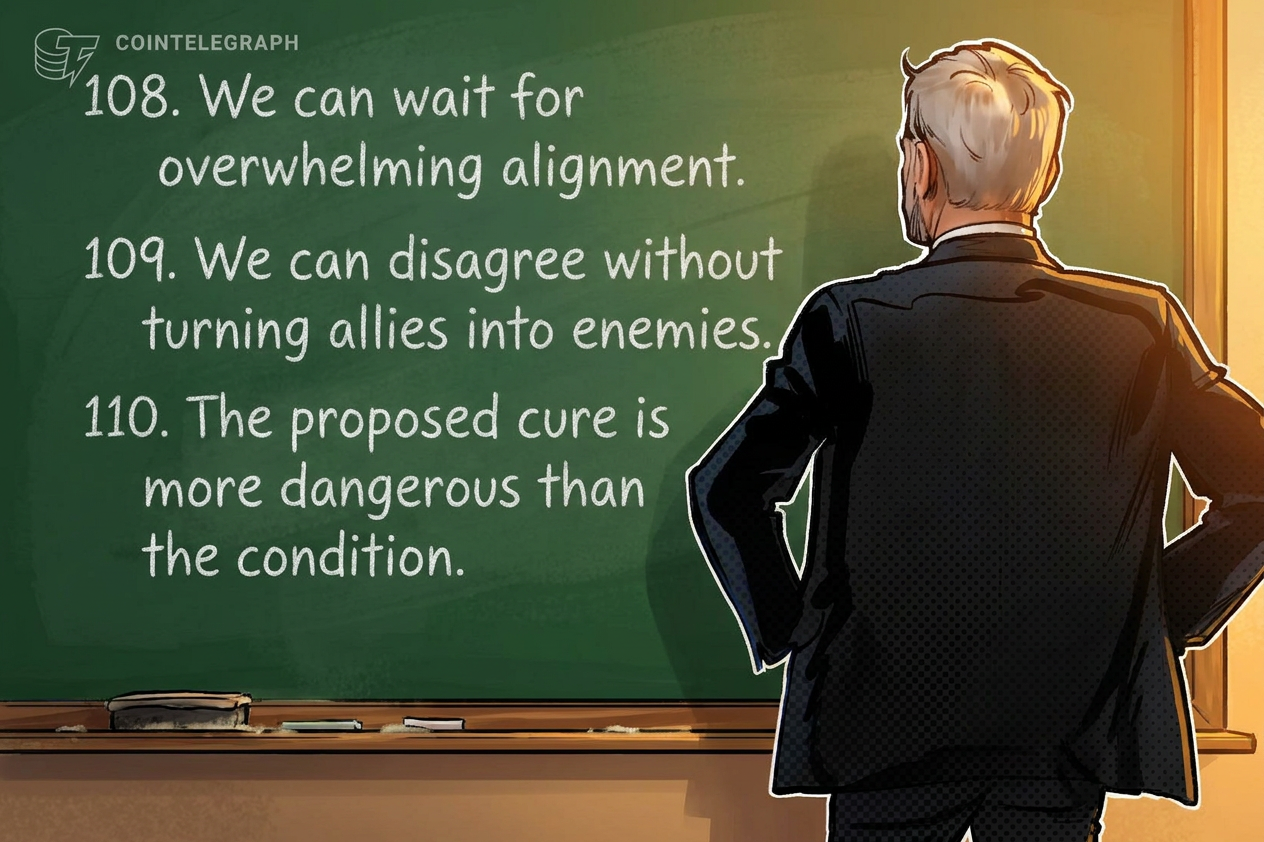
The proposal in question, BIP-110, would install a temporary filter on non-financial data written to the Bitcoin blockchain, a category that includes Ordinals-style inscriptions and other non-payment uses that have bloomed since 2023. Cointelegraph reported on 19 July at 16:34 UTC that Saylor has compiled "110 reasons" he considers the proposal flawed, and framed his disagreement in unusually direct terms: he shares the stated objectives of cleaning up the chain, he said, but disagrees with the remedy.
The substantive objection, as paraphrased by CoinDesk on 19 July at 15:19 UTC, is that a temporary, miner-coordinated filter creates a precedent for censorship at the base layer. In Saylor's reading, once the network's neutral-validation guarantee is suspended for one category of data, the mechanism exists for future suspensions of others, and the political pressure to use it will follow. The temporary tag, in this view, is not a containment; it is a permission slip.
That argument lands differently depending on who is listening. Bitcoin Core developers and node operators who have spent three years arguing that the mempool and relay policy are precisely the right places to filter spam, not the consensus rules, will read it as vindication of an approach already in production. Critics who argue that the chain has become a junk drawer at the expense of cheap payments will hear Saylor defending the very problem they want fixed. The proposal's backers say the filter is opt-in, narrowly scoped, and reversible; Saylor's camp replies that any consensus-layer carve-out narrows the surface of neutrality that defines the asset.
The buy side, again
Running in parallel is the more familiar Saylor story. On 19 July at 12:38 UTC, the WatcherGuru Telegram channel posted a short note quoting the chairman as hinting at another Bitcoin purchase, accompanied by the trademark "What's next?" phrasing that has preceded every Strategy disclosure since 2020. The post added nothing to the disclosure record; Saylor does not pre-announce filings. But the timing is the message. He is signalling while the protocol fight is live, telling the market that the corporate accumulation programme continues regardless of which way the BIP-110 debate lands.
That posture is consistent with how Strategy has communicated for the better part of six years. The company treats Bitcoin as a treasury reserve asset, financed primarily through equity and convertible-debt issuance, and Saylor has consistently framed the position as multi-cycle. Volatility is noise. The relevant variable is the long-run purchasing power of the asset, and the relevant counter-party is time. A fight over a proposed consensus change is, in his framing, a distraction from that thesis rather than a threat to it.
Why the price print matters
Reclaiming $65,000 is not a milestone in the way that round numbers used to be, but it is technically meaningful. It returns the spot price to a range last sustained in mid-2025, after a drawdown that took the asset through a prolonged winter below the prior cycle's high. The Polymarket alert at 00:47 UTC on 20 July does not specify the catalyst, and the sources do not either. Liquidity is thin in this segment of the cycle; a single large market order on a major venue can move the tape by a percentage point or more.
What the print does establish is that the market is willing to clear offers into a headline environment that includes both an unresolved governance debate and a fresh round of corporate buying signals. Buyers are not waiting for the protocol question to settle. They are pricing the asset on liquidity, macro tone, and the credibility of the largest accumulator, with the protocol argument as background noise rather than the main event.
The structural frame
What is happening here is a quiet realignment of who speaks for Bitcoin's governance. For most of the asset's history, the answer was "nobody in particular": Core developers wrote code, miners ran the infrastructure, and holders accepted whatever shipped. The 2017 blocksize war and the 2017–18 SegWit drama established that this is a contested political space, not a technocratic one. BIP-110, whatever its technical merits, is the first serious attempt since the Ordinals era began to use a consensus-layer lever against a category of usage. Saylor's intervention is the first time a holder of his scale has publicly opposed such a move on principle, rather than on tactical grounds.
The counter-narrative is straightforward: the same corporate voice that has spent years arguing Bitcoin is the only neutral money is now the loudest voice in a debate about what counts as legitimate use of the chain. To critics on the developer side, that is the proof of concept for the worry; to defenders, it is the proof of concept for the asset. Both can be true, and the sources do not resolve which framing prevails.
Stakes and what to watch next
If BIP-110 advances to a level where miners can adopt it, the next milestones are miner signalling on the network itself and the response from node operators, who retain the ability to refuse blocks containing filtered data. The sources do not specify a timeline. Saylor's "110 reasons" document, as reported, is the public-facing part of the campaign; the rest is happening in the same developer forums and chat channels where Bitcoin protocol politics has always lived.
On the corporate side, the question is whether Strategy files an 8-K before the next quarter close. Saylor's hinting is a habit, not a commitment, and the market has learned to discount the timing language. What it has not discounted is the direction.
The unresolved question, which the sources do not settle, is whether the same actor can credibly serve as both the largest holder and the loudest defender of a specific protocol direction. The price action on 20 July suggests that for now, the market has no problem with the dual role. The protocol fight will tell us whether the rest of the network agrees.
Desk note: Monexus treats this as a governance story with a market print attached, not the other way round. Wire coverage on 19 July focused on Saylor's protocol objections; the price alert from Polymarket is the secondary beat that lets us frame the corporate-accumulation signal in the same piece.
Wire provenance
This editorial synthesis draws on the following public wire/social posts:
- https://x.com/polymarket/status/194778600000000
- https://t.me/s/WatcherGuru/