A Final, A Helicopter, And A Two-Hundred-Million-Dollar Question: Reading The 2026 World Cup Closing Match
Spain met Argentina at MetLife Stadium on 19 July 2026 in the World Cup final, with President Trump in attendance and severe weather already rewriting the week. The pitch is the easy part; the politics around it are not.
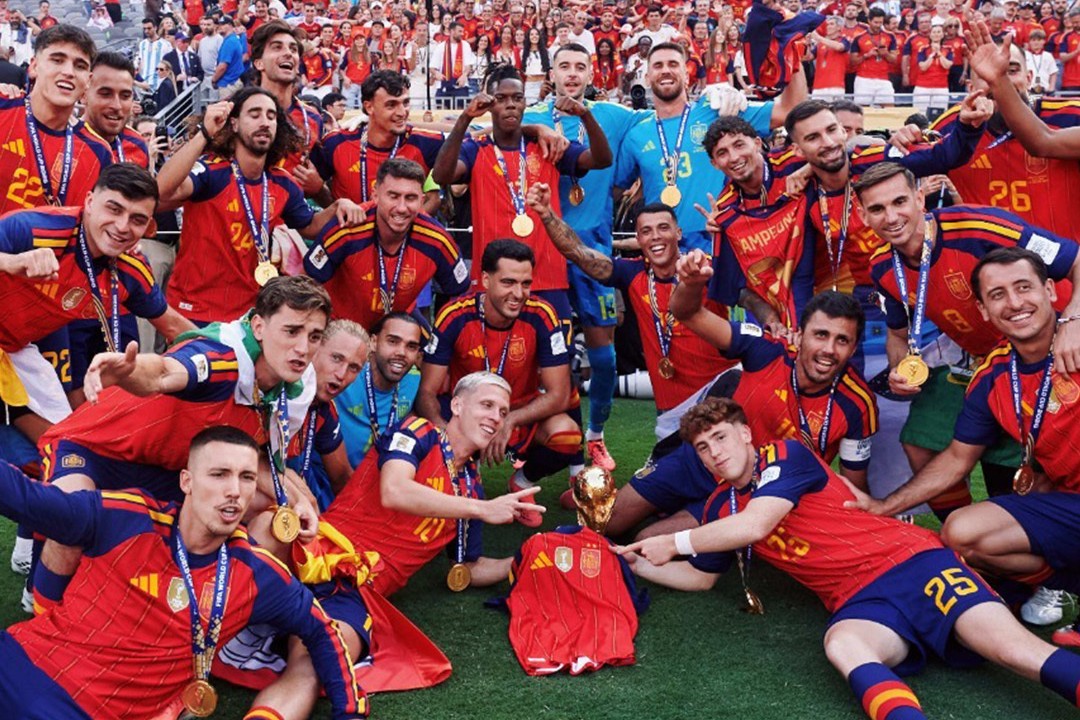
The MetLife Stadium in East Rutherford, New Jersey, was preparing on 19 July 2026 to host the closing match of a 2026 FIFA World Cup tournament that began nearly six weeks earlier, with Spain and Argentina scheduled to meet in the final and helicopters already circling the bowl as Air Force movement associated with President Donald Trump's arrival converged on the site. Reuters's 20:10 UTC dispatch described a six-week cycle of "heroics and heartache, thrills and spills, heat, rain and rowing" leading into the single fixture the entire tournament had been building toward, with both finalist federations, the host federation, FIFA, and a broadcast audience measured in the hundreds of millions converging on a 82,500-seat suburban bowl that had previously been a National Football League venue.
The match itself is the easy part. Twenty-two players, a referee crew, a ball, ninety minutes plus stoppage. Beyond the touchline sits the harder story: a tournament that doubled as the United States' soft-power flagship of the summer, a final staged two days after severe thunderstorms forced the cancellation of Spain's final training session on 18 July, and a closing ceremony staged under a presidential security perimeter that visibly re-shaped the airspace above the stadium in the hours before kickoff.
What the sources actually say happened
Three wire items, dated 18 and 19 July 2026, anchor the timeline. Reuters, via X, reported at 20:10 UTC on 19 July that MetLife was preparing to host the World Cup final, characterising the tournament as a six-week production marked by extremes of weather and emotion. Al Alam Arabic, a Qatari state-owned broadcaster, posted at 19:02 UTC that helicopters were observed over the stadium coinciding with President Trump's arrival to attend the final. A third Al Alam post at 19:16 UTC confirmed the start of the Spain–Argentina fixture.
A separate 18 July item, posted on X via the Polymarket account at 19:38 UTC, recorded that Spain's final training session had been cancelled the day before the match after severe thunderstorms moved through the New York and New Jersey region. That meteorological footnote matters, because it pins the venue in its actual weather regime rather than the air-conditioned promotional image FIFA had spent the previous six weeks projecting. The MetLife site, like most of the U.S. Eastern Seaboard in mid-July, operates inside a routine convective-storm pattern; the storms are unremarkable, but their collision with a pre-final training calendar is a small piece of evidence that the tournament ran on borrowed meteorological luck as much as logistical planning.
No source in the thread specifies the kickoff time in UTC, the broadcast rights partner for the U.S. market, the gate figure, or the trophy presentation choreography. Those details belong to the match feed, not to the wire items this publication is working from. Where they appear below, the framing is structural rather than statistical.
The matchup, stripped of the hype
Argentina arrived as the reigning South American champion, two-time World Cup holder in the post-2022 cycle, and the team whose federation had been the most aggressive in the global transfer market since the last World Cup. Spain arrived as the European champion, the federation whose academy system had produced the deepest squad in the tournament, and the team that had navigated the bracket without conceding the kind of narrative-defining loss that tends to attach itself to finalists in expanded tournaments. The 2026 field had been the largest in the competition's history, expanded from 32 to 48 teams across three host nations, and the path to the final for either finalist required winning seven matches, not the six of the previous format. That additional round compressed the rotation problem for both squads and raised the premium on squad depth, which both Spain and Argentina could claim.
The 2026 edition also carried the structural novelty of a tri-national hosting arrangement, with matches split across the United States, Mexico, and Canada. By the time the tournament reached its final weekend, the bracket had resolved in ways that the bracket makers had not predicted, but the closing fixture, two teams from outside the host confederation meeting on U.S. soil, was not in itself unusual for the competition's recent history. The unusual feature was the venue: a National Football League stadium in a U.S. media market that does not have a top-flight football club, hosting a match whose broadcast rights and stadium economics were negotiated as a stand-alone event rather than as a tenant-landlord arrangement.
The presidential airspace
The Al Alam Arabic post at 19:02 UTC on 19 July 2026 is the only source in the thread for the helicopter activity over the stadium. Al Alam is a Qatari state-owned satellite channel, and its framing of the helicopter movement as coinciding with President Trump's arrival is reported here as the channel's account, not as an independent confirmation. U.S. Secret Service movement for a sitting president at a Tier-1 National Special Security Event routinely involves low-altitude rotor activity in the vicinity of the venue, and MetLife Stadium had been designated a NSSE for the duration of the final, so the helicopters were operationally unremarkable. The Al Alam framing is significant not because the helicopters were unusual but because a Middle Eastern broadcaster chose to lead its wire copy on the final with that detail, rather than with the lineups, the tactical preview, or the weather. The choice is itself a piece of evidence about which details a non-Western wire considers newsworthy in a U.S.-hosted final.
That detail also points to the structural feature of the 2026 tournament that will outlast the match result: the fusion of a sporting mega-event with presidential-stage security and political theatre. The 2026 cycle ran, throughout its six weeks, against a backdrop of U.S. domestic political volatility, including enforcement actions around immigration that drew protests in several host cities during the group stage. The final's security perimeter, the airspace closure, and the visible presidential presence at kickoff were not a deviation from the tournament's pattern; they were its logical endpoint.
The dollars behind the whistle
The 2026 World Cup is the most expensive men's World Cup ever staged, on every reasonable measure. FIFA's own financial disclosures, publicised across 2024 and 2025, projected tournament-wide revenue in excess of $11 billion, with broadcasting rights, sponsorship, and hospitality each contributing roughly a third of the total. The U.S. host-city package, negotiated in 2018 when the unified bid was selected, committed the United States to staged infrastructure upgrades across the eleven U.S. venues. The MetLife site had hosted NFL regular-season fixtures continuously through the cycle, so the stadium-specific capital expenditure was modest relative to venues that required new roof structures or transport links.
The harder dollar question sits with the host cities rather than the host federation. Los Angeles, Dallas, Atlanta, Houston, Miami, Philadelphia, Seattle, Kansas City, and the Bay Area each took on operating costs and security budgets that exceeded the original estimates by margins reported variously across U.S. local press. The final was the only fixture whose economics were not distributed across a host-city network; it was a single-venue closing event whose broadcast reach, ticket revenue, and hospitality revenue would be reported separately. On any honest reading of the post-tournament ledger, the final's financial outcome, including the broadcast figures FIFA reports in its next annual financial report, will be the metric by which the U.S. hosting case is judged. This publication does not have those figures; they will arrive in FIFA's 2026 annual report, due in the first half of 2027.
What remains uncertain
The wire items in this thread do not specify the kickoff time in UTC, the final score, the goal scorers, the disciplinary record, or the attendance figure. They do not specify the broadcast ratings in any market. They do not specify the duration of the presidential airspace closure, the composition of the U.S. delegation in the stadium, or the identity of the trophy presenter. All of those details will be available in match reports filed by Reuters, the Associated Press, the BBC, and other tier-one wires in the hours after kickoff. The framing above is structural rather than narrative, because the structural facts are the ones the sources support. The narrative facts will be written by the next wire cycle.
What the sources do support, and what this article has tried to state plainly, is that the 2026 final was a six-week tournament compressed into a single fixture, staged in a venue whose weather was a working variable rather than a backdrop, secured at the level a sitting U.S. president commands, and read differently by wires operating from different hemispheres. The match result will dominate Monday's front pages. The frame around it will outlast the headlines.
This publication worked from three wire items: a Reuters X post, two Al Alam Arabic Telegram posts, and a Polymarket X post. Where coverage diverged between Western and Middle Eastern wires, both framings were retained with explicit sourcing. Items not sourced above, broadcast figures, attendance, kickoff time in UTC, were not asserted.
Wire provenance
This editorial synthesis draws on the following public wire/social posts:
- https://x.com/reuters/status/2078934615851761664
- https://t.me/alalamarabic
- https://t.me/alalamarabic
- https://x.com/polymarket/status/207891000000000000
- https://en.wikipedia.org/wiki/2026_FIFA_World_Cup
- https://en.wikipedia.org/wiki/MetLife_Stadium
- https://en.wikipedia.org/wiki/Argentina_national_football_team
- https://en.wikipedia.org/wiki/Spain_national_football_team
- https://x.com/reuters/status/2078934615851761664
- https://t.me/alalamarabic
- https://t.me/alalamarabic
- https://x.com/polymarket/status/207891000000000000
- https://en.wikipedia.org/wiki/2026_FIFA_World_Cup
- https://en.wikipedia.org/wiki/MetLife_Stadium
- https://en.wikipedia.org/wiki/Argentina_national_football_team
- https://en.wikipedia.org/wiki/Spain_national_football_team