Spain wins the 2026 World Cup, and the broadcast wars tell us why the moment mattered
Spain beat Argentina 1-0 in extra time to lift the 2026 World Cup, and the choreography of the broadcast tells a quieter story about who gets to narrate football.
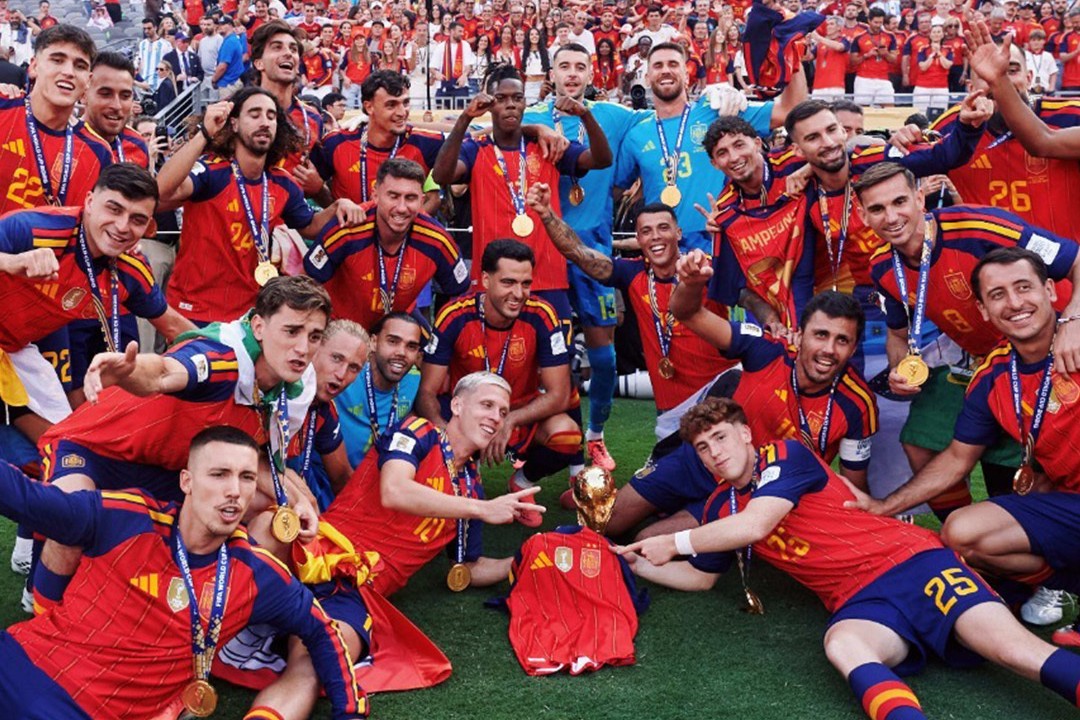
At 21:45 UTC on 19 July 2026, Spain went ahead in the World Cup final. The goal landed in the second minute of stoppage time at the end of ninety minutes, with the score still 0-0, and Argentina never answered. By 22:03 UTC the same evening, three separate Telegram channels had pushed the line that Spain had won the tournament, beating Argentina 1-0, taking the country's second world title. France 24 had already filed its account, framing the match as an "extra-time thriller" in which Spain were "crowned champions." Inside a cinema in Iran, one channel recorded the moment Spain scored, not the moment Argentina conceded: a small detail about whose joy the platform chose to capture.
Spain are world champions again. That is the headline the wires will run, and it is the right one. The match itself was a tactical grind for ninety minutes, broken in the 92nd, settled in the additional half-hour, decided by a side that had spent the entire tournament solving problems other teams created and then running past them. But the final was not only a game. It was a broadcast event with global optics, and the way it was narrated tells a quieter story about who gets to author the world's most-watched sporting moment.
The result, settled in a window of four minutes
The shape of the match is unambiguous in the record. Full time finished 0-0, according to Al-Alam's running updates. Spain scored in the second minute of added time in the second half, Al-Alam and BellumActaNews both reported. The score held through extra time. Spain's players lifted the trophy inside the venue while the channels that had been hedging through the ninety minutes switched to declarations. "Spain deservedly won the World Cup for the second time," Iran's Tasnim agency wrote, adding that "Argentina's offensive line was paralyzed" and that Messi "was left empty-handed." The same result was on Spain's side at 21:48 UTC and at 22:03 UTC, and on every channel that moved on it. There is no real dispute about the scoreline or the trophy. There is also no real need to manufacture drama around a final whose tension was real enough on its own.
Whose lens landed first
What is worth pausing on is the order. Within seven minutes of Spain's goal, the same handful of state-, pan-Arab-, and geopolitics-oriented Telegram feeds had all converted caution into certainty. Iran International, the Iran-aligned Tasnim, the pan-Arab Al-Alam, the conflict-and-sport desk Middle East Spectator, the Spanish-tilted DDGeopolitics, and the Russian-aligned Rybar-linked RNIntel cluster all carried near-identical "Spain wins 1-0" lines. The wire copy landed after. France 24's headline frame, "Spain crowned champions after extra-time thriller against Argentina," sat a step behind the fastest Telegram desks.
This is the new normal of major football news. Telegram channels with editorial axes (some explicit, some opaque) now publish the result inside the same news cycle as the goal. Western sports wires, which once owned these moments, are downstream of feeds their own reporters cannot outrun. The reader who watches the final live and then checks their phone sees the framing chosen by whoever moved first, not by whoever covers the round ball for a living.
Sport as a corridor
A World Cup final is the largest simultaneous broadcast event on earth, and the editorial decisions made during one are not innocent. Which camera holds on which player, which chant is amplified, which reaction is looped on the big screen: these shape the memory of a tournament long after the medal count is settled. The Iran-cinema clip that DDGeopolitics posted is a small case in point. The frame is not the goal. The frame is the audience in an Iranian cinema reacting to a Spain goal, in a country that Western sport coverage rarely reaches except through the lens of national grievance or human-rights framing. A Spanish goal in a public cinema somewhere in Iran is, on its face, ordinary footage. It is also the kind of ordinary footage that a different media ecology would have left on a phone and never elevated.
What the moment shows is how sport has become a corridor. The biggest matches pass through channels with their own geopolitical centres of gravity. The framing you read depends on which corridor your feed sits inside. Spanish and Argentine desks will tell you about Lamine Yamal and Lionel Messi. Iranian and Arab desks will tell you about a team "deserving" it, or about a Spanish result landing in a stadium in Tehran. The French lead frames Spain as "crowned champions" and the goal as a "thriller." Each is a competent summary. None of them are the same story.
What the next four years will decide
The 2026 World Cup was the largest in the tournament's history, co-hosted across the United States, Mexico and Canada, and broadcast to an audience measured in billions. Spain's win will be remembered as a tactical victory by a team that brought its academy age-group into senior football and let them run. The broadcast frame will be quieter and longer-lived.
The next test is whether major tournaments are increasingly read through channels that are not, strictly, sports outlets at all: geopolitical desks, pan-Arab wires, late-night crypto and war feeds that carry a sidebar to a football match the way a regional paper once carried a wire note. The result in the next tournament will land, as it always does. The question is whether the framing of who won, and in whose language, keeps moving further from the round ball and closer to the corridor it travels through.
Wire provenance
This editorial synthesis draws on the following public wire/social posts:
- https://t.me/Middle_East_Spectator
- https://t.me/tasnimnews_en
- https://t.me/alalamfa
- https://t.me/BellumActaNews
- https://t.me/rnintel
- https://t.me/DDGeopolitics