Washington's crypto fight moves on two fronts at once: a senator's definition of decentralisation, and a protocol's defence against quantum computing
Senator Cynthia Lummis drew the line where Washington should not regulate. Two days later, Bitcoin's core developers drew another line, against future quantum attacks. The two fights share a question: who decides what counts as legitimate?
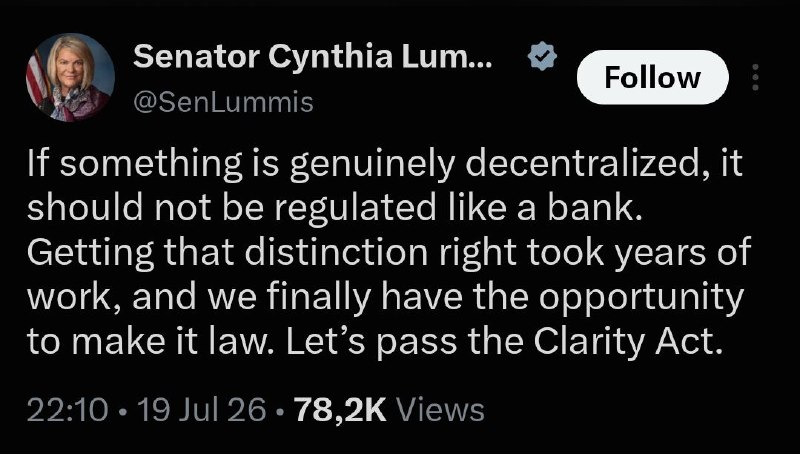
Two statements landed within twenty-four hours of each other this week, and together they sketch the shape of the next twelve months in US digital-asset policy. On 19 July 2026, Senator Cynthia Lummis, the Wyoming Republican who has become Washington loudest voice for digital assets, drew a hard distinction in a single sentence: "If something is genuinely decentralized, it should not be regulated like a bank." Sixteen hours earlier, on the same Saturday, a new Bitcoin Improvement Proposal quietly appeared in developers inboxes: BIP-361, a plan to freeze quantum-vulnerable wallet addresses out of the network and sunset legacy signature schemes within five years. A leveraged BTC whale was sitting on a $107 million long with $1.3 million of unrealised profit at the same moment, a reminder that whatever the policymakers and protocol engineers decide, the market will keep trading.
The thread that ties them together is not technical. It is a fight over who gets to define what a digital-asset network actually is. Lummis wants the law to defer to a property of the system: decentralisation. The BIP-361 authors want the protocol itself to draw the line against a future adversary. In both cases, the question on the table is whether legitimacy lives in code, in statute, or in the political process that connects the two.
The Lummis doctrine
Lummis intervention matters because she is no longer a peripheral voice. She chairs the Senate Banking subcommittee on digital assets, and her standing inside the Republican caucus on this file is unusually high for a junior senator: she wrote the bulk of the legislative language that survived the 2025 FIT for the Future Act negotiations, and her office drafts much of the comment letters industry sends to the OCC and the SEC. The line she drew on 19 July, in an exchange carried by Cointelegraph, was not a generic defence of crypto. It was a definitional claim. If a network is "genuinely decentralized," existing bank-style supervisory architecture, capital rules, KYC obligations, examination regimes, does not apply. Her implicit corollary is that a system which fails that test should be treated as a bank.
The political force of that statement depends on who gets to certify the property. Washington has spent two years avoiding that question. The SEC under both chairs has used the Howey test, a 1946 framework for identifying investment contracts, to police token issuers, while sidestepping the deeper question of when the underlying network itself should be classified. Banking regulators have flirted with the idea that stablecoin issuers are functionally banks and should be chartered as such, which is a different claim: not about decentralisation but about the monetary character of the liability. Lummis is trying to insert a third track, one that rewards architectural choice rather than business model.
Her critics, principally Senator Elizabeth Warren and the center-left policy network around her, argue the opposite. A system can be technically distributed and still concentrate risk: in custody, in oracle infrastructure, in the handful of mining pools that produce most blocks. From that vantage, "decentralised" is a marketing label until the rulebook defines what it has to look like. Both readings are defensible. What neither side can yet answer is the institutional question: who measures it, with what methodology, on what cadence.
BIP-361 and the protocol's other fight
While Washington argues over the legal definition of decentralisation, the people who actually run Bitcoin are arguing about a more concrete adversary. BIP-361, surfaced on 19 July, would do two things. It would stop new BTC from being sent to addresses whose public keys are exposed in a way that future quantum computers could exploit. And it would set a five-year sunset on legacy signature schemes, ECDSA and the related Schnorr constructions, after which those signatures would no longer be honoured by consensus. The proposal is not yet activated; Bitcoin Improvement Proposals move through a years-long social process of mailing-list debate, reference implementation, and ultimately miner and node signalling. But the timing of the public draft matters. Quantum capability is no longer a hypothetical topic in the cryptography community. National-security agencies are publishing transition timelines. Standards bodies are retiring algorithms on shorter cycles than they once did.
The proposal has to navigate two distinct constituencies. Miners have an economic interest in not disrupting fee revenue; a forced migration of every legacy UTXO is a logistical undertaking that would touch millions of dormant wallets, including the Satoshi-era coins that have not moved since 2010. Developers have to balance backwards compatibility against cryptographic hygiene; a hard fork that strands old coins is a governance event as much as a technical one. The five-year sunset is the compromise: long enough that wallet vendors and exchanges can migrate, short enough that the network is not indefinitely exposed.
It also raises a question Lummis framework does not yet address. If BIP-361 activates and the network hard-forks to a post-quantum signature scheme, the old chain, the one with the vulnerable addresses and the unsunset legacy signatures, will continue to exist in some form. Which one is the "genuinely decentralized" network? Which one carries the legal protection Lummis is offering? The technical community will answer that question through hash power and node count. The political community will answer it through whatever rule the eventual statute writes.
What the market is actually pricing
A separate data point from the same Cointelegraph thread illustrates how thin the connective tissue between policy and price still is. On 19 July, a single BTC whale was carrying a 40-times leveraged long with a notional value of $107 million and an unrealised profit of $1.3 million. The position is large enough that a one-percent adverse move liquidates it. The presence of such a position tells you less about the direction of the market than about the structural conditions: derivatives venues are offering leverage at this scale, and at least one counterparty is willing to take it. It also tells you something about how remote the Lummis doctrine and BIP-361 are from the immediate trading day. Neither will move price in the next session. Both will shape price in the next cycle.
The corporate-adoption thesis, articulated the previous day by Michael Saylor, the executive chairman of Strategy (formerly MicroStrategy), in his own framing on 18 July, sits inside that gap. Saylor argued that "for Bitcoin to succeed as a global monetary network, corporate adoption is necessary, inevitable, and welcome." The argument is that the treasury-corporate complex, public companies adding BTC to their balance sheets at scale, is the missing bridge between the protocol and the regulated financial system. It is also the bridge that makes the Lummis doctrine harder to apply. A network whose largest holders are corporate treasuries, with CFOs, audit committees, and quarterly disclosures, is harder to call "genuinely decentralized" in the sense Lummis means. That contradiction is not yet resolved, and the next stage of the policy fight will be precisely about it.
What to watch next
Three dates are worth keeping in front of you. First, the Senate Banking Committee's scheduled markup of the Digital Asset Market Structure Act, which would establish the legal definition of a decentralised network in federal statute. Second, the public comment window on BIP-361, which opens when the reference implementation is published and will run for at least ninety days under the rough norms of the Bitcoin Core mailing list. Third, the next major quantum-cryptography transition announcement from NIST, which has been the de facto reference body for cryptographic standards in the United States since the 1990s and whose algorithm retirement calendar drives both corporate IT planning and, increasingly, protocol design.
The interesting story is not any one of these events. It is that all three are happening in the same year, in a country whose financial rulebook is being rewritten in real time, against a backdrop of a corporate-treasury bid for an asset that the issuer insists is a monetary network. The market, meanwhile, will keep trading. The whale with the $107 million long will either close out at a profit or get liquidated, and a new whale will take the other side. None of that resolves the underlying tension. It just sets the soundtrack while the rulemakers and the protocol developers do their slower work.
Desk note: Monexus framed this as a single question, who defines legitimacy, code or statute, rather than as two parallel news items. The wire coverage on 19 July ran Lummis and BIP-361 as separate stories; treating them together surfaces the structural pattern the wires left implicit.
Wire provenance
This editorial synthesis draws on the following public wire/social posts:
- https://t.me/s/cointelegraph
- https://t.me/s/cointelegraph
- https://t.me/s/cointelegraph
- https://t.me/s/cointelegraph