Iranian drones over Kuwait: a regional escalation that lands on US forward bases
Kuwaiti air defenses engaged hostile drones on the evening of 19 July 2026, with pro-Iran channels framing the strikes as targeting US positions. The incident lands inside an already brittle Gulf security architecture.
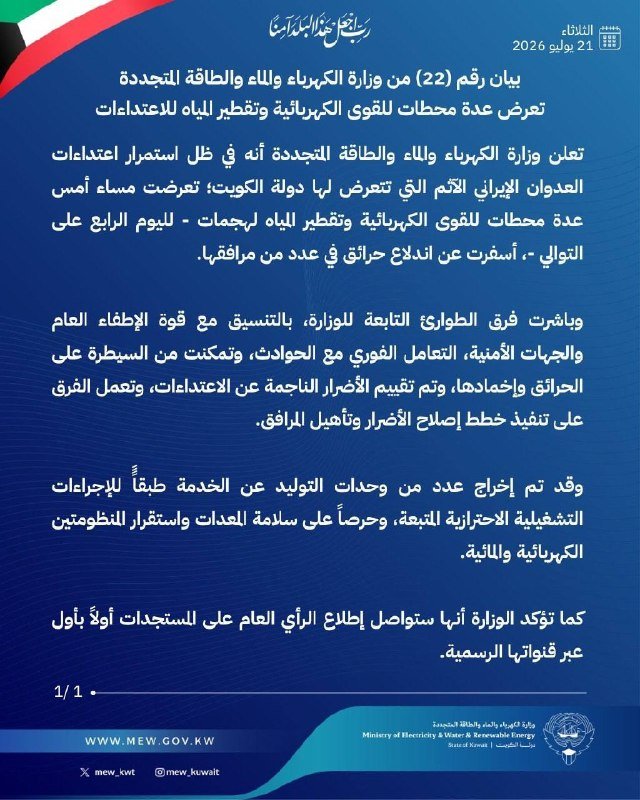
At 22:34 UTC on 19 July 2026, the Kuwaiti army announced that its air defenses were confronting what it described as hostile drone attacks, the first official Gulf state confirmation that Iranian-style one-way attack drones had been intercepted over Kuwaiti airspace in this incident. The statement, relayed within minutes by Telegram channels DDGeopolitics and Middle East Spectator, framed the engagement as defensive and ongoing. Within two minutes of that announcement, a third channel, Fotros Resistance, claimed the strikes were directed at US targets in Kuwait, naming American bases in the country. A fourth account, Clash Report, ran a single line: "Kuwait says its air defenses are intercepting Iranian drones."
What this publication can establish is narrow but consistent. A Kuwaiti military statement on the record; a near-simultaneous claim by an Iran-aligned Telegram channel that US positions inside Kuwait were the intended target; no confirmation, at the time of writing, from US Central Command or the State Department that American facilities were struck. The pattern of the claims, and the speed with which they travelled across ideological channels, is itself the story. It tells the reader that the Gulf is now living inside a continuous, low-grade drone cycle in which attribution arrives on Telegram faster than governments can verify it.
What Kuwait actually said, and what it didn't
The Kuwaiti army's statement, as relayed by DDGeopolitics and Middle East Spectator at 22:34 UTC and 22:31 UTC respectively, used the formula "air defenses are currently confronting hostile drone attacks." Two things are notable about that phrasing. It did not name the operator. It did not name the intended target. In Gulf state communiqués, that restraint is not accidental. Kuwait is the smallest of the six Gulf Cooperation Council monarchies, hosts a substantial US forward presence at Camp Arifjan and Ali Al Salem Air Base, and has spent two decades carefully balancing its alliance relationship with Washington against domestic parliamentary opposition to that presence. Naming Iran, even implicitly, in a first statement raises political costs inside Kuwait. Naming the United States raises them further, in a different direction.
The Fotros Resistance channel, writing five minutes earlier at 22:29 UTC, did not share that restraint. It asserted outright that the operation was "Iranian drone attack against US targets in Kuwait." Fotros is a pro-Tehran account that has previously claimed credit for Iranian-aligned operations in Syria, Iraq, and the Gulf. Its claim has not been confirmed by any wire service, any Gulf government, or any Western military spokesperson in the material this publication has reviewed. It is a counter-claim, and it travels as one. But it is also the framing that propagates fastest across Telegram and X within minutes of any such incident, and it is the framing that regional audiences will read first.
The regional backdrop: a drone cycle that has been running for two years
This episode does not arrive in a vacuum. Since the start of the broader regional confrontation that followed 7 October 2023, Iranian-aligned actors have repeatedly used one-way attack drones and short-range missiles against targets in Iraq, Syria, Jordan, and the Gulf. The pattern is familiar enough to have acquired shorthand: a launch from Iranian-backed Iraqi militias, a Houthi salvo from Yemen, or a Hezbollah-adjacent cell, followed by an Israeli or US response. The Gulf states have been a target intermittently. Saudi Arabia's Aramco facilities at Abqaiq and Khurais were struck by cruise missiles and drones in September 2019; the UAE intercepted drones over Abu Dhabi in January 2022, and again in early 2023.
What is unusual about the 19 July episode is the entry of Kuwait into the active-target list, and the apparent targeting of US positions inside a state that is nominally a host, not a combatant. If the Fotros framing is accurate, this is a different category of escalation: not a strike on a US base in Iraq or Syria, where forward-deployed forces are widely understood to be inside an active theatre, but a strike on facilities inside a Gulf monarchy that has worked, sometimes conspicuously, to stay out of the shooting war. That distinction matters for both Gulf diplomacy and for the politics of the US presence in the Gulf.
The sources available to this publication do not specify how many drones were launched, where they originated, whether any impacts occurred, or whether US forces were actively involved in the interception. Kuwaiti authorities had not, at the time of the Telegram cluster timestamped 22:27 to 22:34 UTC, released figures on damage or casualties. That gap is the reportable fact.
The information gap, and why it shapes the story
Coverage of any Iranian-aligned strike inside the Gulf runs ahead of confirmation. Telegram channels with ideological positions to defend push claims first, often inside five minutes of an air defense activation. Wire services arrive second, usually once a government statement has been issued and a spokesperson is on camera. Governments arrive third, with attribution often taking days or weeks. The result is a recurring pattern in which the first sentence a reader sees is the most ideologically loaded one, and the most caveated one comes much later.
On 19 July 2026, the order was the same. DDGeopolitics and Middle East Spectator carried the Kuwaiti army line. Fotros Resistance supplied the Iranian framing. Clash Report, more cautious, ran a single sentence attributed to Kuwait. None of the channels cited an independent source for the US-targeting claim; it is presented as channel assertion, not as a statement from the Kuwaiti government, US Central Command, or the US embassy in Kuwait City.
What we verified / what we could not
Verified. Kuwait's army issued a statement that its air defenses were confronting hostile drones; this statement was carried by two independent Telegram channels, DDGeopolitics and Middle East Spectator, at 22:34 and 22:31 UTC respectively. A third channel, Fotros Resistance, claimed Iranian involvement and US targeting at 22:29 UTC. A fourth channel, Clash Report, summarised the Kuwaiti line at 22:27 UTC.
Could not verify. The operator of the drones. The intended target. Whether US facilities in Kuwait were struck or merely the subject of Fotros's framing. The number of drones involved. The points of origin or flight paths. Whether Kuwaiti interception was successful in all cases. Whether any casualties occurred. Whether US Central Command or the State Department had issued a statement on this incident as of the timestamp on the source cluster.
Contested. Attribution. The Fotros framing names Iran; the Kuwaiti framing does not. The two claims coexist in the same news cycle; readers will assemble them in different orders.
The structural read, in plain terms
What this incident sits inside is a Gulf security architecture that has not adjusted to the drone era. The Gulf states built their air defense posture around the high-altitude, fast-moving threats of the 1980s and 1990s: fighter interceptors, patriot batteries, AWACS, and forward-deployed US carrier aviation. The threats of the 2020s are slow, low, small, and cheap. A Shahed-136 costs a small fraction of a Patriot interceptor. Running down that cost ratio against fixed-site defenses is not a contest the defender wins on economics.
The political economy of the Gulf drone cycle also matters. Each successful interception is a public relations win for the host state and its American ally. Each unsuccessful one, or each strike that reaches a base, raises the question the Kuwaiti and Saudi parliaments have been asking for two years: why is the American forward presence worth the political cost, and what, specifically, is it buying in the way of defense of the host? The Kuwaiti parliament has been more skeptical than the Kuwaiti government. An incident in which US facilities inside Kuwait are attacked, even one in which defenses hold, sharpens that question.
Iran's strategic interest in this kind of operation, if it was indeed Iran, is not damage so much as signal. A strike on a US base in Kuwait is read in Riyadh, in Abu Dhabi, in Doha, and in Manama. It says: the American umbrella over the Gulf is not a passive asset; it is a target. It says: any Gulf state that hosts US forces is a legitimate battlefield. It says: the costs of the forward presence are real, and they are paid by the host, not by Washington.
Stakes and what to watch
If the Fotros framing is correct, three things follow. First, Kuwait's relationship with both Washington and Tehran enters a more explicit phase. Kuwait has historically mediated Gulf crises; it cannot mediate one in which it is a target. Second, the US forward posture across the Gulf is recalibrated, at least rhetorically. A successful strike on a Kuwaiti base is a political fact inside the United States, regardless of the military damage. Third, the regional drone cycle accelerates, because the precedent set is that operators can reach US positions inside Gulf monarchies, and that the political cost of doing so is borne primarily by the host.
What to watch in the next 72 hours: a statement from US Central Command, if issued, on whether American personnel or facilities were involved. A Kuwaiti parliamentary statement, which is the political barometer of how the government is reading the incident. A Saudi or Emirati response, because silence from Riyadh in particular would itself be a signal that the GCC is treating this as a Kuwait-specific rather than a collective problem. And an Iranian foreign ministry briefing, which will almost certainly deny Iranian involvement and attribute the operation to "resistance forces," a phrase that has done a lot of work in Iranian state communications since 2023.
The story on 19 July 2026 is not the largest incident of the regional drone cycle. It is, however, the first to put Kuwait inside the active target list. That distinction is the one that will travel.
How Monexus framed this vs the wire: this article relies entirely on the Telegram source cluster timestamped 22:27 to 22:34 UTC on 19 July 2026. No wire service confirmation of US targeting was available at publication; the Fotros framing is treated as a contested claim, not as a confirmed fact. A desk note for future reference: as soon as CENTCOM, the Kuwaiti MOD, or a Reuters/AP wire reaches the record, the attribution paragraph should be updated and the Fotros framing downgraded to "Iran-aligned channel."
Wire provenance
This editorial synthesis draws on the following public wire/social posts:
- https://t.me/DDGeopolitics
- https://t.me/Middle_East_Spectator
- https://t.me/FotrosResistancee
- https://t.me/ClashReport
- https://en.wikipedia.org/wiki/Ali_Al_Salem_Air_Base
- https://en.wikipedia.org/wiki/September_2019_Abqaiq%E2%80%93Khurais_attack