England edges France 6-4 in third-place shootout as a heatwave rewrites the sporting calendar
A 6-4 third-place finish gave England something to take home from a tournament defined as much by the thermometer as the scoreboard. The Tour de France was halted. Wildfires multiplied. The question now is what a warming calendar does to the fixtures Europe's broadcasters paid for.
England beat France 6-4 in the World Cup third-place match on 18 July 2026, the closing fixture of a tournament that the climate, more than any single coach, decided. A brutal heatwave that has gripped Europe since late June forced stage cancellations at the Tour de France, fanned wildfires across the Mediterranean, and pushed organisers across multiple sports to redraw fixtures mid-competition. The third-place play-off in the end was a relief, in the most literal sense: ten goals, two exhausted sides, and a result that means something to England and, on this evidence, little more than a finish line to France.
What the past fortnight has demonstrated, with the bluntness only weather can deliver, is that the elite sporting calendar is no longer climate-proofed. Matches were not merely played in heat; the heat was the story, sometimes literally halting the games built around them. The third-place match is a footnote by design, the consolation prize both federations would have preferred to skip. The line on the pitch, however, no longer hides the line on the thermometer.
A scoreline that flatters the occasion
England's 6-4 victory over France carried a goal-count more familiar to a beach tournament in 1994 than a senior men's World Cup play-off. France, the side Les Bleus had built this campaign around, were eliminated at the semi-final stage before the third-place game could be played, leaving a fixture that by long custom delivers low-stakes football and low-scoring caution. This match did neither. The result, confirmed by prediction market Polymarket shortly after the final whistle, handed England a World Cup third-place finish that the federation had not secured in decades and gave France nothing but the long flight home.
The sporting significance is modest. The political read is sharper. Both federations arrived in North America carrying the weight of national expectation and a domestic media cycle that had turned the run-up into a referendum on coaching and squad selection. France's exit at the semi-final stage had already triggered the usual Parisian inquest before the third-place ball was kicked. England's players, by contrast, leave with a result the headline writers can frame as progress, even if the trophy is somewhere else.
The week the heatwave took over
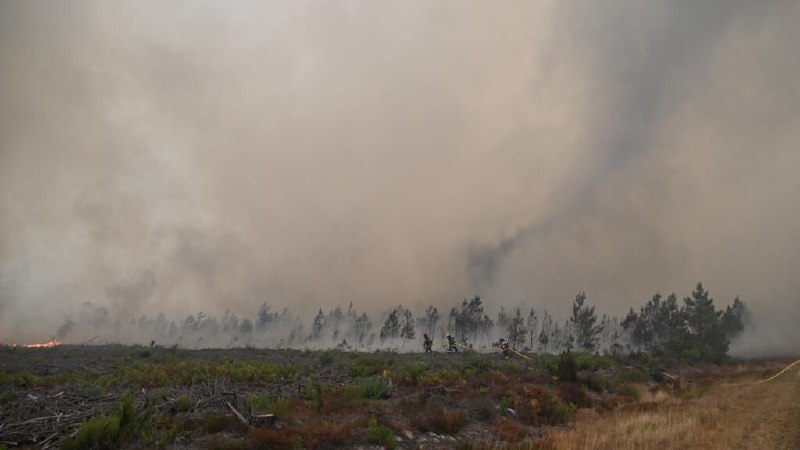
The third-place fixture was the smallest of the stories France 24's week-in-pictures roundup chose to anchor its global frame around. The dominant visual was heat: wildfires across southern Europe, parched riverbeds, athletes staggering. The Tour de France, which had been routed through the Pyrenees and into the Massif Central in the same window, was brought to a standstill by the heatwave. Riders, support staff and the medical convoy were operating under conditions that pushed race management to neutralise stages rather than risk the kind of mass-DNF scenes that marred the 2015 edition. The organisers had no script for a July this hot; the calendar had not been built for one either.
The wildfire footprint around the Mediterranean is the part of the picture that will not disappear when the temperature drops. France, Spain, Portugal, Greece and the Balkans have all reported active fronts through the fortnight; smoke has blanketed cities that usually market themselves as summer destinations. The cost is being absorbed now by emergency services, insurers, and the regional governments that will, in time, push for a reconstruction fund from Brussels.
The fixture list is now a climate artefact
The structural point underneath the scorelines is plain. International sports governing bodies built their calendars in an era when a July in Paris, Madrid or Marseille topped out in the low thirties Celsius, with the occasional spike. That assumption is now a historical artefact. Football, cycling, tennis and athletics all run their marquee events through the northern summer, both because of tradition and because that is when broadcasters can sell advertising. The Tour's August window, the slalom finish to the football season, the late-July athletics meets: all of them now run into a temperature range that is no longer edge-case but routine.
There are three plausible responses, and the next eighteen months will show which one wins. The first is calendar drift: pushing marquee events earlier into spring or later into autumn, accepting the collision with club-season schedules and the Champions League group-stage draw. The second is venue drift: relocating summer events to higher latitudes or higher altitudes, the way Formula 1 has done with Austria and the way the Olympics flirted with Sapporo in 2020. The third is no change, with organisers accepting that some editions will be played under conditions that produce the visuals of the past fortnight. The current trajectory points to a messy mix of all three.
What the broadcasters actually paid for
The closer question, and the one the federations will not say out loud, is who absorbs the cost when the climate bends the fixture. Insurance markets for weather-disrupted outdoor events are thin and re-priced annually. Host-city contracts signed for the 2030 World Cup and the 2028 Olympics were written against temperature assumptions that are quietly being revisited. National federations, broadcasters and sponsors will, between now and the next cycle, renegotiate the risk allocation. The fan in the stadium pays for it in any case: in ticket surcharges, in rescheduled travel, in matches moved to kick-off times that fit the broadcaster's evening slot rather than the player's lungs.
England's players can celebrate a third-place finish on the flight home. The organisers of the Tour de France, the emergency services across the Mediterranean, and the sports executives drafting next year's calendar have a longer, less photogenic to-do list. The thermometer does not negotiate.
Desk note: Monexus framed this as a sports story whose real subject is a calendar. The wire frame, anchored on the third-place result, treats the heatwave as backdrop; the structural read treats the heatwave as the lead.
Wire provenance
This editorial synthesis draws on the following public wire/social posts:
- https://t.me/s/FRANCE24English/
- https://x.com/polymarket/status/1945471128034701849
- https://en.wikipedia.org/wiki/2026_FIFA_World_Cup
- https://en.wikipedia.org/wiki/2026_Tour_de_France