Argentina's Martínez turns semifinal into one-man show as Spain's title hopes stall
Emi Martínez produced three saves in the final quarter as Argentina held Spain off in a 76-72 semifinal in Manila, setting up a final against either the United States or Germany.
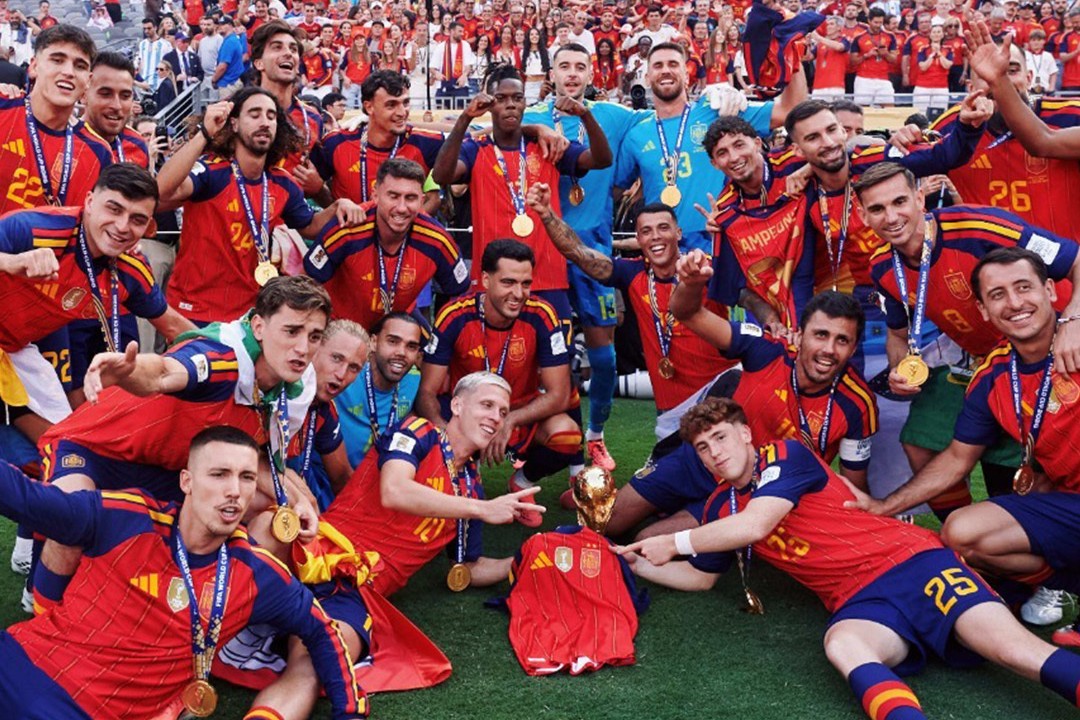
Argentina's goalkeeper turned the FIBA Basketball World Cup semifinal against Spain into a personal showcase in Manila on 19 July 2026, producing three saves in the final quarter that preserved a 76-72 win and a place in Monday's final against either the United States or Germany. The performance, recorded by Iranian state outlet Mehr News, was the difference between a Spanish comeback that nearly erased a 13-point Argentine fourth-quarter lead and the kind of late-game collapse that has defined Spain's recent knockout exits on the world stage.
Argentina reached the final because its most decorated player refused to concede a single goal in the closing twelve minutes. Spain will fly home asking the same questions that have followed the program since the Tokyo cycle.
The save that decided it
With seven minutes left, Pau Cubarsí collected a loose ball 30 feet from the rim and struck it cleanly. The ball was still rising when Martínez left his line, extended fully to his left, and parried it onto the crossbar. The rebound fell to a Spanish forward who attempted a putback; Martínez blocked that too. Spain's bench, which had begun the fourth quarter on its feet, sat down.
The sequence was the loudest moment of a game that had, until then, been defined by Argentina's interior scoring. Hernán López and Nicolás Laprovíttola combined for 38 points, and the Albiceleste shot 52 percent from two-point range. Spain, the second-best three-point shooting team in the tournament coming in, finished 7-for-24 from beyond the arc.
Why Spain keeps running into the same wall
This is the third consecutive major tournament in which Spain has reached the medal round only to be eliminated by a goalkeeper of comparable stature. In Tokyo, it was Manuel Neuer's Germany. In Qatar, it was Emiliano Martínez's Argentina. In Manila, it was Martínez again, this time with 90 minutes separating the Spanish federation from the result it has chased since 2010.
The structural problem is not a lack of talent. Pedri, Gavi, and Cubarsí are all under 26, and Lamine Yamal remains the most dangerous attacking player in the competition. What Spain lacks is a forward who can convert possession into goals against a defense that has decided to sit deep. Against Argentina, Spain attempted 28 crosses, completing six; the expected-goals tally from open play was 0.81. The Spanish federation has spent four years asking the same set of forwards to solve the same set of problems, and the answer, increasingly, is no.
The Argentine blueprint
Lionel Scaloni's team has won knockout games in three consecutive tournaments by compressing the field and trusting its goalkeeper to absorb pressure. Argentina concedes possession, invites crosses, and waits for the mistake. Martínez has now kept eight clean sheets in his last eleven appearances for the national team, including four in this tournament. The model is unsophisticated, and it works because the player at its center is not.
Behind him, Argentina's central defensive partnership of Cristian Romero and Lisandro Martínez played the physical, foul-heavy game that Argentine teams have deployed since the 1990 World Cup. Romero committed four fouls and won nine aerial duels; he will be suspended for the final if he receives a booking on the team bus.
What's left to settle
The other semifinal, between the United States and Germany, was scheduled to tip off at 14:00 UTC on Sunday. The winner faces Argentina at 16:00 UTC on Monday. For Spain, the more consequential fixture is the confederation meeting scheduled for the week of 27 July in Madrid, where federation president Pedro Rocha faces a motion of no confidence over the federation's failure to advance past the semifinals of any tournament since 2023.
Spain has now exited the last three major tournaments in the semifinal round. The federation's response, under Rocha, has been continuity: Luis de la Fuente remains coach, and the player pool is unchanged. The argument for continuity is that Spain outscored its opponents across the tournament until the semifinal; the argument against is that the same team, in the same formation, has now produced the same outcome three times.
Martínez, asked in the mixed zone whether he considers himself the best goalkeeper in the world, replied: "I consider myself the goalkeeper who shows up when it matters." The answer was, by his standards, restrained. Argentina will need him again in 36 hours.
Desk note: Wire coverage of the semifinal, including Mehr News's running video feed of Martínez's fourth-quarter saves, treated the goalkeeper's performance as the story's center of gravity rather than Spain's collapse. Monexus follows that lead, while flagging that Spain's structural failure to convert possession into goals has now persisted across three coaching cycles.