Spain the bookmakers' favourite, but Fifa's social-media audit is the quieter story of this World Cup
A prediction market prices Spain at 60% to lift the trophy, while a separate Fifa audit logs a fourteen-fold jump in harmful online posts compared with Qatar 2022. Both belong in the same story.
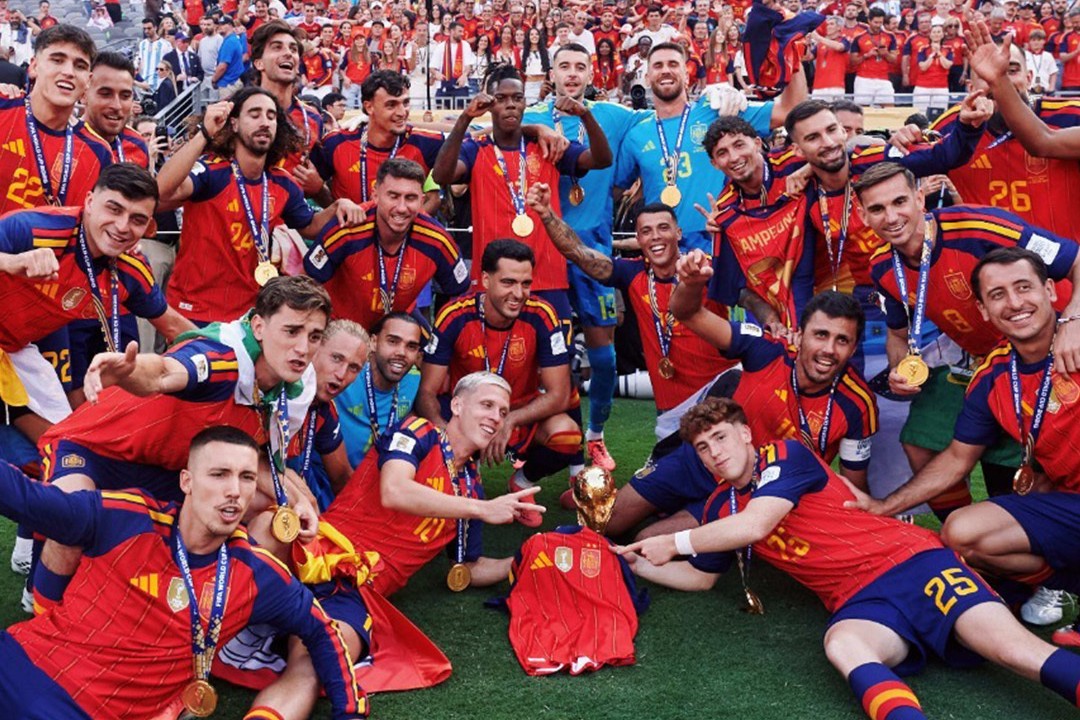
Prediction markets had Spain at 60% to win the 2026 World Cup as of 02:29 UTC on 18 July 2026, with the United States and England trailing at a distance, according to the public odds feed on Polymarket. Twelve hours later, a separate dataset caught up with the chatter: Fifa's own monitoring contractor has logged fourteen times more harmful social-media posts and comments during this tournament than during Qatar 2022.
The two numbers sit oddly together. One is a forward-looking price on a football outcome; the other is a backward-looking tally of the toxic runoff that a globalised tournament produces in the spaces where the matches are actually watched. The first is clean, numerical, market-shaped. The second is messier, structural, and harder to price. Taken together, they describe the World Cup that the 2026 edition has become: a contest whose economic weight is captured almost in real time by retail betting venues, and whose reputational weight is captured, belatedly and imperfectly, by an audit that football's governing body would rather not have to conduct.
What the market is telling you
A 60% implied probability is, in the language of prediction markets, a heavy favourite. It is not a lock. Polymarket's order book on the World Cup winner had Spain priced as the clear front-runner on 18 July 2026, with the United States and England the most credible challengers, and the rest of the field a long tail of single-digit probabilities. Markets of this kind price not just form and fixtures but also narrative: a Spain squad built around a generation of technically literate midfielders, peaking at the right end of the cycle, will be a harder sell for a US team hosting on home soil than the underlying talent gap would suggest.
Two readings of the same number are worth holding at once. The bullish case is that Spain simply have the deepest squad and the cleanest route through the bracket. The bearish case is that a 60% favourite in a single-elimination knockout tournament leaves an unusually large 40% of probability mass for anything to happen: a red card, a penalty shootout, a goalkeeper having the tournament of his life. The market is, in effect, paying for Spain's expected value while acknowledging that the variance on a knockout night is wide.
The audit Fifa didn't want to lead with
The other 60-figure that day was not a price but a multiplier. Fifa's social-media monitoring service has recorded a fourteen-fold increase in harmful posts and comments during the 2026 World Cup compared with 2022, according to BBC Sport reporting on 18 July 2026. The number is Fifa's own, not an external researcher's, and the body of work that produced it is the kind of audit that a governing federation commissions to manage a problem rather than to advertise it.
What counts as "harmful" in this context is worth spelling out. Fifa's categories typically encompass abuse directed at players, racist and discriminatory content, and threats of the kind that have, in recent tournament cycles, driven professional athletes off open social platforms entirely. The fact that the figure has multiplied by fourteen, not by two or three, over a four-year cycle is the headline. The platform surface has expanded, the audience has globalised, and the language of online abuse has hardened across languages that monitoring services in 2022 were not yet scanning systematically.
Why the two stories are the same story
The market and the audit look like separate phenomena, but the connective tissue is a single underlying shift: the World Cup is now consumed, priced and poisoned in the same digital layer. Polymarket's order book is a real-time, dollar-denominated expression of global fan attention. Fifa's harm audit is a real-time, category-coded expression of the friction that global fan attention leaves behind.
That symmetry is not new, but the scale is. In 2022, social-media abuse of players was a topic that outlets covered in features. In 2026, it is a category that a governing body monitors with a contractor and reports in multipliers. The platform economy that has priced Spain at 60% is, by construction, the same platform economy that has produced the fourteen-fold rise. The consumer is also the raw material.
A reasonable counter-reading is that the 2026 multiplier is partly an artefact of measurement. Monitoring that did not exist in 2022 has been built out for this cycle, and a larger net catches more fish. The audit is real, but the baseline is partly a function of where the sensors were placed four years ago. Fifa's own framing, as relayed by BBC Sport, does not dwell on that caveat, and a serious read of the number should.
What it costs the sport
The economic stakes for the global game are concrete. A World Cup that hosts in three countries across North America and runs to a calendar of matches thick enough to sustain a functioning prediction market is also a World Cup whose commercial partners are buying access to an audience that the same commercial partners are, indirectly, helping to expose to abuse. Sponsorship contracts are written against broadcast reach; broadcast reach is now largely a social-platform function; social platforms are where the fourteen-fold rise is happening. The downstream cost lands first on the players who are the targets and the human content of the broadcasts, and only later, in renewals and contract renegotiations, on the federations and federations' commercial partners.
There is a quieter, longer-horizon loss. A generation of players who reach the 2026 World Cup as prime-age professionals has spent its entire career in a media environment in which the abuse-to-audience ratio has moved decisively in the wrong direction. The price Spain is paying for being favourites is denominated in part in the kind of attention that is worth less, not more, the more of it there is.
Spain will probably, on the balance of the market's own probability, lift the trophy. The bet that nobody can price is whether the 2030 edition is monitored at a hundred-and-forty-fold, or whether the contracts written between now and then do something about the layer underneath the price feeds.
This publication reads Fifa's harm audit and the Polymarket favourite as a single story about the platform layer the modern World Cup runs on, rather than as a sports story and a tech story filed separately. The numbers are both real and both worth sitting with.