Kenya's 'baby mama' economy: when fatherhood decouples from marriage
Nairobi's dating economy is producing a generation of fathers who raise children across separate households. A Nation Lifestyle feature asks whether the old polygamy frame still fits.
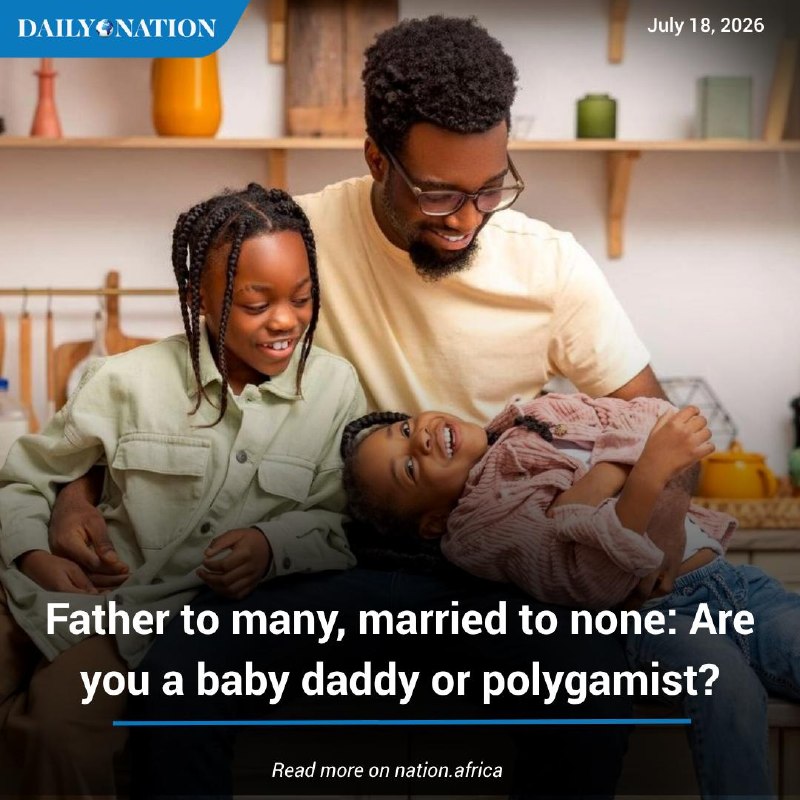
At 04:54 UTC on 18 July 2026, the Daily Nation's lifestyle desk pushed a feature on its Telegram channel with a premise sharp enough to stop a Nairobi commuter mid-scroll: men in Kenya are fathering children with several different women, and marrying none of them. The piece, drawn from interviews by Nation Lifestyle with Kenyan men who identify with the so-called "baby mama" arrangement, asks a deceptively simple question. If the marriage certificate is no longer the organising unit of fatherhood, what is?
The trend is not a curiosity. It is a quiet reorganisation of household economics in East Africa's largest economy, and it is happening fastest among the urban, formally employed men who can plausibly support several households at once. The old frame, polygamy, implied a single legal marriage, a recognised senior wife, and a duty of maintenance that the courts could enforce. The new pattern keeps the financial obligations but discards the legal architecture. The result is a father who is present, in fragments, across several addresses.
What the interviews actually show
Nation Lifestyle's reporters did not publish a statistical sample; they published a texture. The men who spoke described a rotation of childcare, school fees and rent, negotiated by phone and WhatsApp, with no single household functioning as the recognised family unit. Several explicitly rejected the polygamy label, on the ground that polygamy, in its formal Kenyan forms, at least produces inheritance clarity. Their arrangement, they argued, is something else: serial, overlapping, fluid, and resistant to any one woman's claim on the man's income.
The economic logic underneath is plain. A formally employed Kenyan man earning enough to pay rent in two or three middle-class estates in Nairobi, Kiambu or Machakos can sustain a network of small households at a per-unit cost lower than maintaining a single middle-class home with several dependants under one roof. The arithmetic rewards dispersal. The women involved, in the interviews, are not described as passive recipients; they are reported as participants who have calculated, often in advance, that a partial claim on a man's income is preferable to waiting indefinitely for a proposal that will not arrive.
The structure punishes the institution of marriage without abolishing it. Wedding culture in Kenya is robust; the country still records one of the higher marriage rates per capita in the region. What the new pattern erodes is the assumption, baked into property law and succession law, that a man's primary obligation runs to a single legal wife. Several women in similar reporting elsewhere have described the legal vertigo of being a long-term cohabiting partner who cannot inherit, cannot sign medical consent, and cannot be named in a funeral programme.
Why the polygamy frame no longer fits
Traditional polygamy, in the Kenyan context, has a paperwork trail. Customary marriage is registered with elders and, increasingly, with county registries. Islamic marriage in Kenya is documented under Kadhis' courts. Christian and civil marriage is documented by the Attorney General's office. Each path produces a wife with standing, a rank order, and a defined share of the husband's estate. Succession in Kenya, governed by the Law of Succession Act and the Married Women's Property Act, was written with that rank order in mind.
The "baby mama" arrangement produces none of that paper. The man is married to no one in the legal sense; each woman is, in the eyes of the state, a single parent. Children born outside marriage in Kenya have equal legal status to those born inside, after the 2022 Children Act revisions tightened affiliation rules, but the practical machinery of maintenance, school enrolment and medical consent still runs more cleanly through a registered marriage. The men in the Nation Lifestyle feature, by staying outside marriage, are pushing the cost of that machinery onto the women.
This is where the old polygamy frame is misleading. Polygamy, for all its documented strains, distributed legal standing. The new pattern concentrates it on the man, who moves between households without ever crossing the threshold that would trigger succession law, matrimonial property law or maintenance enforcement. The women absorb the legal fragility. The state loses visibility into a growing share of household formation.
The structural picture underneath
Kenya's urban labour market has produced a salaried male class large enough to sustain several households, but a housing market and a rental regime that punish scale. A four-bedroom house in a Nairobi middle-class estate absorbs one household's full middle-class income. The same income split three ways across three smaller units in the same corridor buys each household a working-class lifestyle and the man a kind of mobility. The arrangement is rational under those prices.
It is also accelerated by the gap between the age of economic viability for a man and the age at which his peer group now treats marriage as appropriate. The Nation Lifestyle feature lands in the same month that Kenyan census-linked research continues to show median ages at first marriage climbing for formally employed men in Nairobi and its commuter belt. The longer a man is single, the more likely he is to accumulate children across several relationships before any of those relationships reach the threshold of a wedding. The country is not abandoning marriage; it is delaying it past the point where the average man's first child arrives.
The cultural load is uneven. The men interviewed by Nation Lifestyle describe pride and flexibility. The women in adjacent reporting describe exhaustion, ambiguity, and a constant negotiation over a man's attention that no legal instrument recognises. The state, for its part, is left with a population register that undercounts the country's actual household structure and a tax base that captures only the man, not the households he sustains.
What the data does not yet show
The feature is a qualitative portrait, not a survey. The sources do not publish a national prevalence rate, do not break the pattern down by income band or county, and do not compare the men interviewed to a control group of married fathers. The framing, that this is a rising pattern reshaping Kenyan fatherhood, is plausible and consistent with regional reporting, but the quantified base rate is not in the materials this article draws on. Readers should treat the trend as visible and reportable, not yet as a measured national shift.
What is in the sources is enough to draw one firm line. The arrangement the men describe is not polygamy renamed. It is fatherhood decoupled from marriage, in a legal environment that has not yet caught up, and the women inside it are the ones carrying the legal and practical weight of the gap.
Desk note: Monexus has framed this as a structural story about household formation and legal architecture, not a morality feature. The piece leads with the men's own framing because the source material leads there, then centres the legal and economic consequences the women describe, and flags the gap between qualitative reporting and national prevalence.
Wire provenance
This editorial synthesis draws on the following public wire/social posts:
- https://t.me/DailyNation