England hold off a French rally to win 4-3 in Zurich, a friendly that asked more questions than it answered
A four-goal first half from England, capped by Bukayo Saka's brace, was almost thrown away in seven second-half minutes. The result is a friendly. The reaction is not.
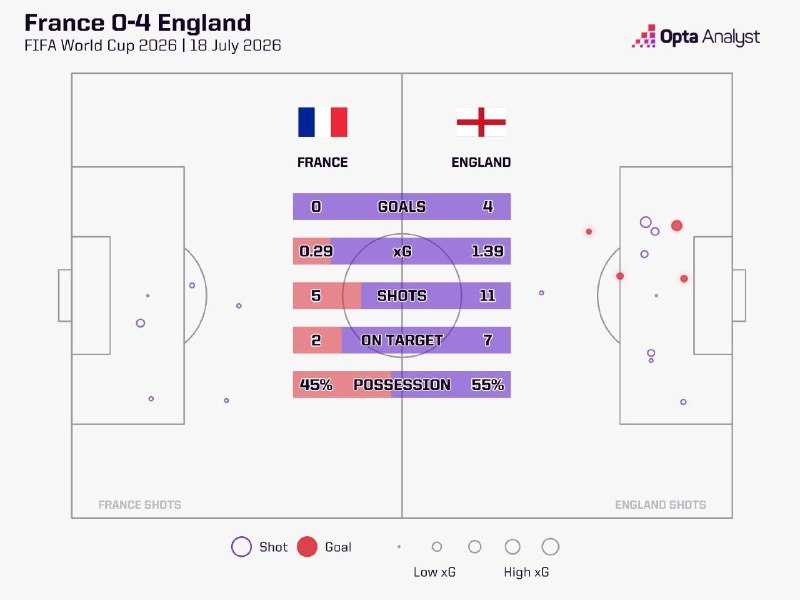
Bukayo Saka scored twice in five first-half minutes at the Letzigrund in Zurich on 18 July 2026, the second a stoppage-time strike that sent England into the break 4-0 up against France and, briefly, made the post-match conversation feel like a coronation rather than a debrief. By full time the score was 4-3, after France scored three times in seven second-half minutes, and the conversation is now about something else entirely: how a side that looked ready to embarrass one of the pre-tournament favourites nearly let four goals of daylight evaporate against a team that had not threatened in the opening forty-five.
The friendly, broadcast in Iran on Channel 3 shortly after midnight local time and followed live by football desks from London to Lyon, was supposed to be a calibration exercise for both squads ahead of the autumn international window. Instead it produced the kind of scoreline that travels: a rout that almost became a collapse, a one-sided half that became a contested ninety minutes, and a set of selection questions for Thomas Tuchel and Didier Deschamps that will not be answered by the goals alone.
A statement first half, built in bursts
England's first goal, in the 18th minute, was scored by Ezri Konsa, the Aston Villa centre-back rising for a set piece that France failed to clear, per a 21:24 UTC match log carried by Tasnim News. It set the tone for a half in which England's set-piece work, a long-standing source of goals under previous coaching regimes, again did the damage. France, by contrast, were loose in transition and second-best to every second ball in the middle third.
The second arrived in the 36th minute, with Saka finishing a move that the same wire described as involving a pass into the box and a calm side-foot finish. The third, on 45 minutes, was Saka again, this time from a tighter angle, and the fourth, in the 45+1 minute, completed his brace and gave England a 4-0 lead that, on the balance of the half, looked entirely fair. France's half-time statistics, posted at 21:59 UTC, told the story: minimal shots, no clear chances, and a midfield that had been bypassed rather than outplayed.
It is worth pausing on the shape of those four goals, because the pattern is what Tuchel will want to keep and what Deschamps will want to dissect. Two of them came from set plays. Two came from quick vertical transitions, the kind England have struggled to produce consistently against elite opposition. The structural read is simple: when England moved the ball early and ran beyond the French back line, France had no answer. When France had possession, they did little with it.
The seven minutes that changed the read
The second half began with France making the running. Within the first five minutes after the restart, France had pulled one back through Empaié, who finished calmly in the 47th minute, per a 22:20 UTC update on the Fars News Agency match feed. The 52nd-minute second followed, and the scoreboard read 4-2 with the bulk of the half still to play. A third, at 3-4, came in the 70th minute per a 22:29 UTC log on the World Football Witness channel, and for a stretch England were hanging on, the back four suddenly a step slow, the midfield no longer screening.
That sequence, three goals conceded in roughly twenty-three minutes of game time, is the only part of the night that will genuinely concern Tuchel. Set-pieces can be coached. Transition defending, the willingness to recover and the spacing between centre-back and full-back, is harder to bolt on at international level where squads meet for days rather than weeks. England did not lose this match, but they lost control of it, and the second-half body language, the slowing of the press, the deeper starting position, is the kind of evidence coaches keep.
What the result does and does not say
A 4-3 win in a friendly is, strictly, almost meaningless in tournament terms. FIFA rankings, which feed seeding for the next major draw, are calculated over a multi-year window, and a single July result moves the needle only marginally. What it does do, however, is sharpen two debates that have been running all summer.
The first is the Saka question. The Arsenal forward has been one of the Premier League's most consistent wide players for three seasons, but his England career has been a story of brilliant cameos interrupted by long stretches of being asked to do a job that did not suit him. Two goals from inside the box in a half of football against a France side that had reached the last two major tournament semi-finals is the kind of audition that resets a narrative.
The second is the French recalibration. Deschamps is in the final phase of a tenure that has produced a World Cup and a Nations League title, and his squad is in the kind of transition that almost every holder of a major trophy has to navigate. Empaié's introduction at half-time, the willingness to commit bodies forward, the speed with which the midfield began to win second balls: these are the markers of a side that can still be rearranged, even if the result went against them.
There is a counter-read worth airing, because the wire accounts do not. France played a fixture that, for them, carried little consequence. They went four down, made three tactical adjustments at the break, and spent the second half running at a back line that was protecting a lead rather than chasing the game. A team in that posture will always look more coherent than a team in the other one. Whether France genuinely fixed what was broken in the first forty-five minutes, or simply enjoyed the freedom of a side with nothing to lose, is something no single friendly can resolve.
What to watch next
The autumn international window opens in September, and both sides have friendlies against South American opposition, with England scheduled to face Argentina and Brazil on successive dates and France set to meet Uruguay and Colombia. Those are the fixtures that will tell us whether Zurich was a real signal or a one-off. For Tuchel, the questions are defensive: how to manage a 4-0 lead without retreating ten yards, how to keep Konsa and his partner in the centre of the back four on the same page for ninety minutes rather than forty-five. For Deschamps, the question is forward: whether Empaié, who took his goals well, can force his way into a starting XI that has been settled for the better part of two years.
The result, in the end, will not appear in any trophy cabinet. The questions it raised will.
How Monexus framed this: the same scoreline was carried in Iran by Tasnim News and Fars, and by international football wires. We led with the match facts and the tactical shape rather than the result, because in a friendly the second tells you less than the first.
Wire provenance
This editorial synthesis draws on the following public wire/social posts:
- https://t.me/TasnimNews
- https://t.me/TasnimNews
- https://t.me/TasnimNews
- https://t.me/farsna
- https://t.me/farsna
- https://t.me/wfwitness
- https://t.me/wfwitness