Apollo's shadow: what the 1969 moon landing still tells us about American ambition
More than half a century on, the Apollo programme remains the high-water mark of US state-led industrial mobilisation, a benchmark against which every subsequent moonshot, real or rhetorical, has been measured and found wanting.
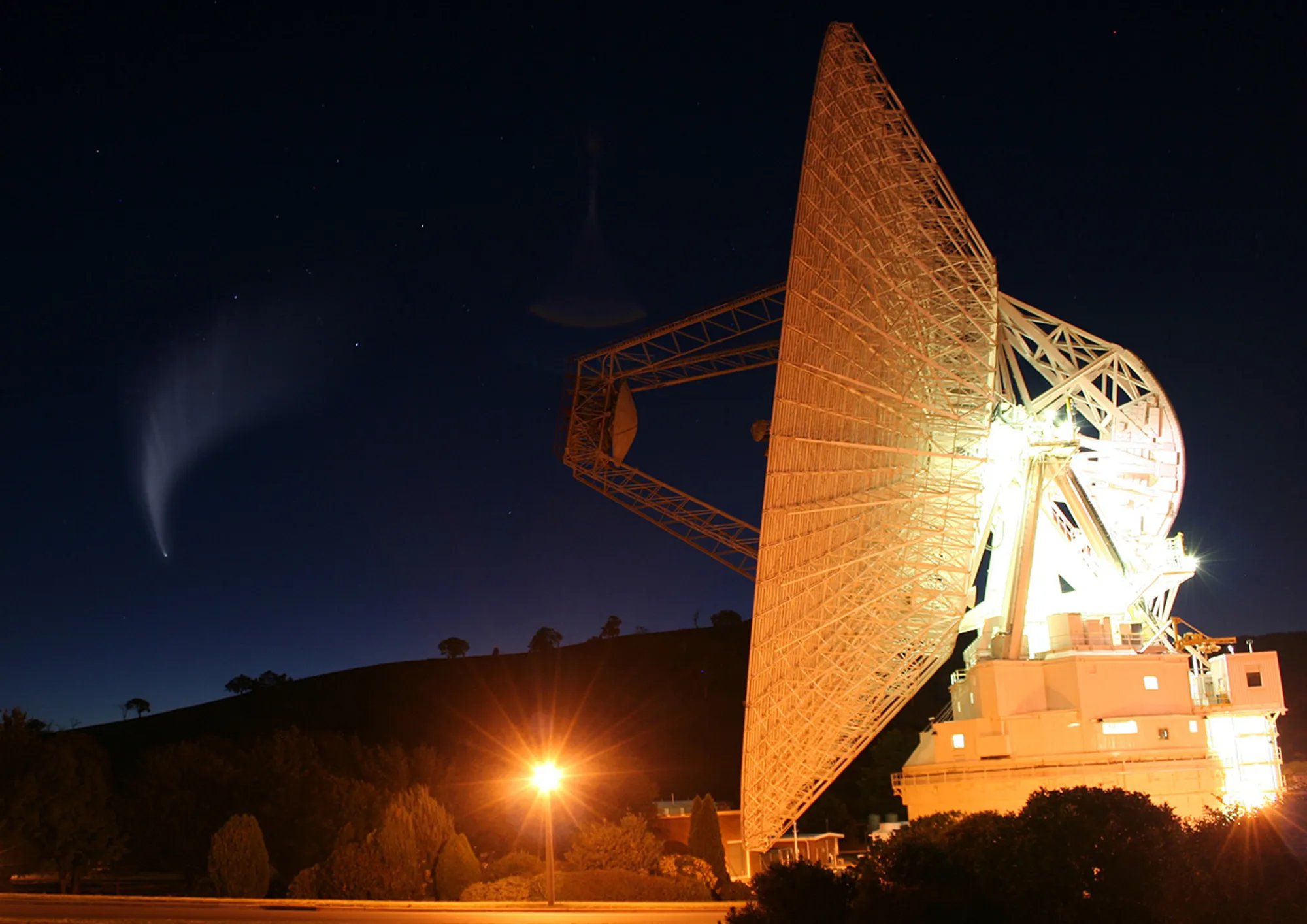
On 20 July 1969, at 20:17 UTC, the Apollo 11 Lunar Module Eagle settled onto the basalt plain of the Sea of Tranquility with about 25 seconds of descent fuel remaining. Neil Armstrong's callout, a small pile of lunar dust, and a televised black-and-white image bouncing off a 64-metre dish at Goldstone in the Mojave Desert marked the first time a human being had stood on another world. The mission is now fifty-seven years old, and the United States has not returned to the lunar surface with crew in the intervening half-century. The Apollo programme is, by any honest accounting, both the most audacious state-directed industrial enterprise of the twentieth century and a benchmark against which every subsequent "moonshot," real or rhetorical, has been measured and found wanting.
A useful exercise, half a century on, is to read Apollo as a logistics problem rather than as a triumphal narrative. The Saturn V rocket that lifted Armstrong, Buzz Aldrin and Michael Collins off pad 39A at the Kennedy Space Centre was the most powerful vehicle ever flown; it remains so. It was assembled in a purpose-built vehicle assembly building, tested in stands at the Mississippi River Test Facility (now Stennis), and fired by a workforce that, at peak, employed roughly 400,000 civil servants and contractors across forty-six states. NASA spent roughly $25.4 billion in then-year dollars on the Apollo programme between 1961 and 1972, a figure equivalent to several hundred billion in present-day money. That sum did not buy a moon landing so much as it bought the institutional capacity to deliver one on a deadline.
What Apollo actually was
The standard hagiography treats Apollo as the fulfilment of President John F. Kennedy's 25 May 1961 speech to a joint session of Congress, in which he committed the United States to landing a man on the Moon and returning him safely to Earth before the decade was out. The speech is real. The geopolitical frame around it is real. Less often remembered is how thin the institutional foundations were when Kennedy made the commitment: in May 1961 the United States had logged a total of 15 minutes and 28 seconds of crewed spaceflight, all of it in suborbital Mercury-Redstone capsules. The infrastructure for orbital flight, launch complex 39, the Apollo spacecraft itself, the Lunar Module, the spacesuits, the mission-control software, did not yet exist in any form that could fly.
What followed was a multi-year build-out that looked less like a research programme than like a wartime mobilisation. Grumman built the Lunar Module in Bethpage, Long Island. North American Aviation built the Command and Service Module in Downey, California. The Marshall Space Flight Centre in Huntsville, Alabama, under Wernher von Braun, integrated the Saturn V. Boeing built the first stage. The Massachusetts Institute of Technology's Instrumentation Laboratory (later renamed Draper Labs) wrote the guidance software that flew the spacecraft to the Moon, roughly 1,400 person-years of effort, much of it done by women whose names Margaret Hamilton among them have only recently entered the canonical history. Every piece was new; every interface was untested.
The story that didn't quite happen
The dominant American narrative remembers Apollo as proof that the country can do anything it sets its mind to. A more careful reading of the archival record suggests something less flattering, and more useful. The programme worked because three conditions were met simultaneously. First, a closed geopolitical environment allowed a single spending decision to be made without the kind of quarterly-earnings discipline that constrains private aerospace today. Second, NASA enjoyed an unusual degree of operational autonomy inside the executive branch, sheltered by Kennedy and his successors from the procurement micromanagement that has since become routine. Third, the Cold War set a deadline with a single, legible metric: land on the Moon before the Soviets.
Take any one of those conditions away and the programme as it actually unfolded becomes hard to reproduce. The Artemis programme, NASA's current lunar effort, runs in a different environment: fixed-price contracting, multiple commercial providers, a public budget that must compete with entitlement spending, and an adversary landscape (China) that does not present the same kind of single-metric race that the Soviet Union did. Whether those structural differences doom Artemis to delay is a separate question. They certainly mean that the Apollo benchmark, invoked so routinely in American political rhetoric, is being misread.
The other view from the launch pad
The Soviet Union ran its own lunar programme in parallel, and the story usually told in the West, of a Soviet Union that lost the race and stopped trying, is partly true and partly a convenient edit. The N1 rocket, the Soviet counterpart to the Saturn V, failed in four consecutive launch attempts between 1969 and 1972, each destroying the launch pad infrastructure at Baikonur. Soviet chief designer Vasily Mishin carried that record into retirement. But the Soviet space programme did not stop. It pivoted, successfully, to long-duration orbital stations: Salyut, then Mir, then the modules that would form the backbone of the International Space Station's Russian segment. By the time the United States returned to crewed spaceflight after the Columbia disaster of 2003, Russian Soyuz vehicles were the only way NASA astronauts reached orbit, a fact that ran on every American network for nearly a decade. The race that mattered for the two decades after Apollo was the one the United States, in some quiet sense, lost.
A second framing, common in the global south and in post-colonial scholarship, reads Apollo as a spectacular exercise in imperial projection rather than as a universal scientific achievement. The astronauts returned home to ticker-tape parades; the lunar samples were distributed, mostly, to American research institutions. The political constituency for Apollo was American, the political constituencies against it were American, and the rest of the world was, in the main, a passive audience. That reading is not wrong. It is also not the only reading. The science returned by Apollo, the lunar rock catalogue, the laser ranging retroreflectors still in use at observatories from McDonald to Observatoire de la Côte d'Azur, the photography that produced the first complete geological map of the Moon, has been used by every spacefaring nation since.
What the benchmark is actually for
The most useful way to read Apollo in 2026 is not as a story about astronauts or as a story about the Cold War. It is as a story about what a state can do when it treats an industrial target as a single problem rather than as a portfolio of contractor opportunities. The benchmark that the rhetoric preserves, and that the rhetoric often misses, is the institutional one. A national aerospace capability built around a specific flight cadence, a specific supply chain, and a specific authority to make procurement decisions outside the ordinary federal acquisition process is a particular kind of institutional arrangement. It was built once. It has not been rebuilt.
That observation is not a counsel of despair. The Artemis programme, for all its delays and cost growth, has produced a working super-heavy launcher (the Space Launch System, flown for the first time in November 2022) and a partially completed Gateway station in lunar orbit. China's Chang'e programme has, by any objective measure, become the most active lunar science programme of the 2020s, with sample return missions and a robotic lunar far-side landing that the United States has not matched. India's Chandrayaan-3 soft-landed near the lunar south pole in August 2023. The global lunar environment in 2026 is more crowded than it has been since the Apollo era. What is missing is not the technical capacity to land on the Moon. It is the political decision to do so on a deadline, and the institutional architecture that would let such a decision survive a change of administration.
Eagle's landing gear is still on the Sea of Tranquility, exactly where Armstrong and Aldrin left it. The retroreflector they deployed is still returning photons to Earth. The institutional capacity that put them there, however, has to be rebuilt in some form before the next footprint.
The Monexus science desk framed Apollo as an institutional case study rather than as anniversary nostalgia: the question worth asking in 2026 is not what the astronauts did, but whether the federal architecture that put them there can be reconstructed under present procurement and budgetary rules.
Wire provenance
This editorial synthesis draws on the following public wire/social posts:
- https://en.wikipedia.org/wiki/Apollo_11
- https://en.wikipedia.org/wiki/Apollo_program
- https://en.wikipedia.org/wiki/Saturn_V