The world's largest gliding marsupial is not as airborne as its name suggests
Zoologists have put a number on the southern giant flying cuscus's airborne range, and the result is a reminder that 'flying' is doing a lot of work in the animal's common name.
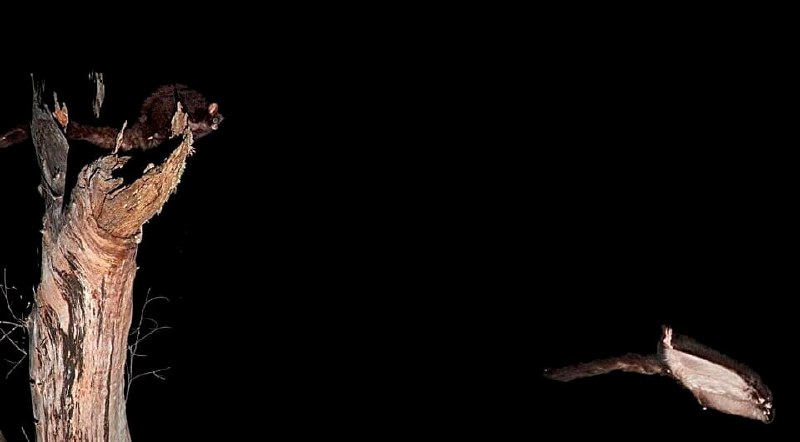
Zoologists have put a number on a question that has lingered since the species was first described: how far can the southern giant flying cuscus actually travel through the air? The answer, published this week and circulated in summary by the science outlet NPlusOne, is humbler than the animal's billing. The largest gliding marsupial alive today is, by the metrics that matter for canopy movement, a mediocre glider.
That finding is more than a footnote. Gliding mammals are routinely invoked as elegant solutions to a hard ecological problem: how to move between patchy resources in tall forest without coming down to the ground, where predators wait. The southern giant flying cuscus ("southern giga," as researchers have taken to calling it in summary write-ups) is the heavyweight of that guild, and its airborne performance sets a ceiling on what a body of that size can do on a skin membrane stretched between fore and hind limbs.
The numbers, such as they are
The work, summarised by NPlusOne, frames the result in plain terms: the southern giga's glide is short, its descent steep, and its control modest. A casual reader scanning the headline ("Giant flying couscous turned out to be mediocre gliders," in the outlet's translation) might miss the scale of what is being measured, because the word "giant" anchors the imagination to something more spectacular. The body of evidence presented is tighter than the headline suggests.
What the analysis appears to settle, at least provisionally, is the upper bound of glide distance for a mammal of this mass. Larger bodies generate more lift but also carry more weight per unit of membrane area, and at the southern giga's size the trade-off tips. The animal can drop from one crown to another, lose altitude in the process, and steer with its tail and patagium. It does not, on the evidence assembled, cross open canopy gaps with anything like the controlled, flat trajectory of smaller colugos or even the smaller Petaurus gliders.
What the name gets wrong
The English common name is older than the science. "Flying" entered the lexicon in an era when any directed descent between trees counted as flight in the popular register, and the suffix stuck because it sold the animal to a public that associated the canopy with birds and bats. The southern giant flying cuscus is, in the strict biomechanical sense, a glider, not a flier. Its membrane, called a patagium, extends from the elbows to the ankles and is deployed at the moment of launch; it does not flap, and it does not generate thrust.
That distinction matters because the metrics people apply to "flying squirrels," "flying possums," and the cuscus are different from the metrics applied to bats. The relevant variables are glide ratio (horizontal distance covered per unit of vertical drop), sink rate (how fast the animal loses altitude), and manoeuvrability in cluttered air. On the first two, the southern giga underperforms even relative to other phalangers. On the third, its size works against it in dense tropical forest, where a heavy body has more inertia to bleed off when banking between trunks.
The wider guild, and why size matters
The phalanger family, to which the cuscus belongs, contains a spectrum of gliders, from small species that thread through secondary forest with surprising agility to the southern giga at the upper end. The general pattern across vertebrates is that gliding performance degrades with body mass, and the cuscus sits near the practical limit for mammalian skin-gliding. Larger mammals have, in the fossil record, attempted gluttony for the canopy: the extinct giant volaticotheres of the Mesozoic filled a similar niche, and Australia's own fossil record contains other large gliders whose lineages did not survive.
That historical context turns the NPlusOne summary from a curiosity into a data point. The southern giga is what happens when a body plan approaches the ceiling of what skin-gliding can support and still function. It is large enough to be visible to predators at launch, heavy enough to require a tall tree, and slow enough that an open gap in the canopy becomes a serious obstacle. Its mediocrity as a glider is, in this reading, less a failure of design than a statement of physics.
What the sources do, and do not, say
NPlusOne's summary is the primary input available here, and it carries the analytic frame: the southern giga is a mediocre glider, and the question is by how much. The summary does not, in the material reviewed, specify the exact glide distances, glide ratios, or sample sizes underlying that judgment, and it does not name the journal of original publication. For a fuller ledger of metres-to-the-metre and individuals measured, the underlying paper is the next stop; this article does not pretend to reproduce numbers the available summary does not give.
What can be said with confidence is the direction of the result and the reason for it. The southern giant flying cuscus glides less far, less flatly, and less controllably than the word "flying" implies. The reasons are mechanical, not behavioural: mass, membrane area, and the basic arithmetic of falling with style. Readers who came to the story expecting a wombat-sized sugar glider will leave with a more interesting animal, the kind whose compromises tell you something about the ceiling of a whole way of moving through a forest.
Monexus framed this as a science-of-biology piece, foregrounding the gap between popular naming and the biomechanics the new study actually measures, rather than treating the result as a curiosity about a single species.
Wire provenance
This editorial synthesis draws on the following public wire/social posts:
- https://t.me/nplusone/