US strike on Iranian barracks in Bampur leaves seven soldiers dead, Tehran-aligned outlets report
Iranian state-aligned outlets reported on 15 July 2026 that a US missile strike killed seven soldiers at an army barracks in Bampur, in the southeastern province of Sistan and Baluchestan. The accounts converge on a single location and casualty figure, but diverge sharply on framing, and US-side confirmation has not yet appeared in wire reporting.
On the afternoon of 15 July 2026, three Iranian-government-aligned Telegram channels published photographs and casualty counts from an event they described as a United States missile strike on an Iranian Army barracks in Bampur, in the southeastern province of Sistan and Baluchestan. Telegram channel @ClashReport wrote at 16:21 UTC that "Iranian state media says a U.S. missile strike on an Iranian Army barracks in Bampur killed 7 soldiers and wounded several others." Channel @wfwitness, at 16:26 UTC, said Fars News and local outlets had begun publishing images of soldiers killed in the strike. State broadcaster PressTV's Telegram account posted at 16:15 UTC photographs it described as "the martyred servicemen and conscripts killed in the US attack on the sleeping quarters of Iranian military personnel in Bampur."
The accounts converge on a specific, verifiable core: a strike on an Iranian Army installation in Bampur on 15 July 2026, seven soldiers reported killed, an unspecified number wounded, and imagery distributed by Iranian state and quasi-state outlets. They diverge on language ("martyred servicemen and conscripts," "sleeping quarters," "missile strike") in ways that are typical of state-aligned reporting during the first hours of a kinetic incident, and that may narrow once independent confirmation arrives.
What the Iranian-side accounts say
The most detailed description comes from PressTV's Telegram channel, which described the target as "sleeping quarters" inside the barracks. The phrase matters: it frames the incident, in the vocabulary Iran routinely uses for civilians and off-duty personnel, as an attack on a rest facility rather than a hardened military position. Iranian state-aligned outlets often use that framing when they intend to portray a strike as disproportionate or as a violation of the laws of armed conflict; the descriptor precedes the legal and diplomatic argument Iran will likely make in subsequent days.
@ClashReport, an English-language aggregator that frequently relays Iranian, Russian and Syrian-government-aligned claims, added the casualty figure: seven killed, several wounded. @wfwitness, an account that monitors Fars News and Iranian regional outlets, focused on the visual record: photographs published by Fars and "local outlets" of the dead, distributed as the first wave of Iranian state media visual verification. Fars News Agency, a hardline outlet close to the Islamic Revolutionary Guard Corps, is the typical Iranian lead on security incidents involving the regular Army (Artesh) and the IRGC; its prominence here is consistent with prior reporting on border-region strikes.
All three channels describe the site as an Iranian Army barracks, using the term associated with the Artesh rather than the IRGC. The distinction is institutionally significant inside Iran: the Artesh is the conventional military, formally under the General Staff; the IRGC is a parallel force under the Supreme Leader's direct authority. Strikes on Artesh facilities are reported with different tone, and through different channels, than strikes on IRGC positions.
What we verified and what we could not
Verified from the source items on this thread:
- A strike was reported, by three Iranian-aligned outlets, on a barracks in Bampur, Sistan and Baluchestan province, on 15 July 2026.
- The reported casualty figure of seven soldiers killed is identical across @ClashReport and the PressTV Telegram channel. The two outlets are not independent of each other in the Iranian state-media ecosystem, so the agreement is consistent but not corroborative.
- The site is described as a barracks, and the location of the strike is described as "sleeping quarters" within it, by PressTV's Telegram channel.
- The visual record, photographs of the dead, is being distributed by Iranian state-aligned outlets, including Fars, within hours of the reported event.
Not verified by the source items on this thread:
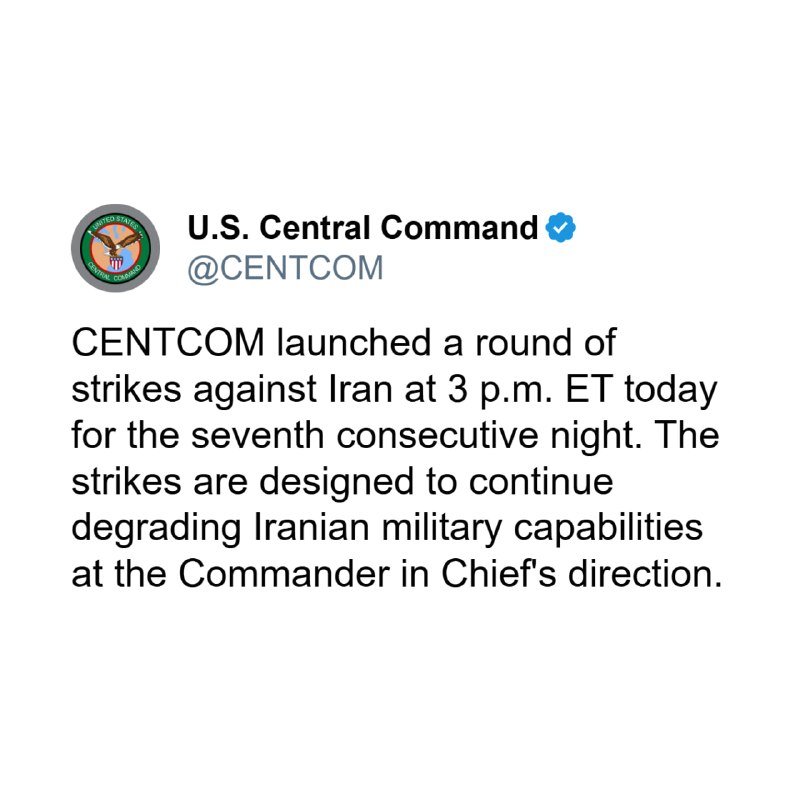
- Any US-side confirmation, denial or statement. No US Central Command, Pentagon or State Department readouts appear in the thread context. The strike's existence and attribution to the United States are, at 16:30 UTC on 15 July 2026, claims made exclusively by Iranian state and state-aligned outlets.
- Independent wire confirmation from Reuters, Associated Press, Agence France-Presse, the BBC or the Guardian.
- The precise weapon used ("missile" is the term @ClashReport used; the source items do not specify cruise, ballistic, air-launched, or otherwise).
- The number of wounded. "Several" is imprecise; the source items do not give a number.
- The unit designation or garrison name of the barracks in Bampur.
- Whether the facility was operating under any specific alert status at the time of the strike.
- Any Iranian official casualty notification through official state channels (the Supreme National Security Council, the General Staff, the foreign ministry).
- Any Iranian retaliatory action, diplomatic protest, or UN notification. Iranian responses typically lag initial state-media reporting by several hours and are not yet visible in the source items.
The single most important caveat in this story is that the attribution to the United States rests on Iranian-side reporting alone. That is not, on its own, a reason to disbelieve it. Iranian state media has been wrong about casualty counts and circumstances in past incidents, and it has also been right, particularly when the targeting is photographed on the ground by its own correspondents. The verification problem is one of independence, not of plausibility.
Why Bampur, and why now
Bampur sits in the eastern part of Sistan and Baluchestan, Iran's poorest and least central province, on the road between Zahedan and the Pakistani border. The province has been the site of recurring clashes between Iranian security forces and Sunni Baloch armed groups, most prominently Jaish al-Adl ("Army of Justice"), which operates across the Iran-Pakistan border and has claimed attacks on Iranian Revolutionary Guard personnel. Zahedan, the provincial capital, has been the site of weekly Friday protests since the September 2022 killing of Mahsa Amini in neighbouring Kerman.
A strike on an Artesh barracks in Bampur is, on its face, an unusual target profile. The Artesh's role in counter-insurgency operations in the province is real but secondary to that of the IRGC's Ground Force and the provincial law-enforcement command. The Artesh's southeastern units are also the formations that have, in past reporting, hosted joint exercises and personnel exchanges with Pakistani forces under border-cooperation agreements renewed in recent years. If the attribution to the United States is correct, the choice of target raises a question the source items cannot answer: whether the strike was directed at the Artesh's conventional posture in the region, at a specific set of personnel present in the barracks at the time, or at an infrastructure node that has a dual civilian-military function. PressTV's framing of the target as "sleeping quarters" implies Iranian state media is preparing to argue the third: that a barracks hosting off-duty personnel at night was chosen, and that the timing is itself the message.
The geography also constrains Iran's response options. Sistan and Baluchestan is far from the Strait of Hormuz and the Persian Gulf ports that have been the conventional leverage points in past US-Iran confrontations. A strike in Bampur would be felt domestically, in Zahedan and Tehran, rather than commercially, in global oil markets, unless Iran chooses to escalate by linking it to the Hormuz file, which is a political choice rather than a geographic one.
The structural frame
This is the third reported US-Iran kinetic incident inside Iranian territory since the start of 2026, on the count maintained by Iran International and Western wire services, and the first reportedly directed at an Artesh facility rather than an IRGC-linked site. The pattern that matters is not the casualty count of any single incident. It is the gradual widening of the target set: from IRGC Quds Force-linked facilities in Syria and Iraq, through Iran-aligned militia infrastructure in eastern Syria, to, now, regular Iranian Army infrastructure inside Iran proper.
What that widening reflects is a posture in Washington, visible across multiple administrations since 2020, that has treated Iran's conventional military as a permissible target in narrow, escalating circumstances while treating the country's territorial integrity and the lives of its soldiers as, in practice, negotiable. Iran's state-aligned outlets will frame the incident in those terms. They will also, separately and correctly, point to the long record of US use of force in Iranian-bordering states without congressional authorisation. Both arguments are likely to land in the parts of the Global South that have watched the US-Iran file most closely, including in the Non-Aligned Movement, where Iranian diplomats have built durable relationships.
Iran's counter-framing, the Iranian state media materials now in circulation, will emphasise three points: the attack on what they call a rest facility, the deaths of conscript-age soldiers, and what they will describe as the absence of any public US acknowledgement. The first point is the legal hook. The second is the moral hook. The third is the political hook: a strike that the US will not put its name to in public is, in Iran's telling, a strike the US expects Iran to absorb in silence.
What to watch
Three dates and indicators will determine how this story develops. First, the Pentagon and US Central Command daily readouts at their usual morning (Washington) window on 16 July. A US confirmation, denial, or studied silence will tell the verification story. Second, an Iranian foreign ministry summons of the Swiss chargé d'affaires, the diplomatic channel through which the United States is represented in Tehran, which typically follows within 24 to 48 hours of an incident inside Iran. Third, the price print on Brent crude in the Asian session; the geography of Bampur argues against an immediate oil shock, but a Hormuz-linked Iranian response would change that arithmetic within hours.
The seven families named in the photographs now circulating on Iranian Telegram channels are the first fact. The verification problem is the second. The geopolitical read is the third, and the slowest. On 15 July 2026, the first is visible, the second is open, and the third has not yet had the data it needs.
This article reflects the wire as it stood at 16:30 UTC on 15 July 2026. Three Iranian-aligned Telegram channels had reported the strike; no US-side confirmation, denial, or independent wire corroboration had appeared in the sources reviewed. The casualty figure of seven killed is consistent across the source items; the attribution to the United States rests on Iranian-side reporting alone and may shift once independent reporting arrives.
Wire provenance
This editorial synthesis draws on the following public wire/social posts:
- https://t.me/ClashReport
- https://t.me/wfwitness
- https://t.me/presstv