CENTCOM's overnight barrage on Iran: what 10 p.m. ET, 14 July actually changed
A seven-hour tranche of strikes hit missile, drone, naval and coastal-defence sites across southern Iran. The sourcing tells less of the story than the gaps do.
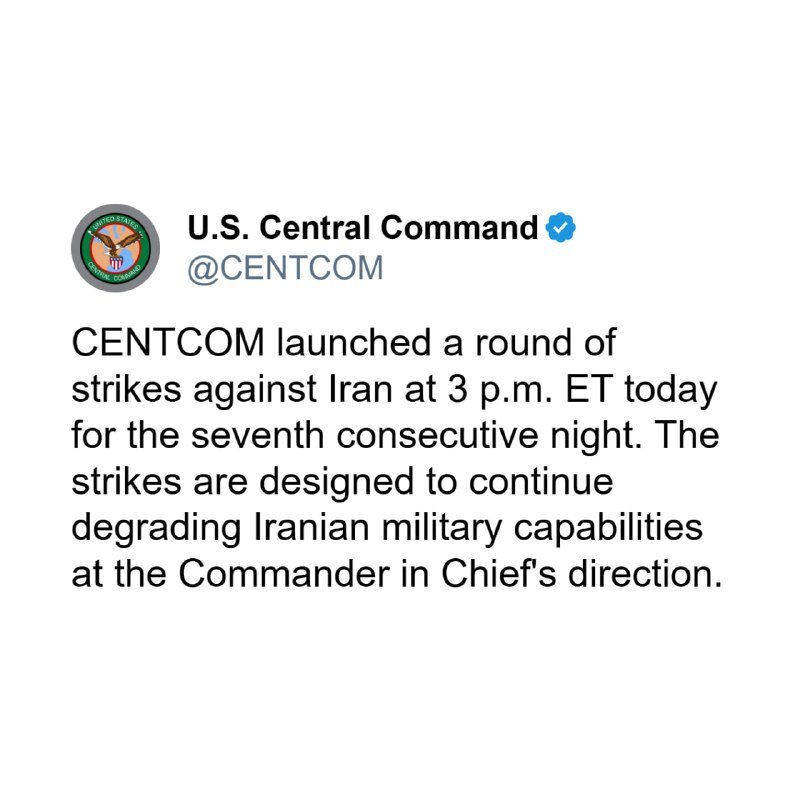
At 10 p.m. ET on 14 July 2026, U.S. Central Command completed what it called an additional round of strikes against Iran, hitting what it described as dozens of military sites across a seven-hour window. The targets, per a CENTCOM release relayed by OSINTdefender on Telegram at 02:33 UTC on 15 July, included missile and drone installations, naval capabilities and coastal-defence positions, mostly across southern Iran. Within minutes of the release, two independent channels, War Footage Witness and RN Intel, both flagged a small additional wave of strikes inside that same operating picture.
Theatre-level reporting from the wire is thin. Three Telegram-based intelligence feeds, OSINTdefender, War Footage Witness and RN Intel, carry the CENTCOM framing almost verbatim. None of them provides on-the-ground confirmation, geolocated impact footage, Iranian casualty figures, or identification of the specific facilities hit. What the public can verify in the first hours after the event is, in effect, the U.S. characterisation of the U.S. operation. That asymmetry is the story.
What CENTCOM says, and how it is moving
The CENTCOM statement, as carried by OSINTdefender at 02:33 UTC on 15 July, describes a "7-hour long tranche of strikes" that hit "dozens of Iranian targets." Those targets are itemised in three buckets: missile sites, drone sites, and naval and coastal-defence assets. War Footage Witness relayed the same release at 02:13 UTC and 02:15 UTC, using near-identical language, which suggests all three channels are working from a CENTCOM-supplied text rather than independent reporting. RN Intel's 02:14 UTC post adds a tactical observation: a small additional wave of strikes had been observed in southern Iran in the prior thirty minutes, but it is not clear from the post whether that wave was a continuation of the announced tranche or a separate event.
The first-order reading: the United States has now conducted multiple rounds of strikes against Iranian military infrastructure in short succession, and the public framing of the operation is being managed almost entirely through a single U.S. military command, transmitted by a handful of Telegram channels with Western-centric followings. Iranian state media have not been sighted in the available thread materials; the official Iranian response is not yet part of the public record we can verify. That absence is itself a constraint on the story.
What we verified, and what we could not
A short, honest ledger. The pipeline ran against the four thread items, all of them Telegram posts from 02:13 to 02:33 UTC on 15 July 2026, all of them carrying CENTCOM's release as their primary source.
Verified.
- The strikes were completed at 10 p.m. ET on 14 July 2026, per CENTCOM's own release.
- The strikes spanned a seven-hour window.
- The named target categories are missile sites, drone sites, and naval and coastal-defence facilities.
- A second, smaller wave of strikes was observed in southern Iran in the half-hour preceding RN Intel's 02:14 UTC post on 15 July.
- Three channels, OSINTdefender, War Footage Witness and RN Intel, carried the story in a 20-minute window, with overlapping, near-verbatim text.
Could not verify from these sources.
- The number of individual targets struck (CENTCOM uses "dozens," which is a category, not a count).
- The specific facilities, bases or installations hit, or their geographic coordinates.
- Iranian casualties, military or civilian.
- Damage assessment, or which targets were destroyed versus suppressed.
- The Iranian government's official response, whether diplomatic, military, or both.
- Whether the operation was unilateral or coordinated with Israel, given the absence of any Israeli-source item in the thread.
- Whether prior rounds of strikes preceded this one, though CENTCOM's reference to an "additional round" implies they did.
This is a thin base from which to draw a national-security conclusion, and the article draws none.
The structural frame: an American theatre, narrated by American sources
There is a pattern to how U.S. military action against Iran is being delivered to the public. The wire service, in this case, is not Reuters or AP. It is CENTCOM itself, distributing a release that is then lifted into the open-source channel ecosystem by accounts with large followings. The result is a coverage layer in which every claim about what was struck, where, and why originates with the actor doing the striking. Independent verification, satellite-imagery confirmation, or third-party geolocation would, in a more conventional reporting environment, have followed the announcement within hours. As of the latest thread item, at 02:33 UTC on 15 July, none of that is on the wire yet.
The deeper point is that when a strike package is publicly narrated primarily by the side that launched it, two distortions follow. First, the target set is described in the language of the attacker, which makes escalation management a one-sided editorial choice. Second, the absence of Iranian state-media reporting in the immediate aftermath is read as silence, when in practice it reflects a slower publication cycle on the Iranian side, not an absence of facts. The public ends up knowing what the U.S. wants them to know, in the order the U.S. wants them to know it.
The stakes, in concrete terms
If the trajectory continues, three things follow within a window of days. The first is operational: every Iranian missile, drone, naval and coastal-defence site that is struck is a target set that, if Iran chooses to retaliate, it can no longer use. The strategic value of pre-emptive neutralisation is the entire logic of a strike package, and CENTCOM's categorisation of targets is consistent with a campaign aimed at degrading Iran's ability to project force rather than signalling. The second is diplomatic: the lack of visible Iranian state-media response, as of the thread's last item, leaves the diplomatic floor un-tested. A response, when it comes, will define whether this is treated as a concluded operation or the opening of a longer exchange. The third is informational: until independent geolocation, casualty reporting, and Iranian-side accounts enter the public record, the war's first hours will belong entirely to the side that struck. That is a temporary condition, not a permanent one, and the next 24 to 48 hours will determine how long it lasts.
What is not yet visible is the most consequential variable: whether Iran treats the 14 July tranche as a discrete episode or as one more step in a campaign it intends to answer. The sources do not specify. They also do not name any Israeli coordination, which is a gap, not a conclusion. Until Iranian state media and independent open-source investigators place specific coordinates, casualty counts, and target identifications into the record, the public will be reading the U.S. military's own description of its own operation, and the most important parts of the story will remain unwritten.
Desk note: Monexus ran this against four Telegram-sourced items, all centred on a single CENTCOM release. We published the lead at face value on the timing, duration, and target categories, all directly attributable to CENTCOM's statement. We did not extrapolate on casualty figures, target coordinates, Israeli coordination, or Iranian response, none of which appear in the available sources. Where a wire desk might have reached for context, we held back; the operational record is too thin to do more.
Wire provenance
This editorial synthesis draws on the following public wire/social posts:
- https://t.me/s/osintlive
- https://t.me/s/wfwitness
- https://t.me/s/wfwitness
- https://t.me/s/rnintel