Argentina's flag, England's wound, and a World Cup final nobody can ignore
After Argentina's players unfurled a 'the Malvinas are Argentine' banner in the World Cup semi-final, the 155-year sovereignty dispute followed them to Spain's doorstep, and Sunday's final inherits a political freight no one on the pitch can lift.
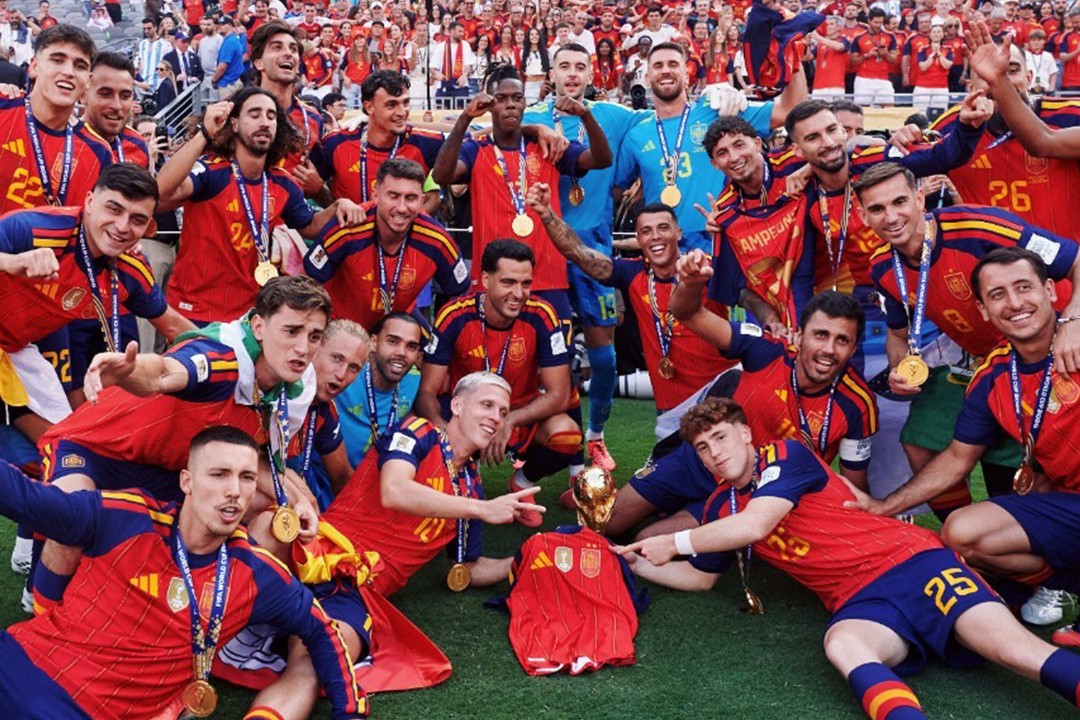
At 21:34 UTC on 15 July 2026, a sports wire carried three identical dispatches inside five minutes: Argentine players had draped a banner reading "the Malvinas are Argentine" over the stadium hoardings minutes after their side's semi-final victory over England, and Argentina would face Spain in the World Cup final on Sunday. The banner was a flashpoint before the confetti had been swept away, and by Wednesday night the wire had reproduced it three times without adding a single new line of context. The repetition, not the slogan, is the news.
The thumbnail of a stadium celebration has reopened a 155-year sovereignty dispute just as Argentina prepares to walk out at the 2026 final. Spain is the inconvenient host of that argument: a co-belligerent of the lost cause in the 19th-century, a neutral bystander today, and a country whose own secessionist movements, in Catalonia and the Basque Country, sit uneasily close to the script. The match will be played; the geopolitics has already kicked off.
A banner the cameras couldn't crop
The flag-bearing followed the same choreography that has played out at Argentine sporting events for at least two decades. Win a fixture of consequence against England, unfurl something claiming the archipelago, let the broadcast cut away, and wait for the diplomatic notes to follow. Argentina's Football Association has historically defended the practice as a political statement rather than a provocation, a position consistent with Buenos Aires's constitutional claim to the territory and its standing United Nations position that the dispute be resolved through bilateral negotiation. The English FA has historically condemned the gestures as politicising sport.
What is different in 2026 is the venue. Spain is not a neutral stage for this argument. Madrid was the metropolitan hub of the Spanish Empire that lost the Malvinas archipelago to Britain in 1833. Argentine public discourse still commemorates the 1982 military effort to recover the islands as a long-thwarted national cause rather than a junta's gambit; the veterans' centre in Buenos Aires is a block from the football association's headquarters. Whichever way the federation reads the room on Sunday, it reads it in a country whose flag was once flown over the territory in question.
Spanish political reaction is the variable the wire has not yet filed. The federation's governing bodies, FIFA and UEFA, have historically treated on-pitch political displays with discretionary sanctions, fines for breaches of equipment regulations, bookings for unsanctioned insignia, quiet rulings from disciplinary committees that rarely surface outside the sporting press. Whether Spain's football authorities request a pre-final briefing, or whether the wider political class uses the moment to triangulate its own grievances, will shape how the footage travels.
The 155-year bill
The fundamentals have not moved. Britain has administered the islands continuously since 1833, except for the ten-week Argentine occupation of 1982. Argentina has never recognised that administration and continues to press its claim through the UN's Special Committee on Decolonisation, the most recent iteration of which reaffirmed the "question of the Malvinas Islands" as a non-self-governing territory awaiting decolonisation through bilateral talks. London describes the islands simply as the Falkland Islands and considers the matter closed. The populations on both sides of the dispute remain immovable in their respective majorities, around 3,500 islanders who vote overwhelmingly to remain British, an Argentine population for whom the cause is constitutional and inextricable from national identity.
The banner does not move that dial. But it does test the patience of the hosts, and it does reintroduce an issue onto a stage whose commercial logic depends on issues staying in their boxes. Argentina's footballers are political actors who know what the cameras will catch; the rest of the federation is a political actor trying to keep those catches from costing points.
What Spain inherits
Spain brings its own unsettled map. Catalan independence parties hold meaningful seats in the regional government and have, in recent memory, tested the constitutional court. Basque separatism is dormant rather than defunct. Madrid's posture on sovereignty is firm, but its position on foreign-territorial disputes is shaped by neighbours who read it carefully. Hosting a final between two teams, one of which will arrive with banners demanding a piece of another country's overseas territory, is a logistical complication FIFA would have preferred not to purchase.
The final will also test the Spanish federation's tolerance in real time. Match protocols require the host association to deliver a clean fixture, which historically has meant pre-game briefings to both camps on display rules. If the Argentine camp comes back asking whether banner politics will be tolerated inside the stadium, the Spanish federation will have to choose between the procedural answer and the political one. There is no comfortable middle.
The angle nobody can plan for
The interesting question sits with the camera. The 2026 tournament's broadcast infrastructure is the most surveilled in the sport's history; every frame is reviewed in near-real time for compliance with FIFA's commercial and political-display rules. A banner that survives ninety seconds in the lower deck is a banner a hundred broadcast partners have to choose whether to show. Decisions on what to air get taken in broadcast trucks by producers working from a rule book FIFA redrafted after the 2022 Qatar cycle. Argentina's players know this. The federation knows this. The choice to unfurl anyway is a measurement.
The rest of the night will run on the choreography of football: line-ups, anthems, substitutions. The politics has already been filmed. Sunday will only be a question of whether anyone in Madrid decides to call a foul.
Wire provenance
This editorial synthesis draws on the following public wire/social posts:
- https://t.me/s/BellumActaNews
- https://en.wikipedia.org/wiki/Falklands_sovereignty_dispute
- https://en.wikipedia.org/wiki/2026_FIFA_World_Cup
- https://en.wikipedia.org/wiki/United_Nations_Special_Committee_on_Decolonisation