Baghdad on Pennsylvania Avenue: What Trump's Iraqi bet actually trades away
A White House meeting between Trump and Iraq's new prime minister frames the militias question as a transactional oil swap. The disarmament arithmetic on the ground tells a different story.
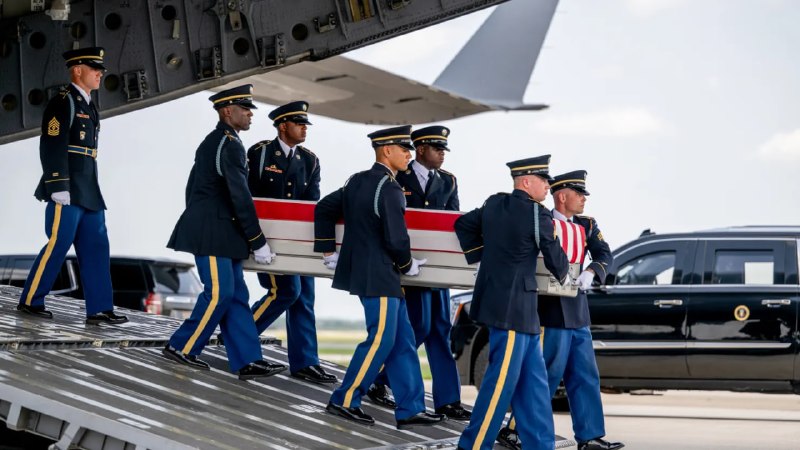
At 16:00 UTC on 14 July 2026, a sitting US president leaned into a bank of cameras and described a foreign head of government as "young and handsome" before pivoting, in the same breath, to the proposition that America would soon be "taking out a lot of oil" from that man's country. The guest was Sudani-era Iraqi political figure Mohammed Shia' al-Sudani's successor; the venue was the White House; the transaction on the table, by every read of the day's reporting, was the disarmament of Iran-aligned militias inside Iraq, paired with a renegotiation of the American military footprint that has held the country's airspace open since 2003.
The optics are easy to mock and the policy underneath is harder to dismiss. The Trump administration's pitch to Baghdad boils down to a swap: Iraqi politics can settle its Iran problem on its own terms, the residual US troop presence shrinks, and the Iraqi state collects oil revenue on terms it has not seen since 2014. The Iraqi counter-pitch, delivered in real time by the same news cycle that carried Trump's "young and handsome" aside, is that militias do not disarm because a foreign president wishes them to. The day of the meeting, the armed factions inside the Popular Mobilisation Forces were already publicly pledging partial rollbacks; privately, as reporting across Iraqi outlets and Western wires has long established, the calculus inside Kata'ib Hezbollah, Asa'ib Ahl al-Haq, and the Badr Organisation turns on Iranian resupply lines through Syria and on Iraqi state salaries, not on White House messaging.
The bargaining chip that is not for sale
Trump told reporters on 14 July that "we don't think we need the military there anymore," framing the drawdown as a gift rather than a concession. That framing flatters the Iraqi government and conceals the actual strategic asset the United States is offering. Iraq's central bank still routes its dollar transactions through the Federal Reserve; Iraqi airspace is still patrolled by US and coalition aircraft operating out of Al Asad and Erbil; Iraqi intelligence sharing on ISIS remnants flows through the Combined Joint Task Force. None of that infrastructure disappears when a brigade rotates home; it is renegotiated, and the price of renegotiation is exactly what Trump and al-Sudani spent the day arguing over.
Deutsche Welle's 14 July morning brief on the meeting identified the disarmament of Iran-allied militias as the headline agenda item, and noted that some factions had already publicly pledged to surrender weapons ahead of the visit. The reporting flagged the obvious gap: public pledges from militias under Tehran-aligned patronage have, in the past three Iraqi political cycles, been followed by private weaponisation. The Hashed al-Shaabi umbrella was formally absorbed into the Iraqi state in 2016 and 2017; the same organisations have continued to operate paramilitary wings outside state chain of command. Iraq watchers across the spectrum, from the Atlantic Council to the Iraqi Communist Party, treat the integration decree as a paperwork event, not a disarmament.
The oil framing, decoded
Trump's oil remark is the lever. Iraq produces roughly 4.3 million barrels per day under OPEC+ quotas; the Iraqi state budget is functionally a hydrocarbon revenue distribution formula with a small public sector attached. When an American president says "we're going to be taking out a lot of oil," the verb matters. The most charitable read is that the US is offering Iraqi crude preferential access to US Gulf Coast and Asian refiners, in exchange for the political cover Baghdad needs to confront the militias. The less charitable read is that the US is signalling to Baghdad, Tehran, and the OPEC+ secretariat that Iraq's quota will be adjusted to favour American downstream interests. Both reads circulate in Iraqi oil ministry circles; neither has been confirmed.
The geopolitical subtext is that Iran's military position has weakened dramatically in the four months preceding the meeting. Trump's 14 July statement that "Iran's military power is just a tiny fraction of what it was four months ago" and his claim that "they shot first, and that was a big mistake" set the rhetorical frame: the Iraqi militias are now negotiating from a position of weaker external sponsorship than at any point since 2014. Combined with Trump's separate warning that Iran would use a nuclear weapon "within one day" if it acquired one, the message to Tehran is that Iraqi militias cannot rely on Iranian resupply at anywhere near historic levels. Tehran's response, delivered through the same Telegram channels that carried Trump's quotes, has been to redirect some Iraqi militia funding toward political rather than military activity. The disarmament conversation, in other words, is partly being held in code.
Why Baghdad cannot deliver what Washington wants
The Iraqi state apparatus that al-Sudani's successor now leads was constructed, in its current form, around a sectarian power-sharing formula codified after 2003. The Iran-aligned blocs sit inside the governing coalition, not outside it. Asking the Iraqi prime minister to disarm those blocs in a single political cycle is asking him to dissolve his own parliamentary majority. There are two ways this normally resolves in Iraqi politics: a slow bribery-based co-optation that leaves the militias armed under new letterheads, or an armed confrontation that the Iraqi security forces are not currently configured to win.
The reporting from Deutsche Welle and from the Polymarket wire on 14 July both emphasised the formal agenda of the meeting as "disarming Iran-backed militias." Neither outlet's coverage suggests the Iraqi side offered a binding timeline. The most credible Iraqi commitments under discussion, per the briefing-style reporting that ran in the hours before the meeting, are: (a) a freeze on militia payroll for formations outside the formal Popular Mobilisation Authority roster, (b) a partial redeployment of the most visible Iran-aligned units away from the Green Zone perimeter, and (c) an agreement in principle to allow International Atomic Energy Agency access to sites formerly inspected under the 2015 Joint Comprehensive Plan of Action framework. None of those commitments constitute disarmament; all of them could be reversed inside an Iraqi cabinet reshuffle.
The structural problem is that Iraq's militia economy is not separable from its political economy. The Popular Mobilisation Forces employ somewhere on the order of 150,000 personnel, control parallel infrastructure projects across Shia-majority governorates, and sit on the boards of multiple Iraqi banks that have been sanctioned for dollar-laundering concerns by the US Treasury in prior years. Disarming them means taking apart a patronage network that runs through the Iraqi judiciary, the Iraqi Ministry of Interior, and the commercial banking sector. That is a generational undertaking, not a single meeting on Pennsylvania Avenue.
What the Trump deal actually moves
If you strip the rhetoric, the meeting delivered four things on 14 July 2026. First, an Iraqi prime minister publicly committed to disarming Iran-aligned militias, with no binding timetable and no specified verification regime. Second, Trump announced a drawdown of US forces inside Iraq, the pace of which remains to be negotiated. Third, Iraq received an implicit US oil-access commitment in exchange for steps one and two. Fourth, Tehran received a signal that its Iraqi proxy network can no longer count on Iranian resupply at historic volumes.
Each of those moves can be reversed. The drawdown can be paused. The oil access can be conditionalised. The disarmament pledges can stall. The signal to Tehran can be countermanded by a single Iranian drone strike on a US position in eastern Syria. What cannot be reversed, if the meeting produces a written framework, is the precedent that the Iraqi state has formally accepted that Iran-aligned militias inside Iraq are a problem the Iraqi state is responsible for solving. That admission, however unenforceable in the near term, is the political asset Trump walked away with. Whether the Iraqi state can convert the asset into action is a question that will be tested in the next Iraqi budget cycle, not the next White House press conference.
Desk note: Monexus frames the Trump–al-Sudani meeting as a transactional negotiation, not a strategic pivot. Western wire coverage led with the disarmament agenda; Iraqi and Iran-aligned Telegram channels led with the oil language and the troop drawdown. We treat the meeting as the opening move of a longer bargaining sequence whose outcome will be measured in Iraqi budget cycles, not press cycles.
Wire provenance
This editorial synthesis draws on the following public wire/social posts:
- https://t.me/ClashReport
- https://t.me/ClashReport
- https://t.me/ClashReport
- https://t.me/ClashReport
- https://t.me/ClashReport
- https://t.me/ClashReport
- https://t.me/ClashReport
- https://x.com/polymarket/status/
- https://x.com/polymarket/status/