A giant bird on a Melbourne bridge, and the question of who gets to keep it
Days after police arrested the artist behind a giant bird painted on a Melbourne bridge, a debate over preservation has split residents, officials and the city's street-art establishment.
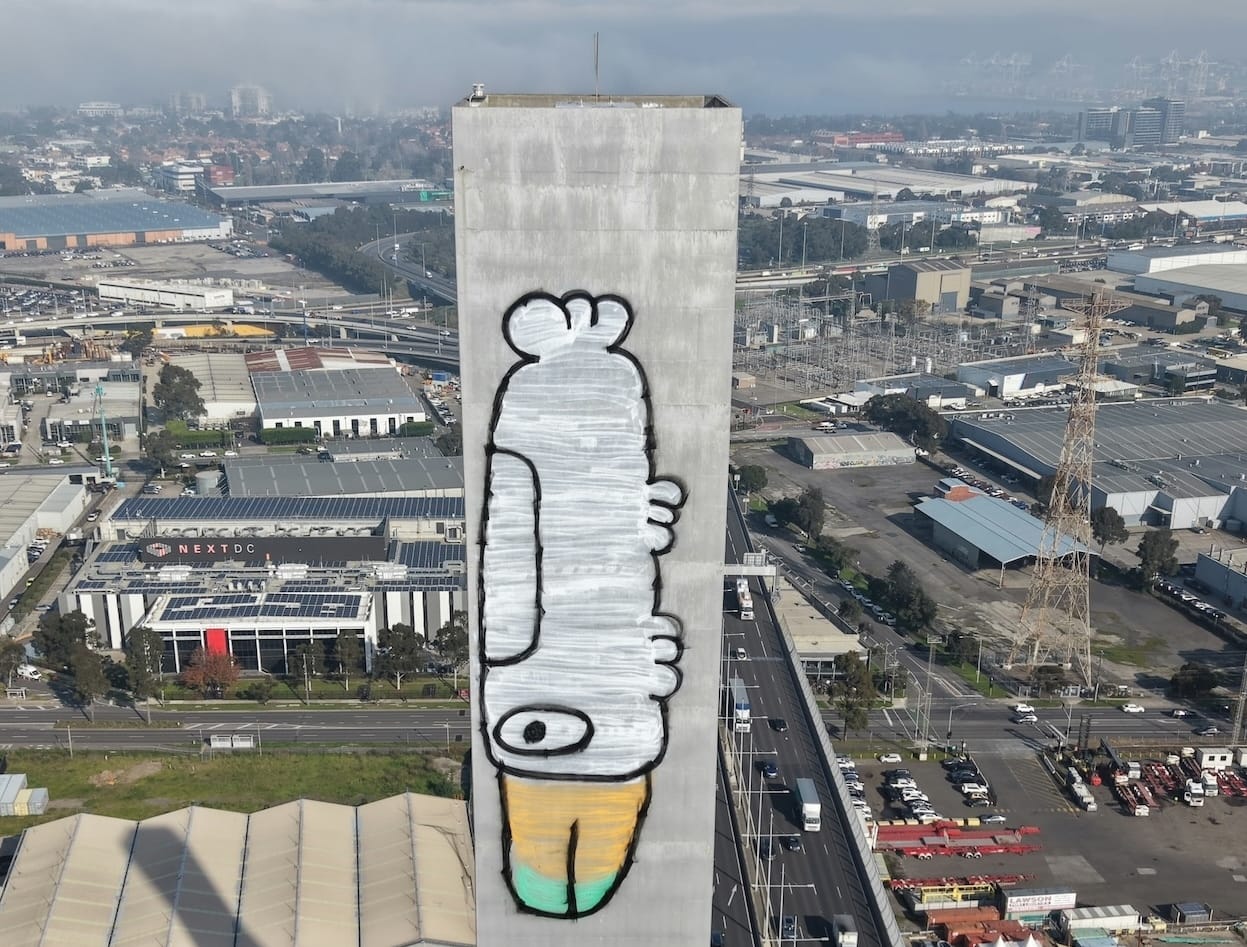
The tags went up before dawn, somewhere in Melbourne, on the vertical concrete of a bridge support that the city had spent years trying to forget. By the time commuters crossed the Yarra on the morning of 10 July 2026, a single enormous bird, long beak, flat head, cartoon eyes, stared back at them from roughly the height of a six-storey building. Within days, the artist had been arrested, and a quieter, stranger argument had begun: should the city keep the bird, or scrub it?
The dispute, reported by Hyperallergic on 13 July 2026, is the latest round in a long-running fight over who owns the visual surface of a city. Melbourne has, for two decades, sold itself as the street-art capital of the southern hemisphere, with council-funded laneway commissions, Hosier Lane as a tourist magnet, and a graffiti-management industry that blends tourism marketing with rapid paint-overs. The new bird, known colloquially as "Pam the Bird" after the artist's recurring avian alter-ego, sits at the awkward intersection of those two Melbournes: the curated, marketable one, and the unsanctioned one that tends to be wiped.
The arrest, and the speed of it
The artist behind the bird was taken into custody days after the piece appeared, according to Hyperallergic. The pace of the arrest matters. Tags in central Melbourne routinely survive weeks before being buffed; larger pieces on rail corridors and arterial bridges are typically removed by contracted cleaning crews rather than escalated to criminal charges. The decision to arrest, rather than simply paint over, signals that the bridge in question was treated from the outset as critical infrastructure rather than as wall space.
That framing is doing a lot of work. Bridges in the road-and-rail sense are governed under state transport statutes that treat graffiti as vandalism regardless of artistic merit, and that impose heavier penalties for work on structural elements than for tags on a private wall. The bridge operator has not, in the reporting so far, commented publicly on whether the bird was painted on a structural surface or on a non-load-bearing support tower, but the enforcement choice, arrest rather than cleaning, reads as a position: this is not a canvas, this is a piece of public infrastructure, and we will defend it as such.
The case for keeping it
A petition circulating among Melbourne residents, and reported on by Hyperallergic, argues that the bird should be preserved, sealed under anti-graffiti coating, fenced off if necessary, and treated as a fait accompli. The reasoning is partly aesthetic: a six-storey bird is a visual event on a flat city skyline, and Melbourne's identity as a street-art city depends on tolerating exactly this kind of bold gesture. The reasoning is also partly cynical: the artist has now been charged, the work is famous, and removing it removes the only evidence that the arrest was about something more than maintenance.
There is a precedent, of sorts, for keeping what was not meant to be kept. In 2024, a large paste-up in Collingwood that depicted a local football figure survived an initial removal order after a community campaign argued, successfully, that the work had become a landmark faster than the council could buff it. The Pam the Bird case is being pitched by its supporters as the same logic at scale: if the city is prepared to monetise Banksy lookalikes and stencil pieces in Hosier Lane, it should be intellectually consistent about a work that has done more for the skyline in a week than most commissioned murals manage in a decade.
The case against
The case for removal runs along three tracks, only one of which is purely aesthetic. The first is structural: bridges carry load, and any paint system, however benign, alters how concrete weathers, how water sheds, and how inspectors read a surface. Transport authorities have a defensible institutional interest in not allowing their assets to become canvases, regardless of how good the work is.
The second is precedent. If this bird stays, the next one stays, and the one after that. The argument that "this one is special" is the argument every tagger makes; the city's counter has always been that taste cannot be the gatekeeper of what is permissible on public infrastructure. The third is more pragmatic and more uncomfortable: the artist has been charged, and preserving the work effectively converts a vandalism case into a curatorial one. The legal system would then be asked to validate a piece of evidence it was about to prosecute.
What it really is
Strip away the bird and the dispute is a familiar one about who has standing to write on a shared surface. The Western art-world framing, graffiti as vernacular expression deserving of curatorial patience, collides with the property-and-infrastructure framing that treats any unauthorised mark on a public asset as a defect to be corrected. Melbourne has spent twenty years trying to have it both ways: a council-managed street-art trail for the visitors, and quick-dry paint for everyone else. The Pam the Bird controversy is what happens when a piece that nobody commissioned, and that nobody can ignore, lands on the wrong surface at the right scale.
The contest that follows will probably be decided not by the art establishment or by the graffiti community but by the bridge operator's lawyers. If they paint over, the work becomes a rumour. If they preserve it under glass or coating, the city has quietly admitted that the wall was always a canvas. The artist, in the meantime, has the thing most street artists want and few keep: a visible arrest, a visible work, and a public argument about whether they should still be there.
How Monexus framed this: the wire story leaned on the novelty of the preservation petition; this piece pulls back to the structural question, who governs the surface of a city, and under what statute, which the Hyperallergic piece leaves implicit.
Wire provenance
This editorial synthesis draws on the following public wire/social posts:
- https://t.me/hyperallergic/2808961073