IRGC claims third-wave strikes on Persian Gulf targets in widening "Promise 2" operation
Iran's Revolutionary Guards say Navy and Aerospace Force units destroyed weapons warehouses, ship and aircraft parts, and an MQ-9 drone launch ramp in a third wave of "Operation Promise 2," as Gulf reporting remains dominated by Iranian state-aligned channels.
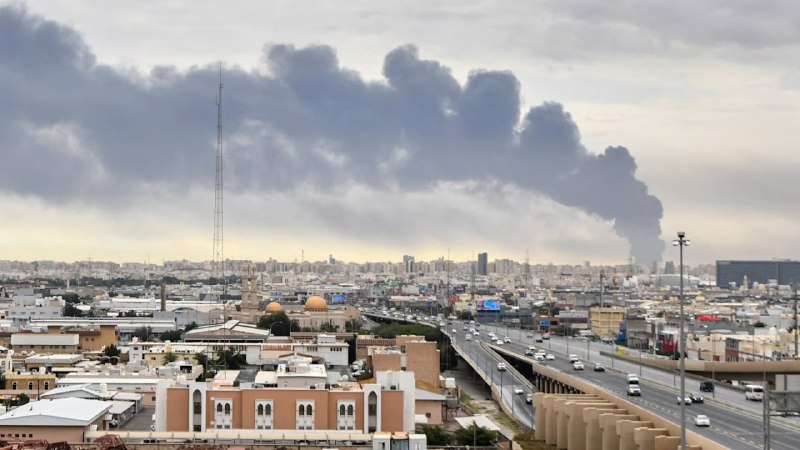
At 18:48 UTC on 14 July 2026, the public-relations office of Iran's Islamic Revolutionary Guard Corps told Iranian state-aligned outlets that a third wave of simultaneous missile and drone strikes had hit targets including weapons-storage warehouses, ship and aircraft parts depots, and what it described as a launch ramp for MQ-9 unmanned aircraft. The announcement, distributed through Al-Alam Arabic, Tasnim English, and PressTV within minutes, framed the strikes as a joint IRGC Navy and IRGC Aerospace Force operation under the banner of "Promise 2."
The corpus of claims is Iranian, by Iranian, for an Iranian record. Read together, they describe a campaign now in its third declared wave inside roughly twenty-four hours. Read against what is missing, they describe a public information environment in which Tehran controls the operative language and outside verification is thin. That gap is itself the story.
What the IRGC says it hit
The text of Announcement No. 10, distributed in English by Tasnim and in Persian to Al-Alam viewers, lists four target classes: storage warehouses for weapons; parts facilities associated with "enemy ships and aircraft"; the MQ-9 launch ramp; and, in PressTV's English version, "several warehouses" destroyed in a "simultaneous missile and drone operation." The framing language is the same across the three channels, a tell that the text originated from a single IRGC public-relations draft and was passed to aligned outlets for simultaneous release.
The targeting grammar is familiar. The MQ-9 reference points to U.S. remotely piloted aircraft, several of which have been shot down or have crashed in the wider Gulf theatre in recent years. "Enemy ships and aircraft" is the standard Iranian formulation for U.S. and allied naval presence in the Persian Gulf, the Strait of Hormuz, and the Gulf of Oman. No coordinates, unit numbers, satellite imagery, or independent on-the-ground reporting appeared alongside the announcement. No claims of casualties, on either side, were issued.
The information stack, top to bottom
Three Iranian state-aligned channels carried the announcement inside a four-minute window: Al-Alam at 18:48 UTC, Tasnim English at 18:52 UTC, PressTV at 18:52 UTC, with Tasnim posting a follow-up clarification at 18:56 UTC. The sequence, the identical wording, and the absence of any non-Iranian sourcing in the cluster are the operation's second deliverable, after whatever physical effect the strikes produced.
Western wire services have not, in the materials available to this publication as of writing, carried on-the-ground confirmation of the specific targets. The implication is not that the strikes did not happen; the IRGC has a documented history of strike claims, and Iranian-aligned reporting in past rounds has tracked closely with damage assessments later produced by independent analysts. The implication is that the public record, at the moment the third-wave announcement dropped, is the IRGC's alone. Damage assessment from Western or Gulf state sources, satellite-firm overlays, and any U.S. Central Command acknowledgement are the verification instruments that would convert a claim into a fact.
What "Promise 2" implies, in plain language
The naming of the operation is itself a payload. The original "True Promise" was the IRGC's April 2024 missile and drone operation against Israel; "Promise 2" extends that brand into the maritime Gulf theatre. Branding matters in the architecture of deterrence: it signals to regional audiences that the same force, the same command, and the same escalatory logic that struck Israeli territory is now being applied to a different geography, a different set of targets, and a different audience.
In the broader pattern of the region's recent months, this is the third front opened by Tehran in close succession: a maritime and coastal infrastructure campaign aimed at the same general class of targets, MQ-9 launch infrastructure and naval logistics, that Israel struck inside Iran in October 2024 and again in June 2025. The U.S. footprint in the Gulf, the maritime logistics that underpin it, and the drone-launch capacity that has probed Iranian airspace are the connective tissue. Tehran's claim, stripped of the IRGC voice, is that those are now all on the same target list.
What stays uncertain
The press releases do not specify location. "Enemy ships and aircraft parts" could mean facilities in a U.S. base in Qatar, Bahrain, Kuwait, or the UAE, or it could mean forward-deployed stocks aboard vessels in the Gulf of Oman. The MQ-9 ramp reference could point to a specific airfield, or to a hardened dispersal site the IRGC has long claimed to have under surveillance. Without coordinates, the geography is a variable the IRGC has chosen to keep open.
It is also worth naming what is not in the announcements: no claim of casualties, no claim of a specific U.S. or allied response, no claim of interception, and no claim of a fourth wave. The press stack is calibrated for messaging, not for accountability. A reader building a picture of the situation from these sources alone is reading a press release, not a battle damage assessment. The plausible alternative reading, that the IRGC is using strike announcements to shape regional perceptions ahead of diplomacy that may be happening in parallel, sits alongside the reading that this is a kinetic escalation in real time. Both readings remain live until independent reporting closes the gap.
What the next twelve hours will tell is whether the announcement generates a U.S. or Gulf-state response that confirms the target set, or whether it sets a baseline the IRGC will build on, wave by wave, in the same branding template. The Monexus wire will track the next announcement in the series and any U.S. Central Command or affected-host-state read-out as those become available.
This article relies on Iranian state-aligned reporting and the IRGC's own public-relations output. The verification work, geographic precision, and casualty record remain with Western wire services, independent OSINT analysts, and host-nation statements that have not yet been published.
Wire provenance
This editorial synthesis draws on the following public wire/social posts:
- https://t.me/presstv/
- https://t.me/tasnimnews_en/
- https://t.me/alalamfa/
- https://t.me/tasnimnews_en/