Bandar Abbas rocked by strikes as US-Iran accord hangs over Geneva ceremony
Two airstrikes hit Iran's main Gulf port hours before Washington and Tehran were due to sign a peace accord in Geneva. The governorate reports no casualties; Iranian state media promises a supplementary toll.
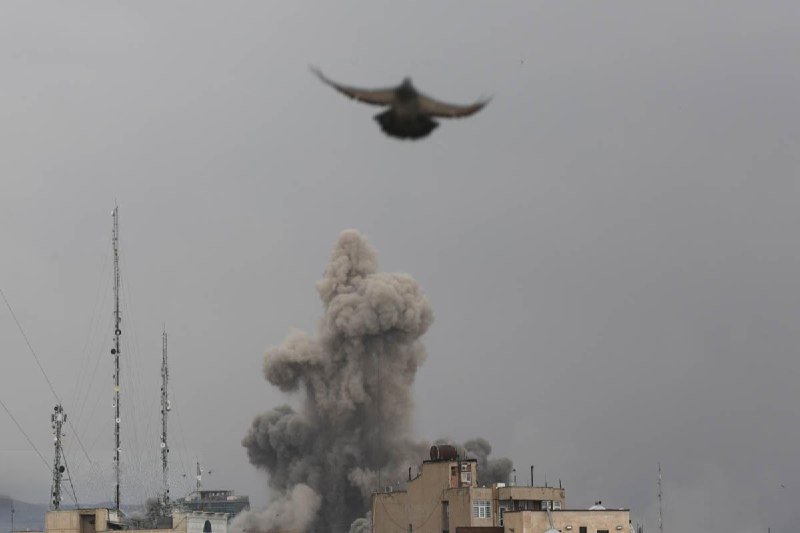
At 21:27 UTC on 14 July 2026 two airstrikes hit Iran's principal Gulf port of Bandar Abbas, the same city whose governorate minutes later insisted there were no casualties. Telegram channel @intelslava, monitoring open traffic on the Strait of Hormuz, posted the first alert at 21:27 UTC and tagged the round as "🇺🇸❌🇮🇷". Two minutes later, at 21:29 UTC, Iran's state-aligned Tasnim News Agency wrote that "another point was hit" and that a supplementary report would follow initial assessments. By 21:44 UTC, the Bandar Abbas governorate, relayed by Middle East Eye's live blog, was reporting no casualties from the dual strike. The timing is the story: the rounds landed fifteen hours before Washington and Tehran were due to put pen to paper on a peace accord in Geneva.
What the public record so far documents is a small, sharply targeted act of violence inserted into a much larger diplomatic choreography. If the governorate's first count holds, the human cost is zero. If the strike count is right and the casualty count climbs in Tasnim's "supplementary report," the diplomatic cost is something else entirely. Monexus is publishing what the wires and the governorate actually say, in that order, because the order itself is the news.
What the wires show, beat by beat
The chronology is unusually clean. At 21:27 UTC the @intelslava channel, which tracks shipping and incident traffic in the Persian Gulf, registered two airstrikes on Bandar Abbas and tagged them as US-on-Iran. At 21:29 UTC, Tasnim News Agency, the outlet closest to the Islamic Revolutionary Guard Corps press operation, confirmed a second impact in the same city: "a few minutes ago, another point was hit in Bandar Abbas." At 21:44 UTC, the Bandar Abbas governorate, paraphrased by Middle East Eye's live blog on the Geneva accord, said no casualties had been reported.
Three things stand out. First, the lag between the strike reports and the casualty denial is fifteen minutes, too short for a confirmed body count, exactly the right window for an initial reassurance. Second, the corroboration layer is thin: an open-source channel, an Iranian state outlet, and a governorate quoted on a Middle East Eye live blog. Third, the event is being framed inside an existing diplomatic frame, a US-Iran accord signing scheduled in Geneva, rather than as a freestanding escalation. The wires are not telling readers what was struck, what munition was used, or who fired. They are telling readers when, where, and roughly how loud.
The Geneva frame and the silence inside it
Middle East Eye's live blog frames the strikes inside the larger US-Iran accord signing scheduled for Friday in Geneva. The implicit argument: a kinetic event on Iranian soil, hours before a ceremony intended to close a chapter, has to be read against that ceremony. The reading the wires permit is narrow. They do not say the strikes were coordinated, retaliatory, accidental, or symbolic. They do not name the target. They do not name a US or allied command. They do not name Iranian casualties beyond a governorate-level "no casualties" count that the same governorate could revise within hours.
That silence is itself editorial content. Iranian state media, Tasnim in particular, is fluent in the genre of "supplementary report", a first count, a second count, and a third count, each correcting the one before. The pattern is common enough that careful readers treat an opening "no casualties" line as a placeholder, not a verdict. The structural pattern is familiar: an initial deniability window, then a fuller picture, then a political attribution. Monexus is recording the first window, not the last.
What we verified / what we could not
Verified from the public wires. That two airstrikes were reported on Bandar Abbas at or near 21:27 UTC on 14 July 2026. That the @intelslava channel tagged the action as US-on-Iran. That Tasnim News Agency, an Iranian state-aligned outlet, reported a second impact point at 21:29 UTC. That the Bandar Abbas governorate, as relayed by Middle East Eye's Geneva-accord live blog at 21:44 UTC, said no casualties had been reported. That the strikes occurred on the same calendar day as a planned US-Iran accord signing in Geneva.
Not verified, and not in the sources. The identity of the target inside Bandar Abbas. The munition class, origin, or operator. The number of impact points beyond Tasnim's reference to "another point." The casualty count beyond the governorate's opening "no." A second corroborating source on the US-on-Iran tag, which currently rests on a single Telegram channel. Any official statement from US Central Command, the Israeli Defense Forces, the Pentagon, the Iranian Foreign Ministry, or the office of the Geneva mediator.
Contested. The political reading. Middle East Eye's framing treats the strikes as a complication for the Geneva accord. Tasnim's framing treats them as an act of aggression against the Iranian homeland. @intelslava's framing treats them as a US-on-Iran action. None of those frames is independently corroborated by an official Iraqi, Saudi, Emirati, Omani, or Western-wire readout in the sources available. Monexus reports the frames and labels them as frames; the underlying facts are smaller than the framings admit.
The pattern underneath
Bandar Abbas sits on the Strait of Hormuz, through which roughly a fifth of seaborne oil moves on any given day. It is also home to a major naval base of the Islamic Revolutionary Guard Corps and to civilian port infrastructure that handles a meaningful share of Iran's container traffic. Strikes there, even symbolic ones, carry two kinds of signal. They demonstrate reach against hardened Iranian military infrastructure, a familiar message in the long US-Iran shadow war. They also raise the cost of any diplomatic settlement for Tehran's domestic audience, because an Iranian government signing an accord in Geneva within hours of being struck at home has to manage a base that reads the strikes as humiliation.
The structural pattern is older than 2026. Major-power deals between the United States and adversaries of varying intensity, Moscow, Beijing, Havana, have repeatedly been preceded or interrupted by kinetic events that the warring parties' own spokespeople later described as coincidences, misunderstandings, or third-party actions. The signalling theory is uncomplicated: even a deniable strike reframes the deal, because the deal's terms are now read against the strike. The Iranian counter-pattern is equally familiar: report no casualties first, correct the count later, frame the strike as foreign aggression, use the framing to harden the negotiating position. Friday's Geneva ceremony, if it goes ahead, will be conducted inside both patterns at once.
What to watch before Friday's signing bell
Three signals will determine whether the strikes were a complication, an interruption, or a spoiler. First, the revised casualty count. Tasnim's supplementary report is the next data point; a non-zero number changes the political weight of every subsequent wire. Second, an official attribution. If a US command, an Iraqi militia, an Israeli strike cell, or an unknown actor claims the action, the Geneva accord's scope changes. If no one claims, the strikes remain in the grey zone that both Washington and Tehran have used for years. Third, the ceremony itself. A signed accord, a delayed ceremony, an unsigned joint statement, and a walkout are four very different endings to a single Tuesday evening; the strikes have not yet decided which.
The most important fact about the next twelve hours is what is not yet in the wires. The strike count is two. The casualty count is zero. The diplomatic count, for all the ceremony due in Geneva, is still pending.
, Desk note: Monexus is logging the wires as they arrive and treating Tasnim's "no casualties" line as provisional. The story will be revised when the supplementary report lands.
Wire provenance
This editorial synthesis draws on the following public wire/social posts:
- https://t.me/Tasnimnews_en
- https://t.me/intelslava