Smoke over Manama: What we know about the fire at NSA Bahrain
Smoke rose over the U.S. Fifth Fleet headquarters in Manama before dawn on 13 July 2026. The cause is unconfirmed, but the symbolism is not.
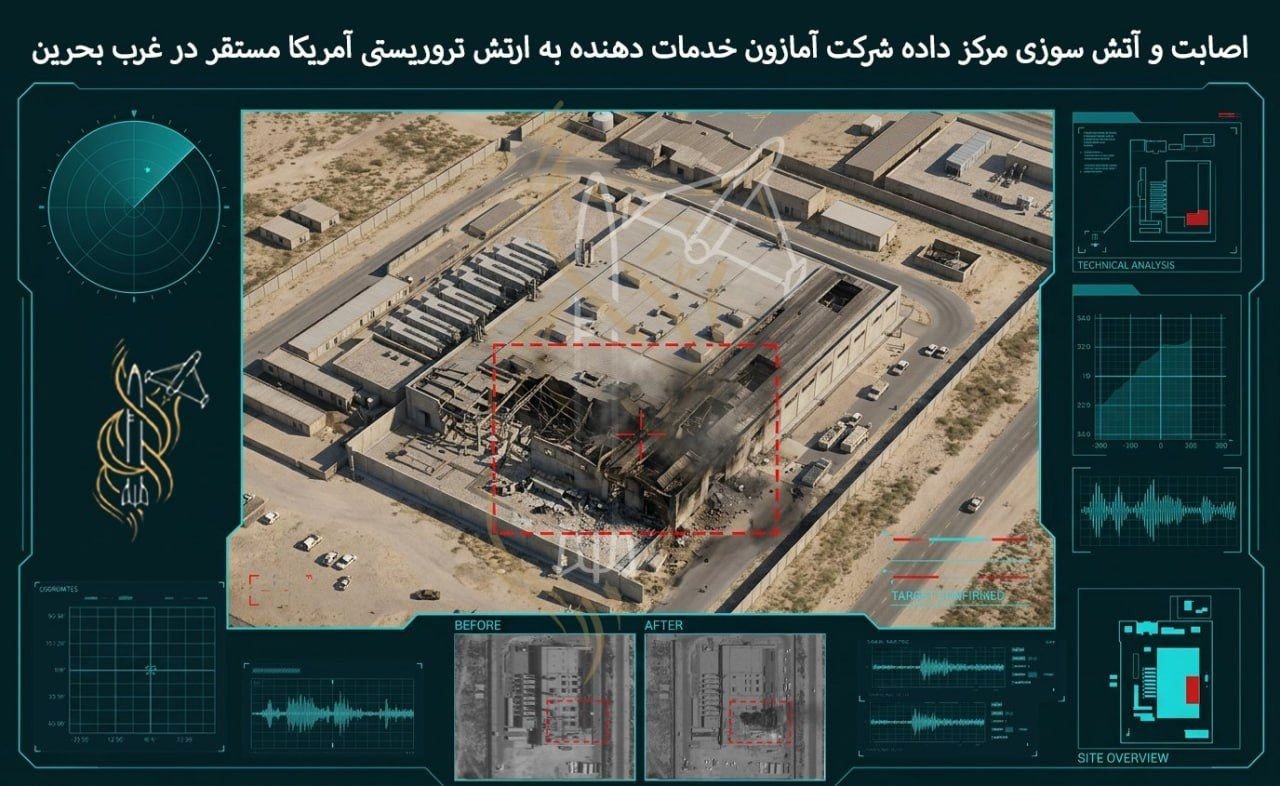
Columns of smoke rose over the U.S. Navy's Fifth Fleet headquarters in Manama in the small hours of 13 July 2026. Footage captured at Naval Support Activity Bahrain (NSA Bahrain) was relayed through at least four Telegram channels between 02:01 and 03:28 UTC, with OSINTdefender reporting that explosions had been heard near the base minutes before the plumes appeared. By 02:21 UTC, the OSINT aggregator intelslava was already posting aerial footage of a large grey-white column lifting off the installation. Within the hour, two further channels had corroborated the visual record: rnintel, citing its own prior reporting, and GeoPWatch, both carrying smoke footage that Monexus has viewed but cannot independently geolocate to a specific pier, runway or warehouse on the base.
What is being read as an attack on the operational hub of U.S. naval power in the Persian Gulf is, on the evidence so far, a fire whose cause has not been publicly established. The base did. The U.S. Fifth Fleet's forward headquarters is a single integrated site that runs maritime surveillance across the Strait of Hormuz, the Red Sea, and the wider Gulf, and Bahraini territory is the only place on earth from which that mission is run. Any sustained disruption at NSA Bahrain is, by definition, a disruption of the architecture the United States uses to watch Iran, the Houthis, and the shipping lanes that carry roughly a fifth of global oil. The Iranian-aligned Telegram channels that circulated the footage did so with directional arrows pointing one way. That framing is itself a piece of the story.
What the footage shows, and what it does not
The most widely circulated clip depicts a single thick column of smoke climbing in still air from what appears to be the interior of the base rather than from a perimeter road or an off-base industrial site. There is no visible ordnance detonation signature, no secondary flash, no fireball. The sound on the OSINTdefender recording, described as "explosions," cannot be corroborated against any acoustic reference and the channel itself does not specify how many detonations were heard or whether they came from inside or adjacent to the installation.
None of the five Telegram sources itemised here identify a specific building struck. None gives a casualty count. None names a weapon, an inbound projectile, a drone, a missile, or a sabotage vector. None of the posts cite an official U.S. Navy, U.S. Central Command, Bahraini Ministry of Interior, or White House statement. The visual evidence is consistent with a major industrial fire inside a fuel depot, a vehicle maintenance bay, a generator farm, or a waste-disposal site. It is also consistent with the early minutes of a strike. The footage does not, on its own, distinguish between those possibilities.
The earliest post in the cluster, from GeoPWatch at 02:04 UTC, predates the OSINTdefender recording by three minutes on the timeline of the thread; intelslava's footage post at 02:21 UTC then travels across the network in the form that the Middle East Spectator relay at 02:15 UTC used to build its own caption. This is a familiar pattern in the open-source ecosystem: a small number of original clips, copied, cropped, and rescreencapped, with attribution chains that obscure who shot first. The image is consistent; the sourcing pedigree is shallow.
Why the symbolism matters more than the cause
NSA Bahrain is not a symbolic target in the way the U.S. embassy in Beirut was in 1983 or the Khobar Towers housing compound was in 1996, but it sits in the same family of facilities: the place where U.S. military power is most concentrated and most exposed in the Gulf. The Fifth Fleet's area of responsibility covers roughly 2.5 million square miles of water including the Persian Gulf, the Gulf of Oman, the Red Sea, parts of the Indian Ocean, and three critical chokepoints. Hosting roughly 7,000 U.S. and coalition personnel at any given moment, the base is also the hub from which the International Maritime Security Construct, the U.S.-led coalition formed after a string of tanker seizures in 2019, was stood up.
The Iranian framing on Telegram is unambiguous. The directional flag combinations on rnintel, GeoPWatch and the Middle East Spectator post all read "🇮🇷❌🇺🇸🇧🇭," with the X positioned between Iran and the U.S./Bahrain pair. That is editorial annotation, not reporting, and it tells the reader how the channel wants the image to be read. It is not, on the available evidence, what the footage establishes. But the framing should not be dismissed as mere signalling. The point being made by the channels carrying the imagery is that the Gulf security architecture the United States maintains from Bahraini soil is, in this reading, an occupying infrastructure, and that any reduction in its operational capacity is, by definition, a service to the regional balance. That framing travels whether or not Tehran had anything to do with the fire.
The Bahraini government, for its part, has framed NSA Bahrain as a sovereign partnership. The base sits on land made available through a 1971 agreement that predates Bahraini independence and has been renewed through successive Manama governments. Bahraini outlets have historically treated the facility as a security guarantor against a more powerful neighbour rather than as a foreign occupation. The contrast between how Bahrain frames the base and how Iranian-aligned channels frame it is the contrast the article needs to make explicit.
The gap between what is being claimed and what can be verified
The honest position at 03:30 UTC on 13 July 2026 is this. A fire occurred, or is occurring, inside Naval Support Activity Bahrain. The visual record from at least two independent vantage points supports that. The cause is not established by the source material. Iranian-aligned Telegram channels are framing the event as an Iranian operation against a U.S.-Israeli-Bahraini target, with no sourcing beyond the image itself. There is no U.S. Navy, U.S. Central Command, Pentagon, or Bahraini government statement in the thread. There is no Reuters, Associated Press, Agence France-Presse, or BBC report. There is no claim of responsibility from any Iranian military or paramilitary outlet. There is no Iranian state media confirmation. There is, in short, a great deal of room between the visual fact and the inferred cause.
The relevant precedent is instructive. The 2019 attack on Saudi Aramco's Abqaiq and Khurais facilities was initially attributed to Iran within hours by Western officials on background, then walked back into "consistent with" language, then formally laid at the door of Iran by Saudi Arabia after a UN investigation, while Houthi-aligned channels claimed the strike from the start. The visual record in that case was also dramatic, the symbolic significance also obvious, and the gap between first impression and corroborated finding also large. The lesson is not that the early framing was wrong; it is that early framing and verified framing are not the same thing, and the difference matters when the target is the forward headquarters of a fleet that patrols one of the world's most volatile waterways.
What to watch over the next 24 hours
Three signals will move the needle from "unconfirmed fire" to "attributed incident." First, an official statement from U.S. Naval Forces Central Command, Bahraini Ministry of Interior, or the U.S. Embassy in Manama identifying the cause and any casualties. Second, an Iranian state-media line, whether from the Islamic Republic of Iran Broadcasting, the Islamic Republic News Agency, Tasnim, or the Foreign Ministry briefing in Tehran, that either confirms, denies, or conspicuously declines to address Iranian involvement. Third, any change in U.S. force posture, including commercial satellite imagery showing additional air defence activity, flight diversions out of Bahrain International Airport, or naval movements in the Gulf. None of those signals are in the source material Monexus has reviewed. All three are likely to arrive within the next 24 hours; the article will be updated as they do.
Until then, the basic facts are a fire inside a base, footage of which is moving through channels that have an interest in how it is read. The base's mission is to keep the sea lanes open from a country whose sovereignty is contested, and the silence out of Washington and Manama at the time of writing is the most informative data point of all.
Desk note: Monexus reports from Telegram channels with explicit sourcing caveats attached. Iranian-aligned OSINT channels are treated here as counter-claim material, not as a stand-alone factual basis, and we have flagged where the visual evidence does not support the editorial framing attached to it. The article will be updated as wire reporting becomes available.
Wire provenance
This editorial synthesis draws on the following public wire/social posts:
- https://t.me/intelslava
- https://t.me/Middle_East_Spectator
- https://t.me/GeoPWatch
- https://t.me/rnintel
- https://t.me/osintlive