Kenya's 15-billion tree pledge runs into the soil: 1.7 billion down, 13.3 to go
Nairobi's flagship greening drive has planted roughly 1.7 billion of a promised 15 billion trees in a decade. With seedlings dying, land rights tangled, and a funding gap widening, the headline ambition is colliding with operational reality.
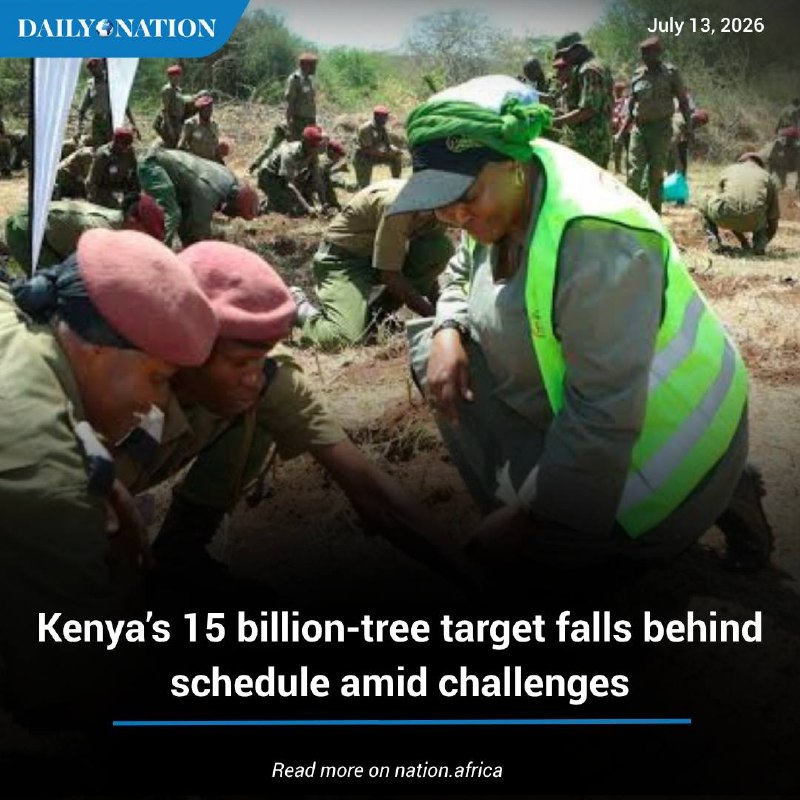
On a Monday in mid-July 2026, the Kenyan government's flagship environmental programme is somewhere between its ninth and tenth billion-tree press release and its first honest spreadsheet. The pledge, announced with the kind of ceremony that travelling climate envoys tend to draw, was to put 15 billion trees in the ground by 2032. The count so far, by the government's own mid-cycle reckoning reported on 13 July 2026, sits at 1.7 billion. The gap between target and tree is now the single most legible fact about Kenyan climate policy.
That gap is not a mystery. It is a logistics problem wearing a green jersey. The Daily Nation's reporting on 13 July 2026 details the operational reasons: seedling survival is patchy, land tenure is contested, the nurseries are underfunded, and the planting calendar keeps colliding with the dry season. The framing inside Nairobi has been that the country is mobilising. The framing on the ground, in catchment areas and county forest offices, is that the country is improvising.
The numbers, and what they actually mean
Fifteen billion trees in ten years, run as an annual cadence, is 1.5 billion a year. The cumulative figure reported on 13 July 2026 is 1.7 billion. By the most charitable read, the country is one year into a ten-year campaign and has produced roughly 1.7 billion trees' worth of effort. The arithmetic is unforgiving. To hit the original target, the planting rate has to roughly double from here, and do so on land that is already the subject of competing claims.
The credibility problem is not the number itself. It is the unit of accounting. A "tree planted" in government press releases is a seedling handed out at a chief's rally, a sapling in a polybag at a school grounds day, and a stem in a commercial plantation, and the survival rates for each are radically different. Until the ledger separates planted from surviving, the headline figure does the work of a slogan rather than a measure. The Daily Nation dispatch does not give a survival rate; the framing it provides is that logistical and operational challenges are the binding constraint, not political will. That is a more interesting admission than it looks, because it concedes that the bottleneck is execution, the part of climate policy that travelling delegations tend to skip over.
What the bottlenecks actually are
Three structural problems recur in any serious reading of Kenyan afforestation, and the Daily Nation piece surfaces all three in shorthand.
First, seedling supply. The nurseries that feed the campaign are largely county-government operations with thin budgets, seasonal labour, and a reliance on rain-fed germination. When the rains fail twice in a season, the seedling pipeline fails with them, and the next planting window ships empty polybags.
Second, land. The high-potential planting sites, the Mau, the Aberdares, Mount Elgon, the coastal hinterland, overlap with irregular settlements, grazing concessions, and parcels held under customary tenure that the state registry does not recognise cleanly. Planting on the wrong parcel, with the wrong customary holder, produces seedlings that survive the dry season and the goats. The political fallout travels up the county.
Third, post-planting care. Trees are not news once they are in the ground. A seedling that gets three watering runs in its first dry season is, by most forestry metrics, a tree. One that gets none is a stick. The campaign's funding flows heavily toward launch events; the recurring cost of weeding, watering, and firebreaks is the part that gets trimmed when the Treasury's quarterly ceilings bite.
There is a fourth problem the reporting does not name but that any operator will recognise: the accounting. Counting trees is harder than counting ballots. The methodology used to convert rallies, school events, and commercial plantations into a single national number is the place where the credibility of the entire programme lives or dies, and it is the place least often audited.
The climate-finance backdrop
Nairobi's tree campaign is not happening in a vacuum. It is one of the most visible pieces of a wider African push to convert the continent's forest and land-use potential into a flow of concessional climate finance, the carbon-credit architecture, the loss-and-damage facility, the bilateral deals on restoration. The trouble is that the same gap that haunts the headline tree count, survival, monitoring, verification, is the gap that determines whether a tonne of sequestered carbon is recognised by a buyer in Geneva or Frankfurt. Kenya's tree programme, in this sense, is not just a national project. It is a stress test for whether high-ambition tree pledges in the Global South can survive the dry season and an audit.
The structural read is simple. A pledge of this scale is a sovereign signal. It is meant to draw concessional capital, donor goodwill, and bilateral partnerships. The signal has worked: Nairobi has been a fixture of African climate diplomacy for two years. The conversion of that signal into trees in the ground is where the model breaks, and the break is most visible to the people whose counties host the seedlings.
What the wire is not yet saying
The Daily Nation reporting of 13 July 2026 is the most concrete open-source accounting of the gap, and it is careful to attribute the framing to operational and logistical challenges rather than to political collapse. The piece does not, at the length circulated by Telegram on the morning of 13 July, give a county-by-county breakdown, a survival rate, or an independent audit of the 1.7 billion figure. The number remains, for now, a self-reported one. The reporting the desk would want next is a verification: satellite-led canopy change against the planting claims, a financial audit of the nursery and seed-supply budget, and a per-county survival study from a body other than the implementing ministry.
What is already clear is the shape of the problem. Kenya is not failing to want to plant trees. It is failing to convert a high-ambition pledge into the unglamorous, recurring, ten-year operational discipline that a forest actually requires. The planting calendar is, in the end, a payroll calendar with seedlings attached.
Stakes: who wins and who loses
If the trajectory holds, the immediate winners are the headline-writers and the delegations. The 15-billion framing survives, the next climate week produces a fresh round of photographs, and the gap between target and tree is treated as an implementation detail. The losers are the catchments. The Mau keeps losing canopy. The rivers that depend on the Aberdares keep silting. The pastoralist households whose grazing is being formalised around a forest boundary keep absorbing the cost of a boundary that the seedling count cannot defend.
If the trajectory bends, the arithmetic changes. Roughly 1.3 billion trees a year for the remaining years of the campaign is the new baseline. That is achievable only with a serious restructuring of the nursery pipeline, a resolution of the land-tenure overlay in the high-value sites, and a financial commitment to the unglamorous middle of the tree's life. The next test is not the next planting season. It is the next dry season, and the next audit.
This article treats the Daily Nation's 13 July 2026 dispatch as the primary wire for the 1.7 billion figure, and reads the gap between pledge and planting as a logistics and governance story rather than a political one. The desk notes that the thread's second item, on the 13 July 2026 Zaporizhzhia shelling, is treated separately on the Europe desk; this article does not extrapolate beyond the Kenyan source material.
Wire provenance
This editorial synthesis draws on the following public wire/social posts:
- https://t.me/DailyNation