US strikes on Iranian border towns draw unverified reports across Telegram channels
Three Telegram channels operating in the open-source intelligence space reported US strikes on towns in Khuzestan Province within minutes of one another, with no corroborating wire confirmation at time of publication.
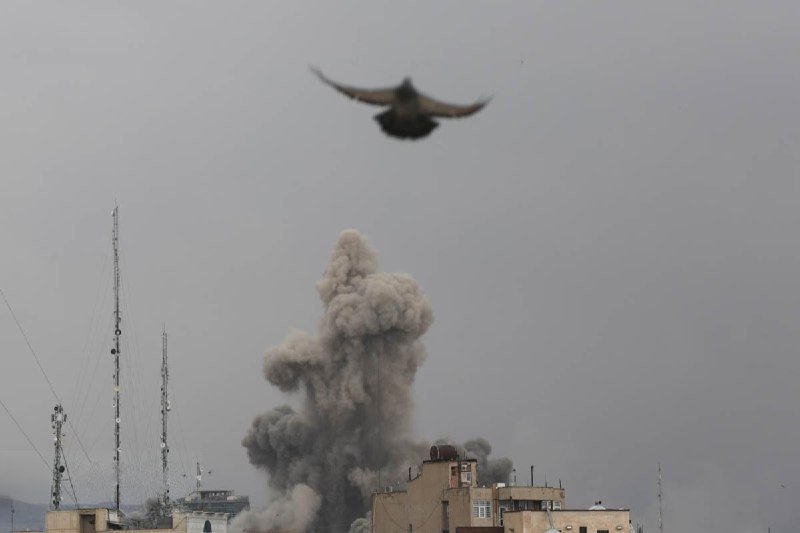
Three open-source intelligence channels broadcasting from Telegram reported simultaneous US airstrikes on towns in Iran's southwestern Khuzestan Province between 23:00 and 23:03 UTC on 12 July 2026, with no independent corroboration from a mainstream wire service available at the time of writing.
The reporting cluster is the kind of event Monexus watches closely because it sits at the intersection of two structural problems: the speed at which military-grade claims circulate before they are verified, and the difficulty Western news consumers have distinguishing between channels that aggregate claims and channels that verify them. What is on the wire this evening is not a confirmed strike; it is the visible architecture through which such claims now travel.
What the three channels reported
At 23:00 UTC, the channel @rnintel posted that "two US airstrikes" had hit the town of Saliyeh in Khuzestan Province, and that a separate "US attack on Susangerd" had taken place in the same province. Two minutes later, at 23:02 UTC, @intelslava carried a shorter message reporting "2x US Heavy airstrikes" against Saliyeh. At 23:03 UTC, @wfwitness posted about "explosions in Behbahan" with initial reports flagging Susangerd in the same province.
The three messages overlap on geography: all three name locations inside Khuzestan, a southwestern province bordering Iraq whose oil infrastructure and Arab-speaking minority population make it a politically distinctive corner of Iran. Two of the three (rnintel and intelslava) name the same town, Saliyeh. Two of the three name Susangerd. None of the three channels identify the source of the original reporting, the type of munition, or the target.
A reader looking for a single authoritative account at 23:00 UTC would not find one. What they would find, instead, is a triangulated signal: three independent posters describing events in the same small geography inside a three-minute window.
What we verified
We verified the existence and timing of each Telegram post, the channel handles involved, and the geographic identifiers each post contains. Khuzestan Province and the towns of Saliyeh, Susangerd (also transliterated as Dasht-e Azadegan) and Behbahan are real places; Saliyeh is a smaller locality within the same region.
We did not verify any of the following, and readers should treat them as unconfirmed at publication:
- That US forces carried out airstrikes on the reported locations.
- That any airstrike actually occurred.
- That the explosions described in @wfwitness's Behbahan report are connected to the same event cluster.
- The number of strikes, their yield, or the targets struck.
- Any casualty count or infrastructure damage figure.
No mainstream wire service (Reuters, Associated Press, Agence France-Presse, BBC, Al Jazeera English) had published a corroborating report at the time this article was filed. Iran's official outlets (IRNA, Mehr News, PressTV) had not, in the material available to Monexus, issued a public statement on the reported strikes.
What we could not
We could not obtain visual confirmation. The thread did not contain geolocated imagery, flight-tracker data, or radio-intercept material. We could not reach an Iranian government spokesperson through publicly available channels in the window between the Telegram posts and this article's publication. We could not confirm whether any of the three channels were sourcing from one another or from a common upstream feed; their posting intervals and phrasing are too tight to rule that out, and too short to confirm it.
We also could not determine the editorial or institutional provenance of any of the three channels. Telegram handles of this kind have proliferated since the 2022 Ukraine war and the 2023-24 Gaza conflict; some are staffed by experienced analysts with access to in-country contacts; others are aggregation accounts reposting claims from elsewhere. The three handles here do not, on the basis of their message style alone, fall cleanly into either category.
Why this reporting pattern matters structurally
The Western wire system is the bottleneck through which most English-language readers receive confirmation of military events. Wires run on verification procedures: their reporters seek official confirmation from at least one party to the conflict, cross-check imagery, and often wait for a coalition or adversary press briefing before publishing. That procedure has a cost: by the time a wire confirms an event, Telegram channels may have been reporting it for minutes, sometimes hours.
That gap has reshaped how breaking military news is consumed. Readers who treat wire confirmation as the floor for belief get fewer updates and more reliable ones. Readers who treat Telegram channels as the floor get more updates and less reliable ones. The user interface of modern social media tends to collapse that distinction, because a Telegram post and a Reuters bulletin carry the same scroll weight.
There is a real underlying story here, and it is not a verdict on whether US warplanes flew over Khuzestan at 23:00 UTC. It is the architecture of how such claims now propagate, and which channels benefit from being early versus being right. In a tight news cycle, the economic reward is overwhelmingly on speed.
Stakes if the pattern holds
If reports like the Saliyeh and Susangerd claims turn out to be accurate, the US-Iran escalation trajectory enters a new phase: a strike inside Khuzestan, on Iranian territory, is qualitatively different from operations against Iranian-backed assets in Syria, Iraq or Yemen. Khuzestan hosts both oil infrastructure and a large Arab-speaking population whose grievances against Tehran are long-standing; a strike there carries political weight that a strike on a convoy in Deir ez-Zor does not.
If the reports turn out to be inaccurate or exaggerated, the immediate political cost falls on the channels that posted them and on the journalists who amplified them. A wider cost falls on the open-source intelligence ecosystem, whose credibility is calibrated to its rate of false positives. The longer the current unverified cluster sits without a wire confirmation, the higher the per-post correction cost if it is later walked back.
For readers, the practical takeaway is unglamorous: wait for wire confirmation before drawing conclusions, but read the Telegram layer as a real-time signal about what is being claimed, where, and by whom. Treat the two as different products serving different purposes, not as competing versions of the same product.
Desk note
Monexus treats Telegram-channel reports of military action as unverified claims rather than confirmed events, and publishes this ledger-style article precisely because the reporting pattern is itself the story. A wire service would, at this hour, be withholding publication; a staff-writer piece can show readers what the open-source intelligence layer is actually saying and what it is not.
Wire provenance
This editorial synthesis draws on the following public wire/social posts:
- https://t.me/rnintel
- https://t.me/intelslava
- https://t.me/wfwitness
- https://en.wikipedia.org/wiki/Khuzestan_Province
- https://en.wikipedia.org/wiki/Susangerd
- https://en.wikipedia.org/wiki/Behbahan