Four killed in Gaza City drone strike hours after Red Crescent reports neighbourhood raid
Two distinct incidents in the Al-Sabra neighbourhood of Gaza City on 12 July 2026 produced overlapping casualty tolls, with the Palestinian Red Crescent and local medical sources reporting separate strikes within hours of each other.
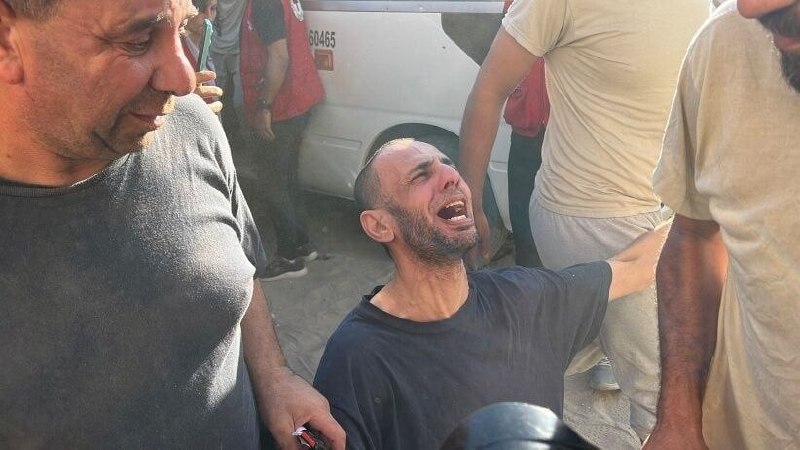
At 11:25 UTC on 12 July 2026, the Palestinian Red Crescent reported two killed and one injured in what it described as an Israeli march on the Al-Sabra neighbourhood of Gaza City. Just over ninety minutes later, at 12:57 UTC, regional outlets citing local medical sources said a separate Israeli drone strike on the same neighbourhood had killed four Palestinians and injured several others. The two incidents, occurring in the same southwest Gaza City district within a single news cycle, produced overlapping casualty accounts that wire desks have so far treated as distinct events rather than a single combined operation.
The pattern matters less for its arithmetic than for what the sequencing reveals about how casualty information moves out of Gaza when communications infrastructure is degraded. An on-the-ground medical agency reports first; minutes later, a separate air strike produces its own toll; both numbers circulate in parallel before any single coordinated picture is possible. Monexus is publishing both sets of figures as sourced rather than merging them, because the two accounts originate from different actors describing different events in the same neighbourhood within a two-hour window.
Two strikes, one neighbourhood
The Red Crescent's 11:25 UTC bulletin, carried by Al-Alam Arabic's Telegram channel, identified the first incident as a raid by an Israeli ground formation on Al-Sabra and gave an initial toll of two martyrs and one wounded. The Red Crescent is the principal Palestinian emergency-medical and ambulance service operating in Gaza, and its communications during the war have routinely been the first formal Palestinian institutional confirmation of casualty figures from incidents inside the Strip.
At 12:57 UTC, The Cradle's Telegram channel carried a separate bulletin attributing the second incident to an Israeli drone strike on Al-Sabra, citing local medical sources and giving a toll of four killed and several injured. The Cradle's framing described the strike location as southwest of Gaza City, consistent with the Red Crescent's reference to the same neighbourhood. The two accounts do not name each other, and no single wire service has so far published a combined operational assessment linking the ground action and the air strike.
The practical consequence is that the cumulative toll from the Al-Sabra district on 12 July 2026, drawn strictly from these two source items, stands at six reported killed and at least four injured across two incidents. That figure should be treated as a floor rather than a final count: the Red Crescent's bulletin specified one injured in the first incident, while the drone-strike bulletin referenced "several" wounded without enumeration.
What the casualty architecture looks like
Reporting from inside Gaza during the war has consistently relied on a layered sourcing chain. Institutional first-responders, principally the Red Crescent and the Gaza Ministry of Health, produce the earliest formal tolls; local medical sources at receiving hospitals then add details, sometimes hours later; and wire services consolidate once a sufficient number of independent accounts align. The two bulletins on 12 July follow that chain but compress it: the time between the ground-raid bulletin and the drone-strike bulletin is short enough that independent verification at the receiving-hospital level has not, as of this writing, been published by mainstream wires.
This compression is itself a story. Where earlier phases of the war produced daily consolidated tolls from the Gaza Ministry of Health that international reporters could cross-reference, the present sourcing structure around Al-Sabra reflects a period in which ministry releases are not the dominant primary source and local medical sources speak directly to regional outlets. The result is that the initial public record of an incident is shaped by which Telegram channel moves fastest rather than by any single authoritative Palestinian institutional voice.
What the framing cannot tell us
Neither bulletin specifies the target of either the ground action or the drone strike. The Red Crescent's account describes a march on the neighbourhood without naming an objective; The Cradle's account describes a drone strike without identifying what was struck. The Israeli military has not, in the source items reviewed here, published a statement on either incident, and major wire services have not yet carried operational confirmation. The two tolls therefore sit in the public record as Palestinian-reported figures awaiting independent corroboration on the targeting question.
A second uncertainty concerns overlap. Without operational confirmation that the ground action and the air strike were distinct in time, target, and tactical purpose, the possibility that the bulletins describe sequential phases of a single coordinated operation cannot be excluded. The bulletins themselves treat them as separate, but the separation is asserted by source rather than demonstrated by evidence.
What we verified / what we could not
Verified from the source items: the Red Crescent reported two killed and one injured in an Israeli march on Al-Sabra at 11:25 UTC on 12 July 2026; The Cradle reported four killed and several injured in an Israeli drone strike on Al-Sabra at 12:57 UTC on 12 July 2026; both incidents are placed in the same Gaza City neighbourhood; the bulletins were issued within a two-hour window.
Not verified from the source items: the identity or affiliation of those killed; the specific targets of either operation; whether the two incidents are operationally linked or distinct; an Israeli military statement on either event; an independent wire-service casualty consolidation; the total wounded count in the drone strike beyond "several."
What to watch next
The first order question is whether mainstream wire services consolidate the two tolls into a single Gaza City incident report or maintain them as separate entries. The second is whether the Israeli military publishes any operational statement identifying the targets in Al-Sabra on 12 July. The third is whether receiving hospitals in Gaza City publish patient-receipt figures that match, exceed, or fall short of the Red Crescent and local-medical-source accounts. Until any of those three checkpoints produces a public record, the two bulletins stand as the most contemporaneous documentation of what happened in the neighbourhood today, and the cumulative toll of six reported killed across the two incidents should be read as a sourced floor rather than a verified final count.
This publication framed the two Al-Sabra bulletins as separate events with separate source attributions, rather than merging them into a single combined toll, because the originating sources treat them as distinct and no consolidating wire confirmation has yet appeared.
Wire provenance
This editorial synthesis draws on the following public wire/social posts:
- https://t.me/alalamarabic
- https://t.me/thecradlemedia
- https://t.me/TheCradleMedia
- https://t.me/alalamarabic
- https://t.me/thecradlemedia
- https://t.me/TheCradleMedia