Venezuela's earthquake death toll climbs past 4,300 as Caracas leans on a familiar relief pipeline
National Assembly President Jorge Rodriguez says 4,333 dead and 16,740 injured from the twin tremors, as Venezuela's relief operation runs through state channels and foreign medical aid trickles in.
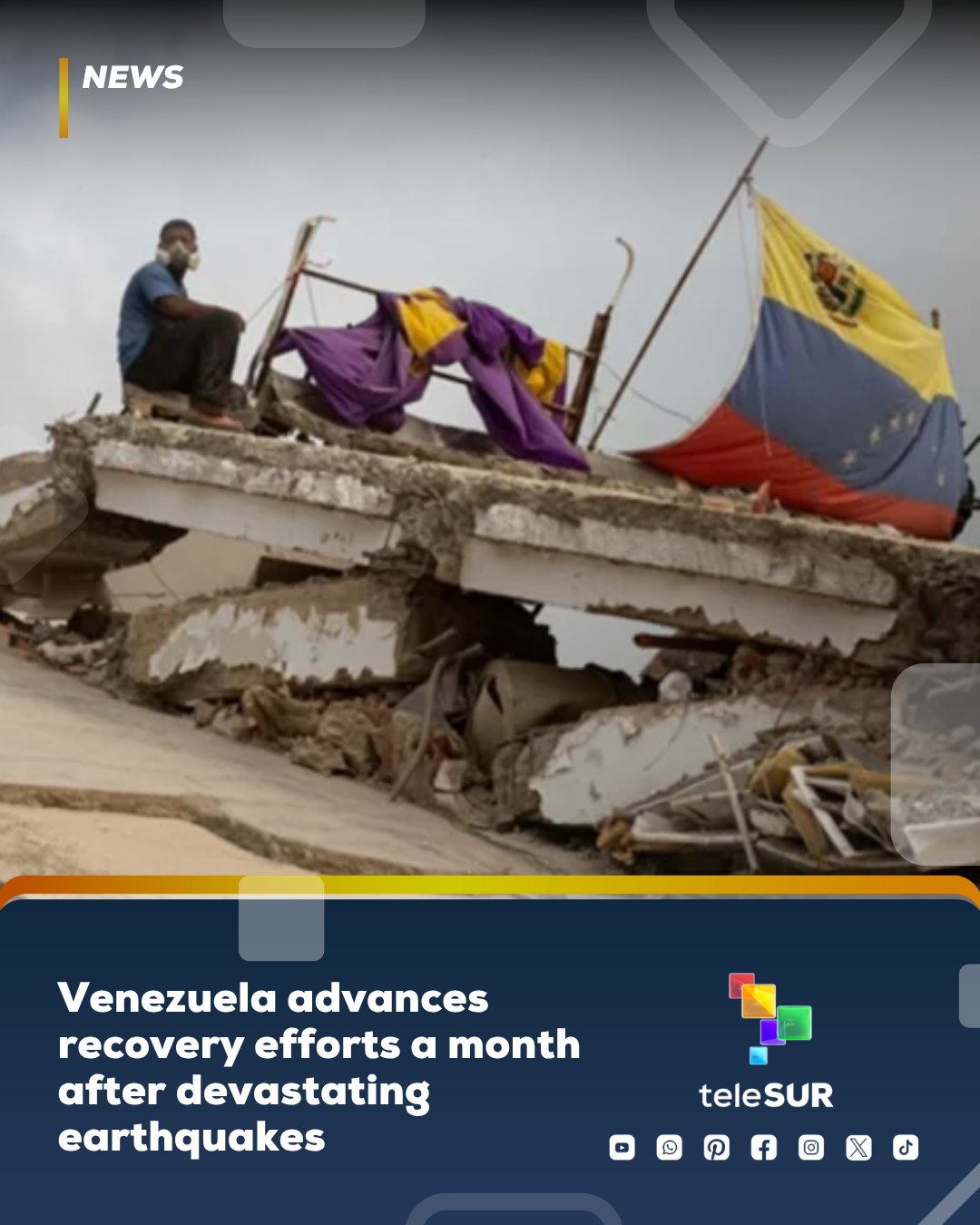
The official tally from Caracas stopped being a number on 11 July 2026 and became a question of trust. At 18:17 UTC, National Assembly President Jorge Rodriguez told reporters that 4,333 people had died in the twin earthquakes that ripped across Venezuela, and that another 16,740 had been injured. The figure, delivered on a national broadcast and relayed through the Standard Kenya wire, is the highest casualty count any official source has put on the record since the second tremor struck.
What Rodriguez's numbers reveal, and what they obscure, will shape both the international relief effort now forming around Caracas and the political weather inside the country for months. The death toll is a state number, produced by a state apparatus that has spent the last decade under US sanctions and inside an information environment of its own making. Aid groups on the ground will test it against their own counts. The question is whether Caracas uses the crisis to widen the narrow diplomatic opening it has been carving out, or whether the same sanctions architecture that has defined its external relations closes in tighter.
The official count, and what sits behind it
Rodriguez framed the casualty update as a national moment of transparency: a figure, a credential (the National Assembly presidency), and a delivery channel (state television) that leaves no doubt about whose accounting this is. The number itself is large enough to put the twin quakes among the deadliest seismic events Venezuela has recorded in living memory, and it lands inside a country where hospital capacity has been thinned by years of economic contraction and where independent press access to disaster zones is constrained.
The Caracas government has historically preferred to consolidate disaster reporting inside official channels. In practice that means relief coordination flows through the presidency, the armed forces, and a small circle of allied governors, with international NGOs and UN agencies required to negotiate access through the same gate. The arrangement can move fast. It can also produce a single narrative that does not survive contact with the first hospital corridor the cameras do not enter.
The relief pipeline, and the foreign-policy underlay
Foreign medical teams and aid flights have begun arriving, routed through the same diplomatic lanes Caracas opened in 2024 and widened through 2025 to ease sanctions on the oil sector. The geography of who is sending what tracks a Global South alignment that has hardened in the past two years: ALBA partners, regional neighbours with left-of-centre governments, and the Russian and Chinese embassies in Caracas have all been visible in the early response.
Washington, for its part, faces the familiar bind. The US Treasury licensing regime that permits some humanitarian transactions inside Venezuela is narrow and bureaucratic, and the political incentive for the Biden-administration successor to widen it during a high-casualty disaster is constrained by a sanctions architecture that still treats the Maduro government as the target. The result is that the relief effort is, almost by default, a multipolar operation before it is an American one. China and Russia can deliver medical teams and prefabricated field hospitals at speed. European governments can fund UN agencies but cannot always get the planes on the ground. The Venezuelan state, in turn, gets to choose whose flag flies over which tent.
What the alternative reads look like
Opposition figures inside Venezuela and a parallel network of diaspora outlets have begun to push two counter-reads. The first is methodological: that the official death toll is both an undercount in rural municipalities that have not yet been fully reached by relief convoys and a politically useful ceiling that lets the government claim command of the response. The second is structural: that the casualty scale is itself a downstream consequence of years of under-investment in building codes, civil defence, and state hospital capacity, an accumulation of decay that turned a seismic event into a mass-casualty event.
Both points have merit. The methodological caution is standard for any large disaster, including in countries with freer press access. The structural critique is harder to dismiss given the public record of pre-quake infrastructure warnings. Neither contradicts Rodriguez's number outright; both contextualise it. The honest reading is that 4,333 is the official floor, not the ceiling, and that the final count will be settled by relief workers with clipboards, not by politicians at microphones.
The structural stakes
For Caracas, the disaster is a test of the partial normalisation it has built over the last eighteen months. If the government can be seen to receive aid from a broad diplomatic spectrum, distribute it visibly, and tolerate a measure of independent reporting inside the affected zones, the case for tightening sanctions further weakens. If the relief effort looks improvised or politicised, the political cost lands on Maduro's coalition, and the hardliners in Washington and Caracas alike gain fresh material.
The deeper pattern is the one that recurs across the wider region. Natural disasters in sanctioned or semi-sanctioned states tend to accelerate, rather than interrupt, the geopolitical realignment already underway: relief flows along the same corridors as trade, investment, and diplomatic recognition. Venezuela's earthquake will not change that architecture on its own. It will, however, give every external actor a chance to demonstrate which side of the new line they intend to stand on, and which partnerships they are willing to deepen in front of the cameras.
The next checkpoints to watch are the Office for the Coordination of Humanitarian Affairs (OCHA) flash update, the first independent casualty audit from a credible NGO or UN agency, and any movement on US Treasury licences for Venezuelan humanitarian transactions. Each will either ratify or revise the number Caracas has put on the board.
Desk note: this piece runs on a single wire input and is deliberately conservative with attribution. The 4,333 / 16,740 figures are sourced to Rodriguez via the Standard Kenya wire; subsequent corrections from UN agencies or independent humanitarian organisations will be tracked in a follow-up filing.
Wire provenance
This editorial synthesis draws on the following public wire/social posts:
- https://t.me/s/StandardKenya