London's outdoor-swim scramble exposes a city built for a cooler climate
Heat-driven demand is outrunning a pool stock built for milder summers. The fix is less about concrete than about governance and water quality.
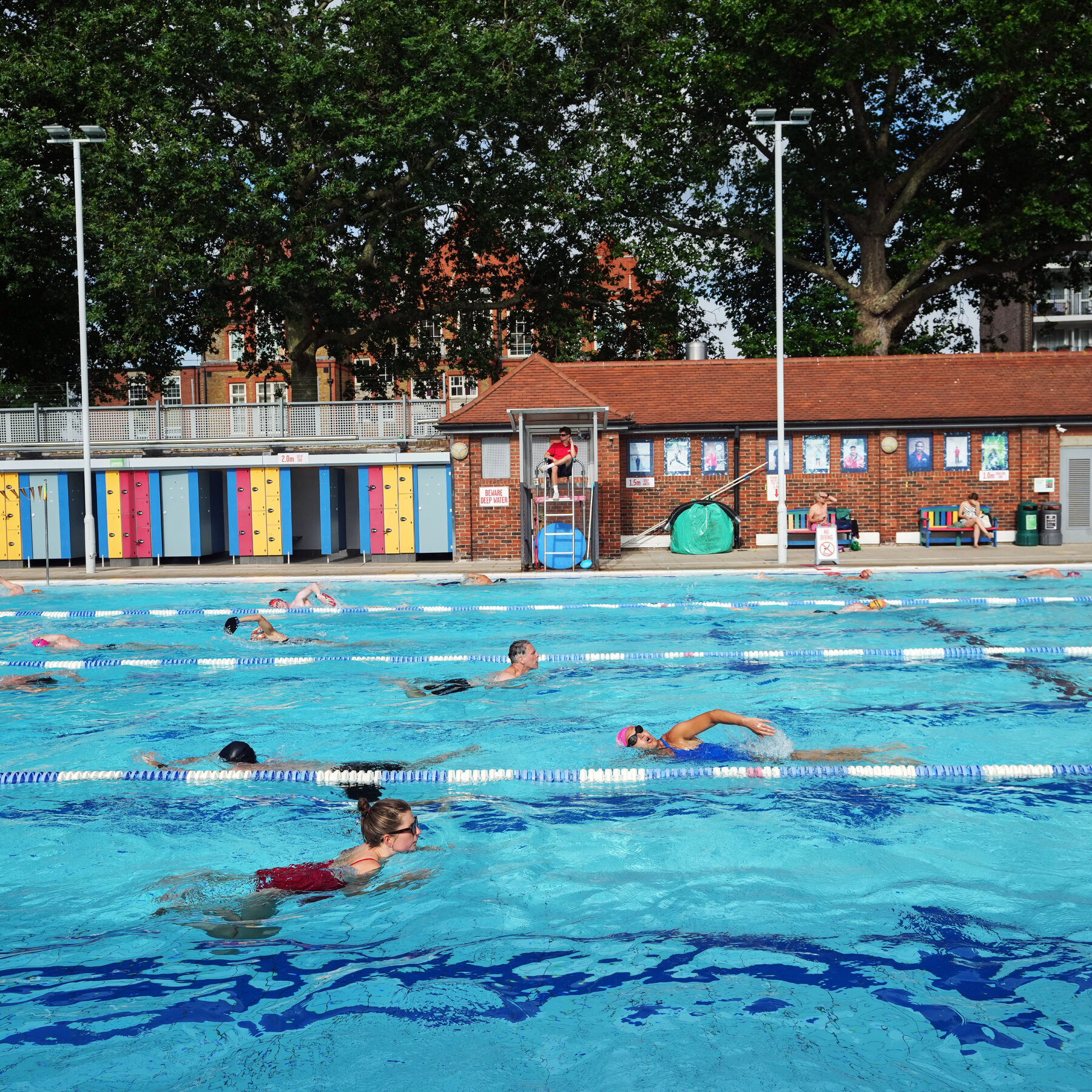
At 18:29 UTC on 9 July 2026, The New York Times reported what anyone who has tried to book a lane in a London lido already knows: the city's outdoor swimming capacity is being overrun by the weather. With air temperatures repeatedly clearing 30°C across south-east England in the first week of July, booking apps for the Serpentine, Hampstead Ponds and Brockwell Lido crashed under the same kind of traffic a rail strike generates. Some swimmers, unable to secure a slot, have begun taking to stretches of the Regent's Canal and the Thames at Hammersmith and Putney, where the water comes with its own problems and its own policing.
The story is not really about a hot week. It is about a capital whose pool stock was planned for a climate that no longer exists, and whose municipal appetite for new infrastructure runs at one speed while the thermometer runs at another. Outdoor swimming in London has stopped being a subculture and become an early-warning system for the politics of a warming city.
A network sized for 1976, not 2026
London's free-to-enter bathing sites are concentrated in a handful of historic locations: the Serpentine in Hyde Park, the Highgate and Hampstead ponds on Hampstead Heath, and a clutch of art-deco lidos built between the wars at Brockwell, Parliament Hill, London Fields and Charlton. The network was assembled when British summers were cooler, wetter and shorter, and when local-authority leisure budgets were funded differently. The result is a city of roughly nine million people served by a handful of unguarded freshwater ponds and a thin layer of chlorinated lidos, most of which are open only in daylight hours and staffed by a lifeguard workforce that is itself seasonal and short.
The New York Times dispatch frames the problem as a scramble for capacity, but the deeper constraint is geographic and fiscal. New Olympic-scale facilities are not being built in the inner boroughs, where the demand lives and where land costs are punitive. The capital's leisure trusts, which run most of the lidos under concession from the boroughs, are operating on contracts negotiated before the current heat cycle began.
The river is not a substitute
Faced with closed gates, swimmers are doing what swimmers have always done: improvising. The Times piece describes groups meeting at the Regent's Canal in Hackney and at Hammersmith, ignoring the formal guidance from the Port of London Authority, which maintains that tidal Thames swimming is unsafe outside of formally organised and buoyed events. The unofficial alternative, the canals, carry their own risks: low visibility, cold shock even in summer, and a chemical profile that varies block by block depending on what has flowed in upstream.
This is the part of the story that the social-media frame tends to flatten. A clip of a swimmer diving into a sunlit canal reads as liberation. The prosaic reality is a freshwater system monitored by the Canal & River Trust for nitrates, hydrocarbons and the occasional CSO overflow after a summer storm, and where the absence of lifeguard cover means an emergency becomes a private one. The counter-narrative to the "the city should just let us swim" mood is that the city has tried to formalise wild swimming and found the water-quality numbers inconsistent. Public-health England advice, repeated by the Environment Agency, is to avoid open water that has not been tested that day.
A structural problem dressed as a vibe
The temptation is to treat outdoor swimming as a cultural story, a London rediscovering its inner amphibian. That framing is half right but conceals the policy gap. Comparable northern European cities have spent two decades planning for hotter summers: Copenhagen has added harbour baths fed by filtered sea water, Stockholm has invested in floating pontoon decks in Lake Mälaren, and Paris has pushed a network of baignades in the Seine open to the public ahead of the 2024 Games. London's equivalent programme, the Thames Tideway tunnel, addresses sewage overflow but does not create a single new bathing site. The capital is, in effect, asking residents to absorb a climate-driven step-change in cooling demand without offering them a corresponding step-change in safe, supervised, publicly accessible water.
The structural pattern here is familiar from other urban-policy stories Monexus has tracked: a piece of public infrastructure sized for one climatic era, a maintenance regime that has drifted, and a population that adapts informally while formal policy catches up on a different timetable. The political cost of doing nothing is low in any given week because the heat is intermittent. The cumulative cost, in drowned swimmers, displaced lower-income households who cannot afford private clubs, and in mounting pressure on emergency services, is paid quietly and out of frame.
What to watch
Three indicators will tell us whether London is treating this as a one-off or a transition. First, the Mayor of London's published bathing-water strategy, due to be refreshed before the 2027 mayoral election year, and whether it adds supervised sites or merely restates existing commitments. Second, the summer 2026 statistics from the Royal Life Saving Society on open-water fatalities in the capital, which are reported annually and which will be the first hard number to break the cultural-narrative frame. Third, the behaviour of the canal-and-river trusts: whether they move from "do not swim" advisory leaflets to seasonal lifeguarded zones on the canals, as Hamburg has done on the Alster. Until then, the scramble described in the Times is what unmanaged climate adaptation actually looks like in a wealthy capital: improvisation at the water's edge, policy still indoors.
The piece is thin on specifics that a desk writer would want, and the wider public-record evidence base is. The Times does not name a spokesperson for the GLA, Mayor Khan's office, or the Canal & River Trust; the available reporting is descriptive, not adjudicative. The numbers on lifeguard coverage, on open-water rescues, and on the comparative capacity of other European capitals are not in the source material and have been left out of this piece rather than guessed at. The shape of the problem, however, is clear enough to report.
This piece was built from a single NYT dispatch filed 09 July 2026 at 18:29 UTC. Where the wire described a scramble, this publication has read it as a governance gap. The swimming happens regardless; the policy is what is missing.