Iran buries Khamenei at Azadi Square as succession question dominates Tehran
Millions line Tehran's streets for the funeral of Iran's Supreme Leader, but the procession's scale is matched by a quieter question: who governs the Islamic Republic next.
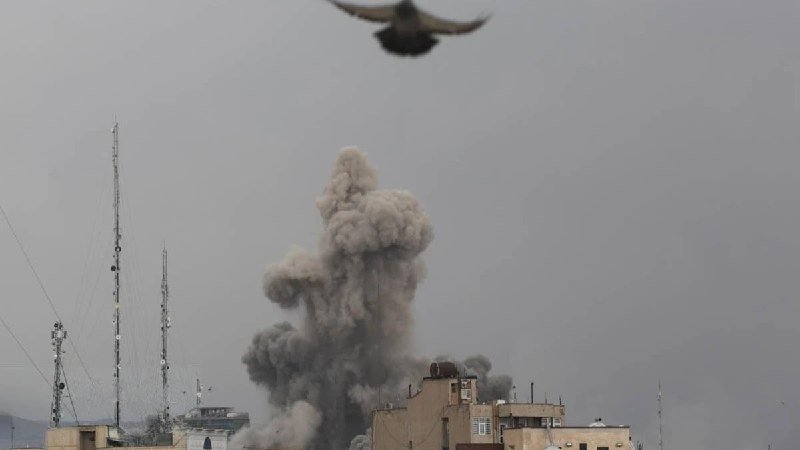
Millions of mourners filled the streets of central Tehran on 6 July 2026 for the funeral procession of Ayatollah Ali Khamenei, Iran's Supreme Leader, whose death alongside family members was formally declared a martyrdom by state channels earlier in the week. State-aligned outlets carried near-simultaneous coverage of the cortège, including a noon adhan broadcast across the capital and a procession routed past the Safinat al-Najat, or Ark of Salvation, monument at Azadi Square. By mid-morning UTC, official Telegram accounts run by the Office of the Supreme Leader and the Iranian military had pushed four separate dispatches describing the turnout as multi-million and the mood as solemn.
What the cameras showed was meticulously choreographed pageantry. What they did not show was the answer to the question every external observer is asking: who succeeds the man whose office has defined the Islamic Republic's strategic direction for nearly four decades, and what does the answer mean for the wider axis of resistance he helped to assemble?
A state funeral, a wartime register
The tone of the coverage is unmistakably martial. Telegram posts by the Khamenei-affiliated channel on 6 July 2026 repeatedly use the word "martyrdom" rather than "death," frame the deceased as a "martyred Leader of the Islamic Revolution," and instruct readers to attach the hashtags #WeMustRise and #MartyrKhamenei to amplify the moment. The language is the language of the Iran-Iraq war memorialised in state iconography; it is not the language of routine obituary. That choice is editorial as much as theological. It positions the funeral inside a continuum of sacrifice rather than succession, and signals to Iran's regional allies — Hezbollah, the Houthi movement, Iraqi Shia militias, and the remaining Assad-era networks in Syria — that the framework binding them to Tehran is framed as martyrdom-legitimised rather than personality-driven.
The noon adhan broadcast across Tehran is a second signal. The adhan is, in ordinary practice, a routine summons to prayer; transmitting it on state-aligned channels at the moment the cortège reaches central Tehran repurposes a religious technology into a political broadcast. The faithful who hear it hear the funeral; the domestic audience who cannot attend hears a curated slice; foreign observers see a coordinated information operation. Each audience is reached in its own register, from one signal.
What the Iranian outlets emphasise — and what they omit
The official Telegram accounts stress three things, in order. First, scale: the procession is repeatedly described as drawing "millions of mourners" through central Tehran. Second, participation of the security services: the Iranian military channel's near-identical text to the IRNA English feed indicates a single editorial line distributed across multiple official handles, with the state news agency IRNA positioned as the lead voice. Third, popular agency: a 6 July dispatch notes that "in the days following the martyrdom of their Leader, the people of Iran seized the opportunity to write messages on the concrete barriers surrounding the site of his martyrdom," with the implication that the mourning is grass-roots rather than orchestrated.
None of these posts, as of 11:43 UTC on 6 July 2026, address the institutional question uppermost in external commentary. There is no named Acting Supreme Leader in the available posts, no announcement of an Assembly of Experts convocation, no reference to the 1989 constitutional procedures that govern succession. The omission is not necessarily evidence of disorganisation; in Iranian institutional practice, the gap between a Supreme Leader's death and a formal announcement of an interim arrangement is typically short, and the public-facing apparatus is rarely the first channel for that announcement. But the silence is itself a story.
The succession geometry
Succession in the Islamic Republic is not a single decision but a layered procedure. The Assembly of Experts, an 88-member body of senior clerics elected to eight-year terms, formally chooses the Supreme Leader, but in practice the choice has historically been settled inside a narrower circle dominated by the outgoing leader's inner network and the heads of the security and judicial institutions. The public-facing process is confirmatory.
Three plausible trajectories present themselves in the coverage window now opening. The first is continuity through an interim arrangement — a senior cleric serving as Acting Supreme Leader while the Assembly convenes, with policy and strategic direction held by existing security chiefs. The second is a managed transition to a successor from within the existing clerical establishment, chosen quickly to project stability at a moment of regional strain. The third is a more contested succession — slower, factional, and visible — in which the IRGC's institutional weight and the clerical establishment's traditional prerogative negotiate in public. The available Telegram material does not adjudicate among these. It would be improper to claim to know which is underway; the public sources simply do not yet say.
What the messaging does suggest is that the official apparatus wants the public conversation to remain on martyrdom, mourning, and mass turnout, not on the mechanics of who governs next. That is consistent with any of the three trajectories; it is not, by itself, evidence for or against any of them.
Stakes — inside Iran and across the axis
The succession will reshape four distinct theatres simultaneously. Inside Iran, the next Supreme Leader will inherit a state that has weathered the killing of senior IRGC commanders, an attritional shadow conflict with Israel, and an economy still under heavy sanctions; the politics of who manages that inheritance will turn on clerical seniority, security-establishment loyalty, and the balance between pragmatic and ideological wings.
Across the region, the so-called axis of resistance — Hezbollah in Lebanon, the Houthi movement in Yemen, Shia militias in Iraq, and surviving Assad-era networks in Syria — has been operationally coordinated through Iranian institutions rather than through the personality of a single leader. The funeral's martyrdom register is, in effect, an attempt to inscribe those institutional ties into a sacred frame that survives the change of personnel. Whether it succeeds depends less on messaging and more on whether Tehran's partners judge the new leadership willing and able to underwrite their security.
In the wider diplomatic frame, the United States, Israel, the Gulf states, and the European Union are recalculating in real time. Iranian foreign policy has rarely turned on the personality of the Supreme Leader as much as on the institutional interests around him; but the optics of transition create windows in which adversaries probe and partners hedge. A managed transition produces continuity; a contested one produces openings.
What remains uncertain
The Telegram material at the centre of this article is state-aligned by design. The claims of multi-million turnout are not independently verifiable from the source set available here, and outside Iran the question of scale is unlikely to be settled by satellite imagery alone — funeral cortèges concentrate participants in ways that look larger than they are, and state-aligned channels have an institutional interest in maximum figures. The "messages on the concrete barriers" claim, similarly, is reported only by channels whose framing aligns with the regime's preferred narrative of organic mourning. None of this means the claims are false; it means the burden of independent corroboration has not yet been discharged. The bigger uncertainty is the one the Iranian state apparatus is conspicuously not addressing from its public channels: who is in charge, in fact, as of 6 July 2026.
Monexus framed this story around the institutional silence at the heart of the official coverage, rather than the more common wire line of "Iran mourns." The signal is in what state Telegram accounts are not saying.
Wire provenance
This editorial synthesis draws on the following public wire/social posts:
- https://t.me/Khamenei_en/1652
- https://t.me/Irna_en/8451
- https://t.me/IRIran_Military/3320
- https://t.me/Khamenei_en/1650
- https://t.me/Khamenei_en/1648