France on Fire, France on Form: A Country Performing in Two Registers at Once
A 10,000-person evacuation on the Côte d'Azur and a fourth straight World Cup quarterfinal inside a week: France is performing its two oldest national scripts at full volume.
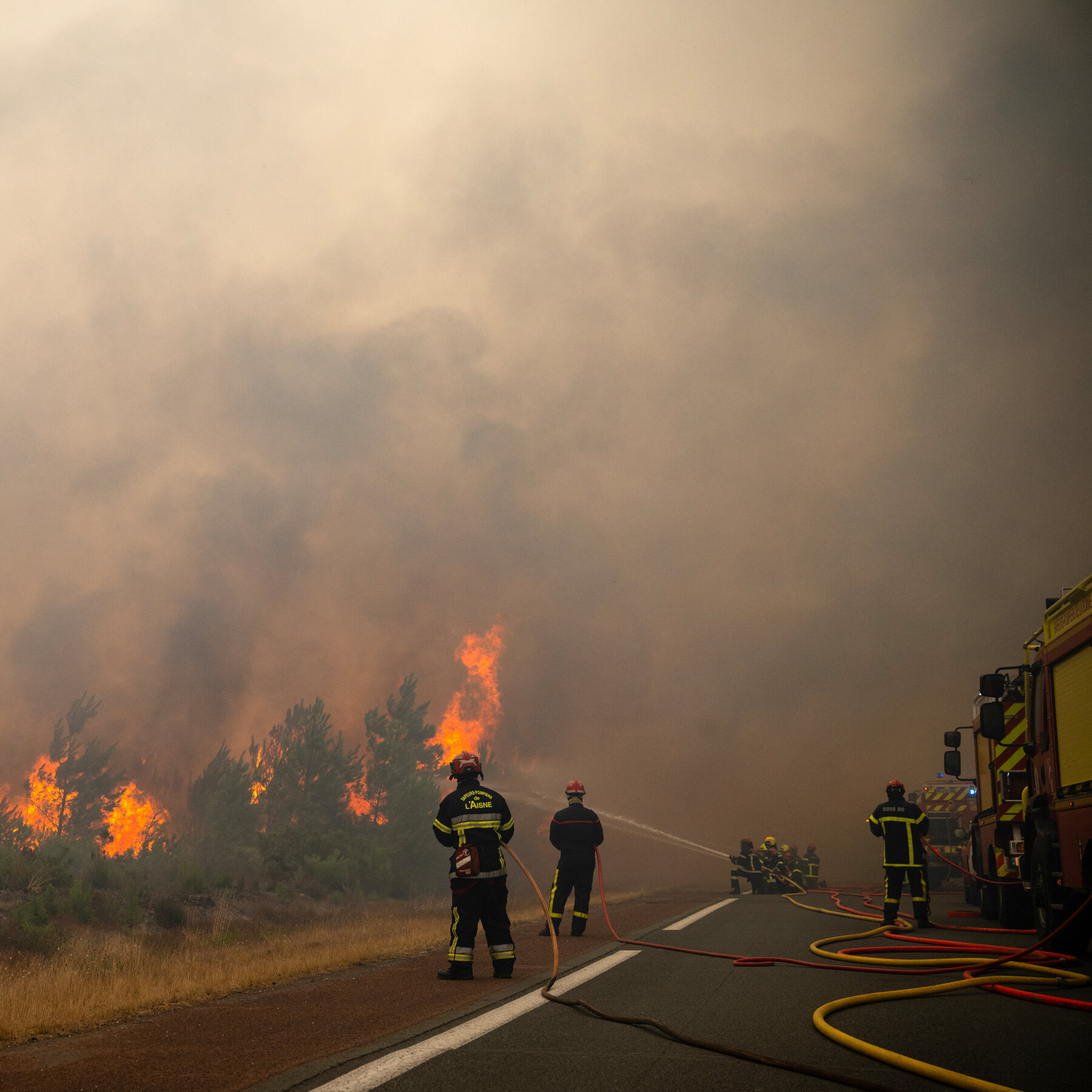
Around 10,000 people were evacuated from the hills above Bormes-les-Mimosas on Monday as a wildfire, fed by Mediterranean winds and a region parched by weeks of heat, tore through roughly 1,500 hectares of forest. Firefighters from three departments converged on the blaze, water-bombers worked through the night, and a red mass-evacuation order was extended to neighbouring communities as the fire front jumped a containment line near the Gonfaron road. It was the largest such operation in the Var so far this summer. Six days earlier, on 4 July, the same country's men's football team walked out of a stadium in the United States having dispatched another opponent on its way to a fourth consecutive World Cup quarterfinal, and prediction markets put its chances of lifting the trophy at around 36 percent. Two registers, one Republic.
The juxtaposition is almost too tidy. France, the cliché insists, is the land of the eternal strike and the burning July. This year the country is performing both halves of that script at full volume, and the strain of holding them together is no longer private. Macron's government is fighting a fire season that opened early and refuses to close, defending tourism revenues on the Côte d'Azur while fielding questions from Brussels about civil-protection capacity. The Football des Bleus, meanwhile, has become a stream of confidence: organised, clinical, and superior to most opponents by the hour mark, the side's run to the last eight is the kind of sustained tournament form that elite programmes usually manage once a generation.
The country that can't sit still
The Bormes-les-Mimosas fire is the headline of a brutal week in southern France. Misted pine slopes on the Massif des Maures turned into torchlight on 6 July, and prefet offices pushed door-to-door alerts through villages that, in calmer summers, host the well-heeled of Saint-Tropez and the cycle teams of the Tour. Local authorities opened reception centres in schools and gymnasiums; the regional prefect appealed for reinforcements. The event tracks a pattern across the Mediterranean's northern rim: a spring that was wet enough to encourage undergrowth, followed by a dry spell that turned it into fuel, with Saharan air overhead to add the insult of poor air quality on top of the danger.
The working week did not pause for the flames. Paris has been recalibrating its posture on a string of foreign files that pull in different directions: the US move to begin delisting Syria from the state sponsors of terrorism list, announced on 8 July, and the pointed exchange between Washington and Tehran that followed, with Iran's deputy foreign minister declaring that Trump "understands the language of force better". Both files matter to the Quai d'Orsay, which is trying to keep a foothold in Levantine diplomacy while preserving its commercial relationships in the Gulf. A country that cannot safely evacuate 10,000 of its own citizens without outside help should, by the logic of any realist foreign-policy school, think carefully before lecturing others on resilience.
Form, and what it costs to keep
On the pitch, the outlook is brighter. France's progression to a fourth straight World Cup quarterfinal, recorded by prediction-market observers on 4 July, is not a fluke: it reflects a squad depth that most federations would envy, a manager with tournament pedigree, and a playing pool that the country's academies and immigration history have spent forty years building. The 36 percent implied probability of winning the tournament is not a boast; it is the market's reading of a side that has finished among the final four in three consecutive editions.
The cost of that form is harder to price. Every match is a national event that pulls attention away from press conferences that should be about budgets, fires or migration. Every stadium win buys the government a few days of good coverage, then the news cycle moves on. The political economy of French distraction is well understood inside the Elysée; a tournament run that ends before the final is more useful to the incumbent than one that ends in it, because a semi-final loss is a story of heartbreak, not a story of failure. The harder the team works to win, the more pressure there is to manage what the win is used for.
Two registers, one newsroom
The press has noticed. Le Monde's front pages in the first week of July have balanced wildfire mapping and player ratings; BFJM's evening news has run helicopter footage of the Maures alongside analysis of Didier Deschamps' midfield choices. The synthesis is uncomfortable: the same country that asks its citizens to respect controlled burns and pre-emptive evacuations also asks them to cheer a team that, by design, refuses to be controlled. France's anthem is used, sometimes within a single broadcast, to mourn a burnt forest and to celebrate a goal in the 89th minute.
What the fire season says about 2026
The clearest reading is that the emergencies are no longer seasonal. The prefecture systems that managed the great fires of 2003 and 2015 are now being asked to handle something close to a permanent state of alert, in a year when the budget for civil-protection equipment is contested and the European Union's rescEU stockpile is itself under review. A tournament run provides cover in two senses: it gives voters something to celebrate, and it gives the government something to point to when the cameras finally turn away from the helicopters. The cover is thinner than it looks. A 36 percent chance of winning the World Cup, held against 10,000 displaced nationals, is a reminder that no national mood is ever a settled thing.
What to watch next: the restart of the Tour de France stages through the southern Alps on Wednesday, where air-quality advisories may force route changes; and the quarterfinal, scheduled for the weekend, which will pull prime-time attention away from anything the prefect might want to say about the next red alert.