Tehran stages the funeral it says the revolution deserves
State media broadcast farewell rites at the prayer hall of Imam Khomeini, framing the late Supreme Leader's burial as a unifying national moment even as the question of succession remains deliberately unanswered.
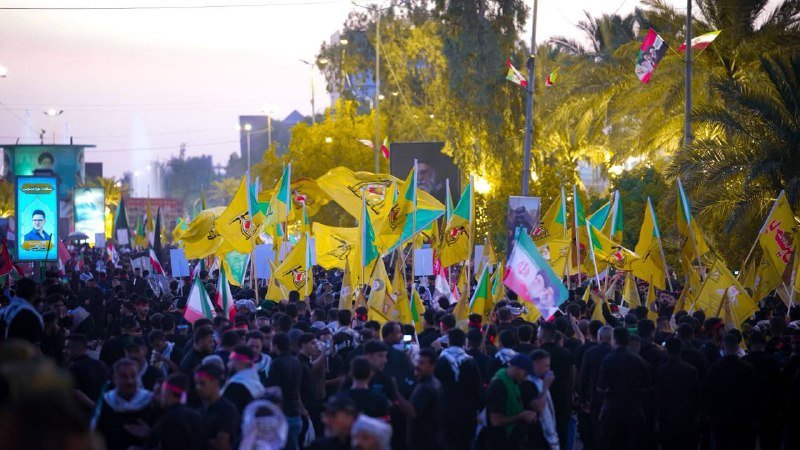
At 21:22 UTC on 5 July 2026, Iran's Mehr News Agency pushed a short video clip from inside the prayer hall of Imam Khomeini in southern Tehran. The caption, posted on the agency's Telegram channel, framed the footage as "the final and painful moments of farewell to the lovers of the martyred leader of the revolution." An Arabic-language channel aligned with the office of the late Supreme Leader posted its own framing at 21:19 UTC, describing the gathering as "an enduring legacy and renewed unity." A third wire, dispatched at 20:17 UTC, made the political ask explicit: "The first requirement for seeking the blood of our martyr is to participate in this funeral."
What is being staged is not just a burial. It is a public test of the Islamic Republic's ability to choreograph grief at scale, on schedule, and on its own terms.
A funeral as a framing exercise
The choice of venue matters. The prayer hall of Imam Khomeini sits on the southern edge of the capital, hard against the Behesht-e Zahra cemetery where the Islamic Republic's founder is buried. Returning the late Supreme Leader to that site, rather than interring him in a purpose-built mausoleum elsewhere, deliberately fuses the two clerics — the founder and the successor — into a single visual lineage. The Mehr News footage is built for that reading: long pulls of the hall, banners, the cadence of a crowd in coordinated rhythm.
State-aligned messaging is converging on the same script. Mehr's 21:22 UTC post uses the language of "martyrdom" — a term the Republic reserves for figures killed in the line of service to the system. The Khamenei-aligned Arabic channel's 21:19 UTC post widens the frame outward, addressing an Arab-speaking audience and urging unity. The 20:17 UTC Mehr post, earlier in the sequence, is the sharpest of the three: it tells viewers that attendance is itself an act, that the chants in the hall should be aimed at "the perpetrators and commanders of the martyrdom of our martyr Imam."
That language does not name a perpetrator. The sources reviewed do not name one either. But the rhetorical slot is left conspicuously open.
Why the production values matter
Iranian state media has spent decades turning ritual into messaging. Funeral processions, martyrs' week commemorations, Friday prayer serials — each is rehearsed and re-broadcast until the official version of an event becomes the version a domestic audience can later cite back to a foreign reporter. The farewell rites on 5 July follow that template. By placing the footage on Telegram in near-real-time, Mehr and the Khamenei-aligned channel are doing two things at once: feeding a domestic audience a curated visual record, and exporting the same record to a regional Arabic-speaking public whose governments are watching.
The contrast with how previous Iranian leadership transitions were visually handled is instructive, though the sources reviewed do not specify a comparison. What is visible is that the 5 July coverage is bilingual, sequenced, and security-coded — the chant quoted in the 20:17 UTC Mehr post functions as a script for the crowd rather than a description of one.
The conspicuous silence
What the three wires do not address is the question every Iran-watcher is asking: who runs the Republic on Monday. The sources reviewed contain no announcement of a successor, no reading of a written will, no naming of an acting council. That silence is itself a political fact. In an institution whose legitimacy is built on continuous clerical authority, a multi-day period in which the top post is publicly unfilled while the cameras roll is a deliberate choice — it converts the funeral itself into a kind of audition, in which every cleric in attendance is being watched.
The Arabic-language framing of "renewed unity" is doing related work. By directing the unity message outward, the Khamenei-aligned channel pre-empts the framing — common in Persian-language opposition channels — that the post-succession system will splinter along factional lines.
Stakes
If the choreography holds, the Republic acquires a usable visual precedent: a leadership change managed inside its own iconography, on its own clock, with its own clergy on screen and its own cameras at the gates. If it slips — through a security lapse, an unscripted slogan, a foreign wire picking up a detail the script did not sanction — the same footage will be re-edited by the Republic's adversaries into a different story. State-aligned Telegram channels in Tehran are not just publishing today; they are also pre-publishing tomorrow's denial.
What remains genuinely uncertain, on the evidence available, is the identity of the figure or institution the 20:17 UTC Mehr post was pointing toward when it called for chants against "the perpetrators." The sources reviewed do not specify, and this publication has no independent confirmation. The framing implies an external enemy; the deliberate ambiguity leaves Tehran's options open.
Desk note: Monexus is treating the 5 July state-media coverage as a primary source for the funeral itself, not as a neutral record of crowd sentiment. The wire logic in this piece follows the Iranian outlets' own sequencing rather than re-narrating the ceremony through Western framing.
Wire provenance
This editorial synthesis draws on the following public wire/social posts:
- https://t.me/mehrnews
- https://t.me/Khamenei_arabi
- https://t.me/mehrnews