Ansarallah's deadliest Saudi-coalition strike in years resurfaces the Yemen file
Ansarallah claims a missile and drone strike on a southern Saudi airbase killed over 100 servicemen. The coalition has not spoken. The gap between the claim and the silence is the story.
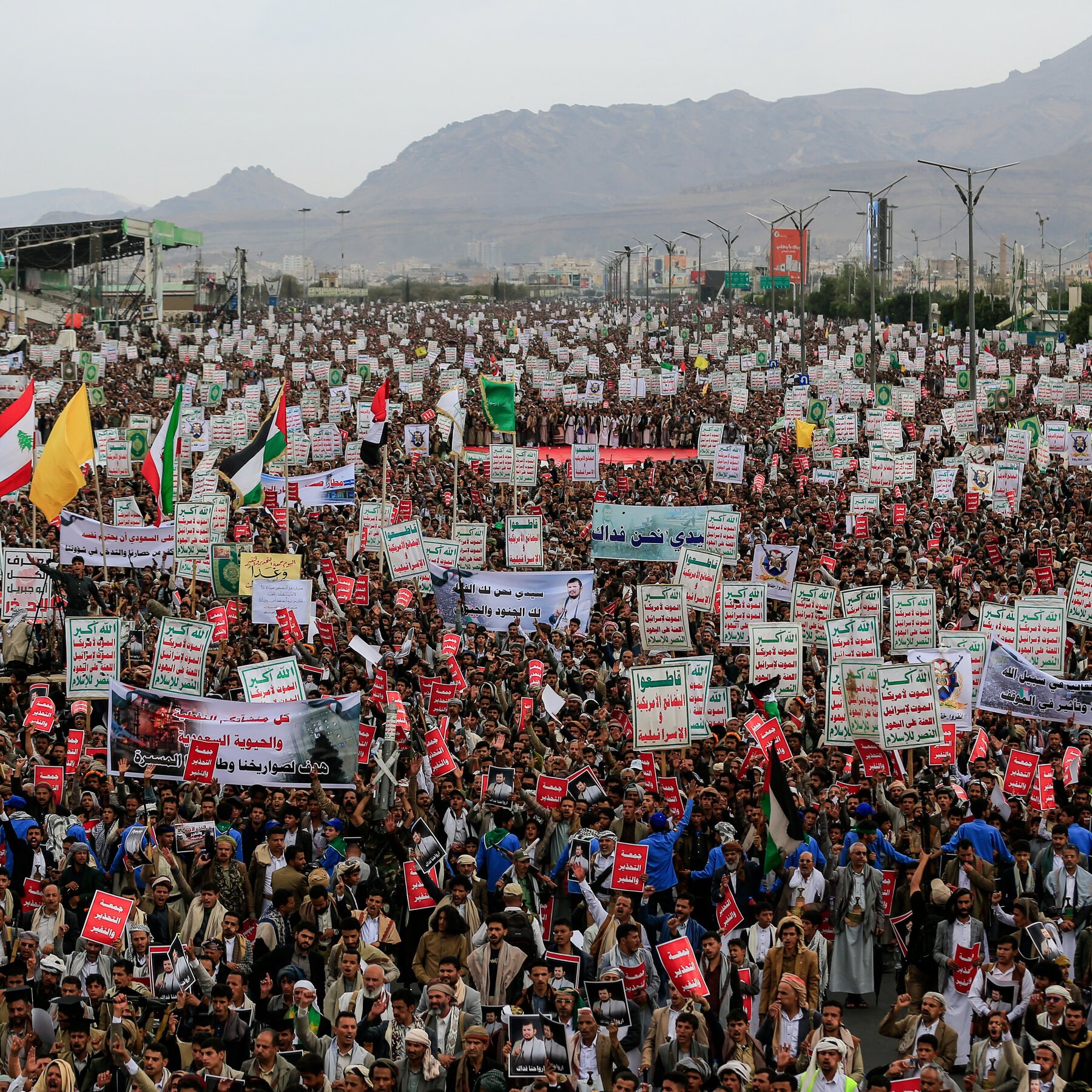
On 5 July 2026, the Beirut-based outlet The Cradle reported that Ansarallah, the Yemeni movement aligned with Iran that has held the capital Sana'a since 2014, claimed a missile and drone operation against targets inside Saudi Arabia and the United Arab Emirates that it said killed upwards of 120 people, more than 100 of them Saudi servicemen at a single airbase in the kingdom's south. The figure, circulated on the movement's channels and amplified by the Iranian state wire Tasnim and other regional outlets, is the highest single-event coalition casualty toll Ansarallah has claimed in years, and it lands at a moment when the Saudi–Iranian de-escalation that took shape in 2023 was supposed to have made exactly this kind of escalation harder to stage.
What can be established on 5 July 2026 is narrower than either side prefers. The Cradle's two posts on the day describe a multi-axis strike attributed to Ansarallah, name a southern Saudi airbase, and place the killed servicemen at over a hundred. Tasnim's English release carries the same claims. Beyond that, the public record is thin: no major wire has yet posted a corroborating or contradicting count, and the Saudi-led coalition has, as of the time of writing, not issued a public statement on the strike. The gap between the movement's headline figure and the coalition's silence is itself the news, because it is precisely that asymmetry that allows an incident of this kind to be read, in Riyadh, in Sana'a, in Tehran and in Washington, as four different events.
The strike as Ansarallah wants it framed
The Cradle's reporting frames the operation as a reprisal for coalition airstrikes on Yemeni civilians and a demonstration that the movement's long-range missile and drone complex, much of it produced domestically and patterned on Iranian designs, retains the reach and the coordination to put multiple southern Saudi facilities and UAE targets at risk inside a single window. Tasnim's English coverage, reflecting Tehran's view, presents the strike as a measured but emphatic answer to a pattern of Saudi and Emirati operations on Yemeni soil, and a signal that the regional de-escalation has not bought Riyadh and Abu Dhabi immunity from the war they opened in 2015.
Read inside that frame, the claimed toll is the point. Ansarallah has spent the last three years pivoting from a Yemeni insurgent movement to a regional actor with two parallel instruments: a missile and drone force aimed at Israel and the Gulf, and a maritime campaign in the Red Sea and Bab el-Mandeb that has, at various points, halved commercial traffic through the strait. A claimed mass-casualty strike inside the kingdom, if it holds up in the days ahead, would be the first proof-of-concept that the first instrument has graduated from harassing fire to something with strategic weight.
The silence as Riyadh's problem
The Saudi-led coalition's absence from the public record is the second-order fact. Riyadh has spent the better part of two years cultivating the diplomatic architecture that produced the China-brokered rapprochement with Tehran in March 2023 and, in its wake, a Huthi–Saudi channel that has at times paused Yemeni cross-border fire. A coalition that confirms the scale of an Ansarallah strike validates the movement's claim to strategic reach and risks the diplomatic shelf the kingdom has been building. A coalition that denies the strike, or stays silent, leaves a vacuum that the movement's own channels will fill. Either choice is expensive.
The wider Saudi–Emirati interest is also the wider Western interest. The maritime campaign Ansarallah has run since late 2023 has already forced a reroute of commercial shipping around the Cape of Good Hope, raised insurance rates on Red Sea transits, and given both the United States and the United Kingdom a domestic political reason to keep striking Huthi positions on Yemeni soil. A confirmed mass-casualty strike inside the kingdom, in that context, would not stay a bilateral Saudi–Yemeni problem. It would re-open the file in Washington, where the Biden administration's framework for the Red Sea has been to treat Ansarallah as a contained irritant, and in London, where the UK's separate strike programme against Huthi launchers has been politically defensible only on the assumption that the campaign was not metastasising.
What the open record can and cannot show
On the strict evidentiary question, the public record at midday on 5 July 2026 is: a claimed strike, a claimed toll, a claimed target set, and a coalition that has not spoken. There is no independent OSINT confirmation of the location, no satellite imagery in the open sources cited, no casualty figure from a UN agency, the International Committee of the Red Cross, or a major Western wire. The Cradle is a Beirut-based outlet with a documented record of carrying Ansarallah communiqués at face value; Tasnim is an outlet of the Iranian state. Both are admissible as primary carriers of the movement's claim, and neither is a neutral adjudicator of it.
The historical pattern matters here. In 2019, Ansarallah's strike on Saudi Aramco's Abqaiq and Khurais facilities knocked out, briefly, half of Saudi oil production. The kingdom's own investigation, with United States and French support, attributed that attack to Iran, not to the Yemeni movement, and the political settlement that followed was built on the assumption that Ansarallah's long-range complex was a derivative of Tehran's, not an autonomous capability. Any strike that puts over a hundred uniformed Saudi personnel on the floor in a single afternoon complicates that assumption, and is precisely the kind of development that takes time to verify through imagery, base rosters, and the slow work of families being notified.
The structural backdrop: a war that has been quietly unending
The Saudi-led intervention in Yemen began in March 2015, nominally as a response to Ansarallah's seizure of Sana'a and the displacement of the internationally recognised government of Abdrabbuh Mansur Hadi. The coalition was led by Saudi Arabia and included the UAE, Bahrain, Kuwait, Egypt, Jordan, Morocco, Sudan and others; the United States and the United Kingdom provided intelligence, logistics, mid-air refuelling and, at key moments, strike support. The war has killed, by conservative counts produced outside the coalition, well over 150,000 people, the majority of them civilians, and has driven Yemen into what the United Nations has described, in successive reports, as the world's worst humanitarian crisis.
The 2023 rapprochement with Iran did not end the war. It produced a Huthi–Saudi channel that has periodically paused cross-border fire, but the underlying territorial dispute, the question of which government runs Sana'a, and the question of who controls the central bank and the flow of humanitarian aid, are all still open. Ansarallah's Red Sea campaign, launched in solidarity with Palestinians in Gaza after October 2023, has at various points drawn coalition retaliatory strikes and a separate American and British air campaign, and has at the same time drawn a sanctions regime on the movement's leadership. The war has been quiet on some fronts and hot on others, and the structural conditions for exactly the kind of strike reported on 5 July have been present for the better part of a year.
Why the Gulf reads it differently from Washington
Inside the Gulf, the strike will be read as a stress test of the rapprochement: is the de-escalation with Tehran a ceiling on what Ansarallah can do, or a floor? Tehran's relationship with the movement is the unresolved variable. The 2023 deal was, on the Saudi side, premised on the understanding that Iran would not green-light a Huthi strike on the kingdom's critical infrastructure. A strike of the scale claimed on 5 July forces a public answer to a question both sides have had an interest in leaving unanswered.
In Washington, the strike, if confirmed, complicates the United States' own positioning. The Biden administration has treated Ansarallah as a contained problem in the Red Sea, not as a strategic actor in the Gulf. A mass-casualty strike inside Saudi Arabia moves the file from the maritime desk to the regional-security desk, and brings with it the question of whether the current American posture, which combines sanctions, maritime interdiction and periodic strikes, is calibrated to a movement that now appears to be able to put southern Saudi airbases at risk. The question for London, Paris and Berlin is similar, in milder registers. For Moscow and Beijing, the strike, whatever its actual scale, hands an opportunity to point at the limits of the American security architecture in the Gulf and the wider Middle East.
What to watch in the next seventy-two hours
The next three days will be decisive for what the strike actually was. The first signal will be from the Saudi-led coalition, which is in the position of having to either confirm, deny or keep silent, and the choice will itself be a reading guide. The second signal will be satellite imagery of the named airbase, which commercial providers will in due course pick over. The third will be independent wire confirmation or contradiction of the casualty count, which is the figure that most determines the political weight of the event.
If the figure holds, the strike is the most consequential Ansarallah operation since the 2019 Aramco attack, and it lands in a regional architecture that has spent three years pretending such an event was not possible. If it does not hold, the strike is still a marker of the movement's capacity to stage an information event of strategic weight, and the Gulf's diplomatic posture, and the American and British strike campaigns off Yemen, are the questions that will not go away simply because the casualty count was lower than the first claim. Either way, the file is open again.
Sources
- The Cradle (Telegram channel): https://t.me/thecradlemedia
- The Cradle (Telegram channel, secondary): https://t.me/TheCradleMedia
- Tasnim News Agency (English, Telegram): https://t.me/tasnimnews_en
- Wikipedia, Saudi-led intervention in Yemen: https://en.wikipedia.org/wiki/Saudi-led_intervention_in_Yemen
- Wikipedia, Red Sea crisis: https://en.wikipedia.org/wiki/Red_Sea_crisis
- Wikipedia, Iran–Saudi Arabia proximity talks: https://en.wikipedia.org/wiki/Iran%E2%80%93Saudi_Arabia_proximity_talk
- OSINTdefender (Telegram), current military air picture over the Middle East, 7 July 2026: https://t.me/s/osintlive
- Field correspondent (Telegram), CNN reporting on U.S. strike on Iranian school, 7 July 2026: https://t.me/s/wfwitness
Desk note
Monexus framed this piece around what the available reporting can and cannot establish, rather than around either the coalition's preferred quiet or the movement's preferred maximalism. The lead is built from the two The Cradle items and the Tasnim release, all dated 5 July 2026; the casualty figure is qualified throughout as the reporting channel's claim, and the absence of any coalition-side statement on the strike is treated as itself a data point. The piece is read against the wider Saudi–Iran de-escalation backdrop rather than treated as an isolated incident.