Tehran's farewell ceremony and the choreography of martyrdom in Iranian state media
Three Telegram posts from Al-Alam paint a single scene of orderly piety. Reading them as text — not as footage — tells a different story about who is being mourned, and to what end.
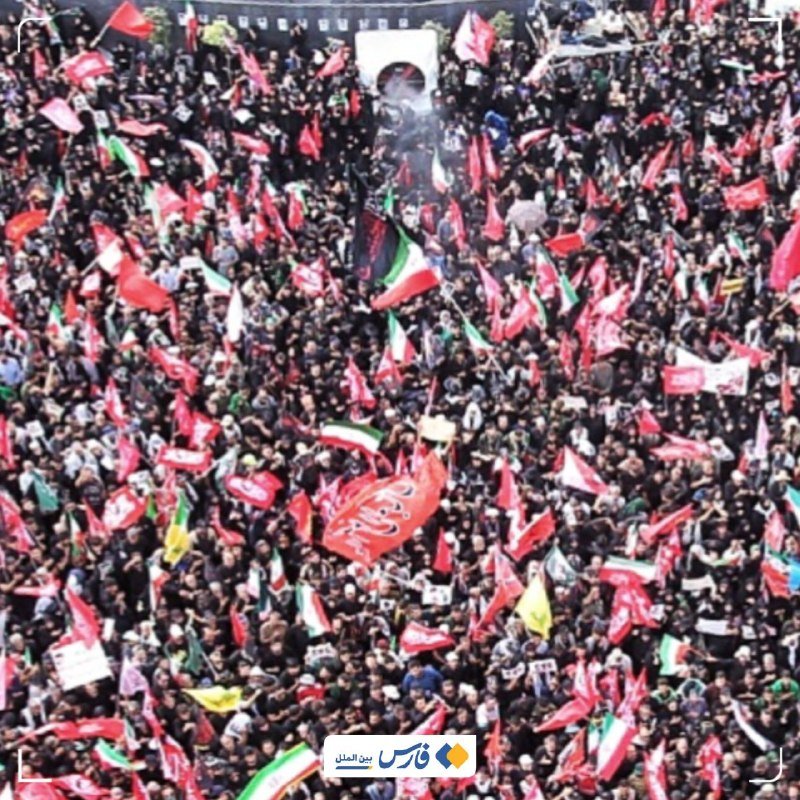
On the afternoon of 4 July 2026, three posts from Al-Alam, the Arabic-language outlet of Iranian state broadcasting, arrived in quick succession. At 16:11 UTC the channel published an image set captioned "from the heart of the farewell ceremony for the martyred leader of the nation… images that summarize loyalty." By 17:09 UTC, mourners had gathered for the Maghrib and Isha prayers in congregation at Imam Khomeini's mosque. Eleven minutes later, footage showed the streets leading to the mosque "full of people" in attendance.
The news, in the narrow sense, is that a farewell ceremony took place in central Tehran. Everything else in the posts — the word "martyred," the choice of Imam Khomeini's mosque rather than any other, the framing of the crowds as embodying "loyalty" — is editorial. That is the point worth lingering on.
What the text is actually doing
The three captions function as a sequence rather than three independent reports. First, a curated still set anchors the emotional register; the word "loyalty" is doing the heavy lifting, asking the reader to read the photographs as evidence of a national disposition rather than as documentation of a single afternoon. Then a beat covering the congregational Maghrib and Isha prayers explicitly binds the gathering to a religious calendar and a sacred site. Finally, video of the surrounding streets is offered as confirmation that the initial image was representative.
This is not journalism. It is a ritual text that uses a Telegram channel to perform mourning for an audience that already knows the answer to every factual question it might ask. The state-aligned outlet assumes the reader shares its grammar of grief, and writes accordingly.
The packaging problem for foreign desks
Western wire reporting routinely compresses material like this into a single descriptive paragraph: "state media showed large crowds at a funeral in Tehran." That treatment is more accurate than Al-Alam's own framing and considerably less informative, because it strips out the lexical architecture — the use of "martyr," the religious timing, the loyalty vocabulary — that is itself the message.
The structural dynamic is familiar. Rival press ecosystems produce exactly the kind of text that fits cleanly into each other's dismissal. A Western editor reads "martyred" and writes a one-liner that treats the underlying claim as an editorial affectation, costing nothing; the underlying claim costs everything for the people it organises. The two sides never actually meet on the page. The reporting does not even register that there is a meeting to be missed.
Why the stagecraft matters beyond Iran
A farewell ceremony is always at least two events: the personal one and the political one. The personal one belongs to the bereaved. The political one belongs to anyone whose position, coalition, or program is being bound up with the deceased's biography. The clips circulated by Al-Alam are doing the second kind of work. Frames that read as devotional inside Iran read as choreographed outside it, and the choreography is the news.
Iranian outlets are not the only producers of this register, and they are not the only audience for the dismissal it provokes abroad. Coverage that treats choreographed state mourning as the obvious product of state media, without analysing the production, ends up restating the regime's terms while appearing to debunk them.
The underexamined bit
The sources disclose almost nothing about the missing context: who exactly is being mourned, when the figure died, how the death occurred, who is expected to succeed, and how the day's program fits into a broader calendar. They disclose everything about how the regime wants that context to land. The gap between those two disclosures is where serious reporting has to operate.
Monexus is treating these posts as raw material, not as a finished story. Staff note: where Al-Alam performs consensus, we report the performance — the sources on file describe ceremony and crowd, and nothing about the underlying event that occasioned it.
Wire provenance
This editorial synthesis draws on the following public wire/social posts:
- https://t.me/s/alalamfa
- https://t.me/s/alalamfa
- https://t.me/s/alalamfa