Joey Chestnut's Eighteenth Mustard Belt, and the Market That Knew It Was Coming
A prediction market priced Chestnut's 18th title at 96% before a single bun was buttered. The bet, not the bratwurst, is now the story.
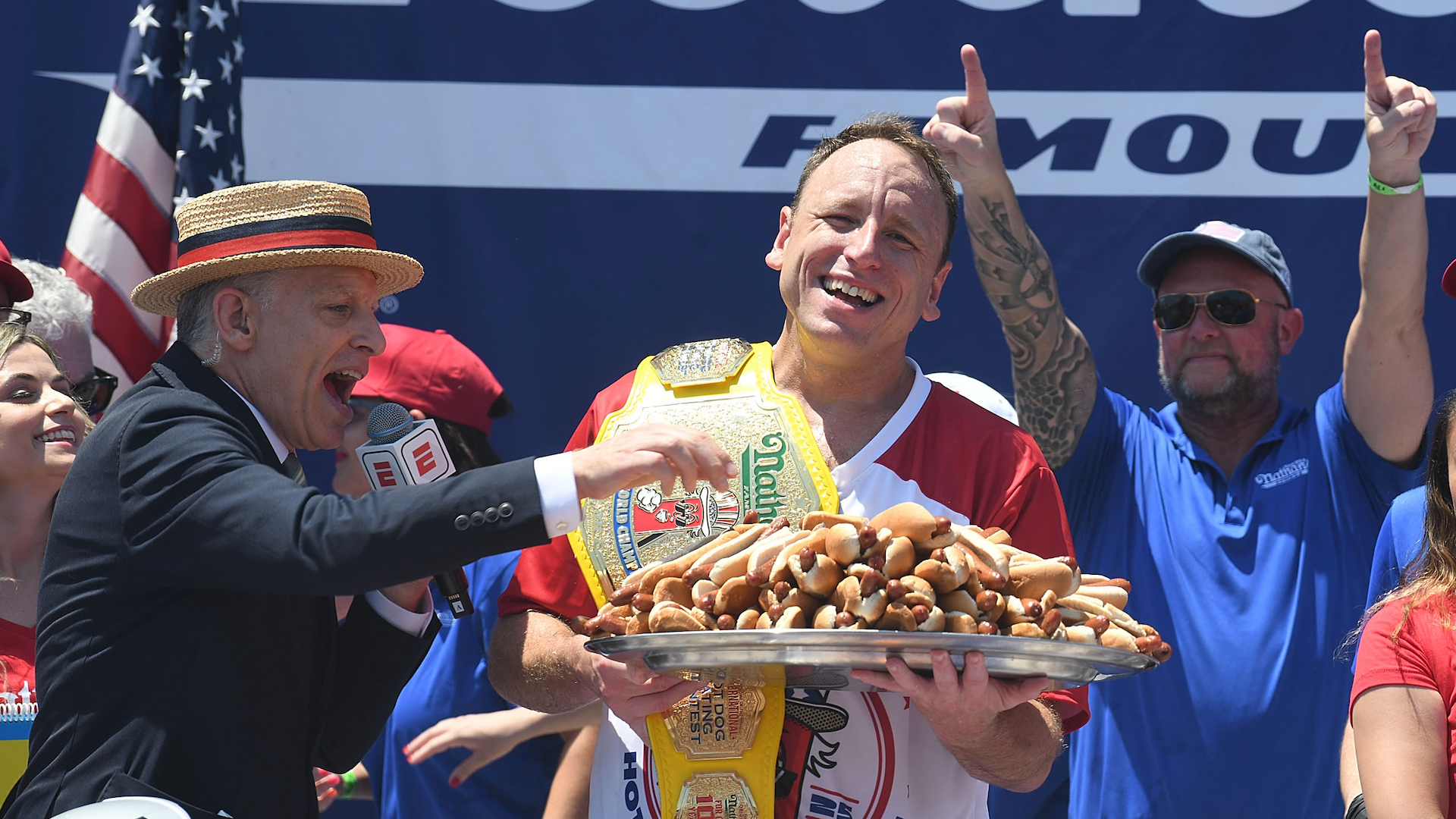
At 17:42 UTC on 4 July 2026, a market-pricing outfit posted a single sentence of American sports trivia to its followers: Joey Chestnut now owns as many Nathan's titles as the Boston Celtics own NBA championships. The cleverness of the line is beside the point. The signal underneath is that a contract for Chestnut's 18th Mustard Belt had been trading all week at a price best understood as certainty. Polymarket's own feed put the implied probability at 96% roughly three hours before the contest began, then confirmed the result at 17:30 UTC when Chestnut downed 66 hot dogs on the board at Coney Island. A prediction market, in other words, less predicted the outcome than priced it — and priced it with enough confidence that a casual observer would be right to ask what, exactly, the market thinks it is doing.
The headline to write is not that Chestnut won. Chestnut winning is a calendar event, the way the sun rising is an astronomical one. The headline is that a financial instrument now sits on top of that calendar, treating a competitive-eating final the way it would treat a rate decision — assigning a probability, laying off risk, and publishing a number that the rest of the internet will quote as fact. That is a quiet kind of cultural annexation.
From hot dogs to high-frequency culture
Polymarket's 96% print is not, on its own, surprising. Chestnut has been the prohibitive favourite at Nathan's for the better part of a decade; the only real competition the market has priced in over the last several renewals is the question of margin. What is new is that a public-facing prediction venue is now editorialising the contest in real time, with a tone that treats a glizzy as a macroeconomic indicator. The 17:42 post — the one comparing Chestnut's belt haul to Boston's seventeen banners — is illustrative. It is written like a sports bookie's dispatch, but it is dressed in a kind of cultural-celebrant register that older outlets used to reserve for genuine novelty.
The effect on coverage is the actual story. A prediction market has, for the first time at scale, a financialised stake in how an American tradition is described — and therefore a financialised stake in who gets quoted, which stats get amplified, and which framings live beyond a 24-hour news cycle. The contest itself is a footnote. The contract is the lead.
The gambler was always there
It is worth resisting the temptation to treat this as a clean break. Wagering on Coney Island outcomes is older than most of the platforms now offering to take the bet: prop sheets have lived on a Coney Island bar since long before blockchain settlement made such things legible to a wider audience. What changes is the distribution of the bet, the legibility of the price, and the audience that the price will reach. A bar-tab wager at the beginning of the contest is forgotten by sunset. A 96% probability pinned to a public feed at 14:26 UTC on 4 July lives forever on the open ledger — and it is precisely the kind of artefact that other newsrooms will quote, even when those newsrooms do not themselves trade the contract.
That is the cultural work a prediction market does in 2026. It is not just a place to put money. It is a place that produces the sentences that the rest of the press can no longer ignore.
Why this one matters less than the model
A reader sceptical of the entire genre — and there is a respectable case to be made — would say: a hot-dog contest is a hot-dog contest, and the financial wrapping adds nothing the times-table could not already tell us. That is fair. The 66-dog total is a Chestnut-class result, well within the range of his last several Fourths, and the comparison to the Celtics' seventeen titles is a parlour-trivia flourish, not a thesis.
But the absence of a thesis is the product. A market that can post a 96% number three hours before the event, then publish the result seventeen minutes after, trains its audience to read the rest of the day the same way: as a ledger of pre-priced certainties, awaiting confirmation. That is a structural change in how a public consumes its news — and a contest like the Nathan's final, precisely because the outcome is so legible and so un-serious, is the training data.
The stake for the rest of the year
Three things to watch through the back half of 2026. First, the venues — if prediction markets can write the lede on a hot-dog contest, they can write the lede on a Fed meeting, a CPI print, or a NATO summit, and the friction between those two writing styles is where the journalistic collisions are coming. Second, the regulators — the legality of event-contract trading on American cultural fixtures remains contested, and a high-profile Nathan's resolution is the kind of headline that brings a congressional staffer to a hearing. Third, the audience — the broader American public, asked to absorb a new category of market-flavoured storytelling every news cycle, will eventually decide whether the price tag is information or noise.
Chestnut's eighteenth Mustard Belt is, in the end, a hot dog. The market around it is the meal.
For this piece, Monexus treated the prediction feed as a wire source rather than as analysis, leaning on its own probability print and confirmation post rather than on secondary commentary, and reporting the contest result as a settled fact rather than as a continuing story.
Wire provenance
This editorial synthesis draws on the following public wire/social posts:
- https://t.me/polymarket/1625864fdf
- https://t.me/polymarket/1625864fdf
- https://t.me/polymarket/1625864fdf