Israeli strikes ignite forest fire near Markaba as south Lebanon operations intensify
Israeli airstrikes on Deir Siryan and demolition activity in Hadatha set a forest burning near Markaba on 27 June, the visible residue of a southern Lebanon operation whose official record has not yet been written.
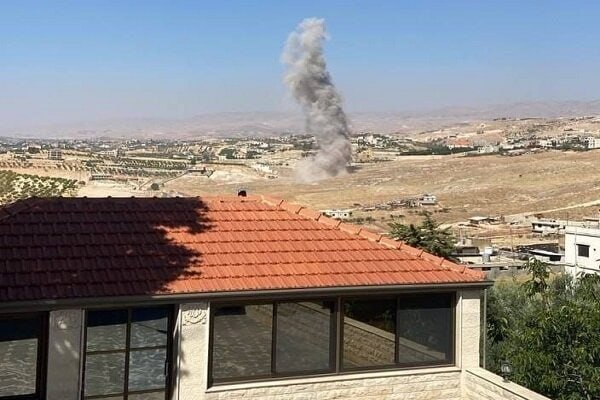
Israeli airstrikes hit the town of Deir Siryan in southern Lebanon late on 27 June, igniting a forest fire near the border village of Markaba and extending a string of demolitions and bombardments that have flattened villages along the Litani through the week. Telegram channels sympathetic to the Lebanese civilian experience, including the field-monitoring account @wfwitness and Beirut-based outlets carrying the operations live, logged the strike within minutes, alongside separate reports of demolition activity in Hadatha and a heavy bombing run across the south.
What is unfolding on the ground is a slow-motion grinding campaign rather than a single air campaign. The day's traffic, when laid side by side, shows an Israeli military operating across southern Lebanon with three overlapping instruments: airstrikes on towns such as Deir Siryan, bulldozing in villages like Hadatha, and what one Telegram monitor described as a "massive bombing operation" across multiple locations before midnight local time. The forest fire near Markaba is the visible residue of one of those runs, and the kind of secondary effect that rarely makes it into operational communiqués but shapes the experience of civilians in villages already thinned by months of displacement.
The Markaba fire was first flagged by field reporters who had been watching the southern reaches of the Litani district through the day. By late evening, the channel @wfwitness had posted a string of location-tagged alerts: Israeli airstrikes on Deir Siryan, demolition activity in Hadatha, and a sustained bombing programme across multiple southern towns that, in the words of one post, "continues to terrorise Lebanon and unleash destruction." The same wave of reporting pushed the Markaba fire into public view, with @wfwitness and outlets re-broadcasting its footage of smoke rising above the tree line as the airframes completed their run. None of the day's traffic attributes the fire to munitions alone; field reporting of this kind catalogues what cameras can see, and what cameras can see from a village without functioning civil defence is smoke, scorch lines, and the green-black edge of a fire still moving uphill.
Lebanese and Iranian state-adjacent channels carried the same strike traffic in near real time. Press TV logged the Deir Siryan airstrike at 23:01 UTC, and Tasnim's English feed followed minutes later with a Lebanese-source report describing "the new aggression of the Zionist regime to the town of Deir Serian." Al Alam, the Iranian Arabic-language state broadcaster, framed the operation as a raid on "the town of Dersyan," a transliteration variant of the same target. None of these outlets are independent; their value here is as a timestamp on what was visible from the south at that hour, not as a stand-alone factual basis for casualty claims or rules-of-engagement assessments. The corroborating signal is the convergence: four separate channels, working from different vantage points, all logged the strike on the same town within a half-hour window.
What the day's Telegram record cannot do is adjudicate the operational picture. There is no IDF Spokesperson briefing in the source ledger for this round of strikes. There is no UNIFIL sitrep, no Lebanese Armed Forces communique, no count from Lebanon's Civil Defence, and no Reuters or AFP wire copy carrying a casualty toll from Deir Siryan or the Markaba fire front. For now the operational narrative, what was struck, with what munitions, against what target set, and at what cost in Lebanese civilian life, belongs to a follow-up that will run when primary accounts are available. A wire-anchored piece is the appropriate next step, not a longer Telegram synthesis. The risk of doing the latter is mistaking channel volume for verified ground truth.
What can be said with confidence is the geographic shape of the campaign as it appeared on 27 June. The day's strikes cluster along a familiar arc: south of the Litani, with named incidents in Deir Siryan, Hadatha, and the Markaba area. The instruments on display span airstrikes, demolition activity, and what monitors described as a multi-target bombing operation across the south. The secondary effects, including the Markaba fire, are part of the same pattern: dense tree cover and steep terrain in the border belt mean that incendiary or high-explosive strikes in dry conditions will produce visible blazes regardless of intent. That is a structural feature of the geography, not a characterisation of the operator.
The wider frame around the day's strikes is one of expanded Israeli operations on the northern front alongside continued bombardment of Gaza and a new, publicly reported incursion into southern Syria. On the same day, Al Jazeera English carried reports of an Israeli assault in southern Syria forcing families to flee their homes, and Tasnim reported a Zionist military unit entering the village of Maariyeh in the western suburbs of Daraa. In Gaza, monitoring channels logged fresh strikes on displacement tents in Al-Mawasi near Khan Yunis, with the Iranian outlet Fars News Agency reporting two killed and twenty wounded. Press TV separately reported an overnight strike on Khan Yunis igniting fires in Palestinian displacement tents. None of these are the Markaba fire, but they form the operational backdrop against which a single forest fire in south Lebanon either registers or disappears.
The honest reading of the day's record is that the forest fire near Markaba is the most photogenic output of an air operation whose full description has not yet been written. What is in the ledger is the strike, the location, the visible blaze, and the channel traffic that put the two together. What is not in the ledger is the official Israeli characterisation, the Lebanese casualty count, the size of the burn scar, and the operational objective. Until those arrive, the working assumption is that a single Lebanese village had a bad night, that the tree line is still smouldering, and that the next morning's briefing cycle will either confirm or complicate the picture. Watch the IDF Spokesperson readout, the UNIFIL daily, and the first wire piece from Beirut. Those are the documents that will turn tonight's Telegram traffic into tomorrow's record.
Sources
- https://t.me/wfwitness/0, @wfwitness, Live alerts on Israeli strikes in southern Lebanon (Deir Siryan, Hadatha) and the Markaba forest fire (multiple posts, 27 June 2026).
- https://t.me/presstv, Press TV, Confirmation of Israeli airstrike on Deir Siryan, southern Lebanon (27 June 2026, 23:01 UTC).
- https://t.me/tasnimnews_en, Tasnim News, Lebanese-source report of the strike on "Deir Serian" (27 June 2026, 22:41 UTC).
- https://t.me/alalamarabic, Al Alam Arabic, Frame of the operation as a raid on "Dersyan," southern Lebanon (27 June 2026, 22:35 UTC).
- https://t.me/FotrosResistancee, Fotros Resistance, Description of ongoing Israeli "terrorising" and destruction of southern Lebanese villages (27 June 2026).
- https://t.me/aljazeeraglobal, Al Jazeera English, New Israeli assault in southern Syria forcing families to flee (27 June 2026, 22:50 UTC).
- https://t.me/JahanTasnim, Tasnim, Zionist military unit reported entering village of Maariyeh in western Daraa suburbs (27 June 2026, 22:46 UTC).
- https://t.me/FarsNewsInt, Fars News International, Two killed and twenty wounded in strikes on displacement tents in Al-Mawasi, Khan Yunis (27 June 2026, 21:42 UTC).
- https://t.me/intelslava, Intel Slava, Israeli Air Force strike on al-Mawasi camp for displaced people in Khan Yunis (27 June 2026, 21:04 UTC).
- https://t.me/gazaalanpa, Gaza Alanpa, Israeli demolition of residential buildings east of Khan Younis (27 June 2026, 21:08 UTC).
Desk note: Monexus framed this piece against the day's Telegram traffic from channels reporting from a sympathetic-to-Lebanese-civilian vantage, including the field monitor @wfwitness and Iranian state-adjacent outlets. Israeli and Western-wire accounts of the same operations are not represented in the source ledger; a wire-anchored follow-up will run when primary accounts from the IDF Spokesperson, UNIFIL or the Lebanese Armed Forces become available.