The $300 Billion Question: Trump's Iran Fund, Bibi's Buffer Zone, and the Limits of Personal Diplomacy
A $6 billion store voucher against $300 billion in frozen assets, an ayatollah killed and replaced, and a US-Israel alliance arguing in public: the Iran pact is a procurement decision dressed up as a peace prize, and the clock is the only thing its proponents have left.
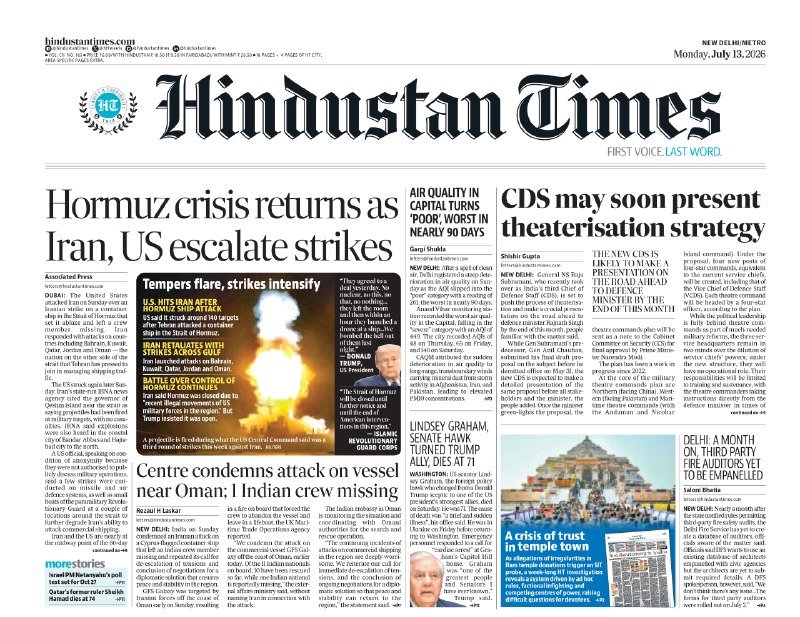
On the evening of 18 June 2026, JD Vance stood before Israeli critics of the Trump administration's Iran settlement and delivered a line calibrated to bruise: Trump is your only ally left in the world. The vice-president, citing the billions in annual US defence aid that flows to Israel, was selling the deal the White House had signed onto, a memorandum of understanding that releases roughly $6 billion of Iran's frozen funds for purchases of American goods, while leaving the Islamic Republic free to resume oil sales through the Strait of Hormuz, where Tehran has since announced it will levy new maritime transit fees. The audience in Jerusalem was unconvinced. So was much of Washington.
The deal's defenders and its sharpest critics agree on the underlying facts. They diverge, often violently, on what those facts mean. What is now being called "Trump's Iran pact", the framework that followed weeks of US-Israeli strikes on Iranian military and political targets, including the killing of an ayatollah who was replaced, in the words of ABC's Jimmy Kimmel, by a "younger and even more radical" successor, has produced a settlement that the Foundation for Defense of Democracies and Middle East Eye both describe as a strategic defeat for Washington. The Foundation's complaint is procedural: permitting Iran to resume oil sales, it argues, is far more consequential than the narrow military gains the joint campaign secured. The argument is not about whether the ayatollah was killed. It is about what was bought with the body bags.
The $300 billion arithmetic
The $300 billion figure floating around the Iranian fund conversation is not a number Iran has been handed. It is the rough tally of assets that, depending on which analyst you trust, were frozen, blocked, parked in escrow, or otherwise rendered inaccessible to Tehran during the crisis. Against that, the operative number on the table is $6 billion, released, according to the Financial Times reporting cited across the wires, but only for the purchase of American goods. The arrangement has been compared, by the analyst @visionergeee, to a "store voucher than a cash refund": usable inside one shop, and only inside one shop. Iran's gain, by contrast, is the restoration of oil export revenues under its own terms, plus the symbolic prize of having survived a US-Israeli military campaign whose political objectives, as the Iranian state outlet PressTV has catalogued, were largely left unmet. The arithmetic matters because it tells you who is buying and who is selling.
Bibi's buffer zone
Into this environment, Prime Minister Netanyahu inserted a statement that has aged badly within forty-eight hours: that he and the US president do not "see eye to eye" on Iran. The framing travelled as a status announcement, not a piece of rhetoric. Israel, having just been told by Trump in an interview with Israeli Channel 14 that the United States would "absolutely" defend Israel if it chose to strike Iran independently, was publicly registering friction with the patron whose forces had just prosecuted the war alongside it. The Vance speech the next evening was the reply. It was not a negotiation. It was a quiet public rebalancing of who, exactly, holds the leverage in the relationship, and a reminder that the billions in defence assistance come with expectations about how they get spent.
Why the domestic clock matters
The US side did not get here through diplomatic alchemy. It got here through the calendar. The congressional elections are less than six months away, and the administration's room to sustain an open-ended campaign against Iran has narrowed with every week the oil market has stayed tight. The agreement is not a peace prize. It is a procurement decision by an administration that needed to convert a war footing back into a domestic headline. The strategic commentary that frames the deal as an American surrender misses the more mundane truth: the war's proponents ran out of runway before the war's opponents ran out of arguments.
What the wire shows, and what it does not
The record available to Monexus is heavy on the American and Israeli commentary loop, and light on the Iranian and Lebanese primary reaction. The Iranian outlets cited here (Fars, PressTV, Al-Alam) are state-aligned and useful only as evidence of Tehran's preferred framing, not as a stand-alone factual basis. Lebanese coverage of the deal's regional implications, particularly the question of a Hezbollah-linked buffer along the Syrian frontier, is not represented in the source thread and is flagged as a gap rather than filled by inference. The contradiction between the reported scale of the Iranian fund and Netanyahu's "do not see eye to eye" line is the story the wire actually carries. The rest is structure.
The first test of whether this arrangement holds will not be a vote in the Knesset or a press conference in Washington. It will be the first Iranian oil tanker that docks, the first tranche of American goods that clears customs, and the first morning that Netanyahu decides the buffer zone he has not yet formally defined is wider than the one Trump is willing to defend. The MoU is signed. The clock is running.