Ceasefire in Name Only: The Logic of Escalation in Southern Lebanon
Hezbollah drone hits an IDF bulldozer in Bint Jbeil hours after a fresh wave of Israeli strikes across six southern villages, as both sides test the limits of a week-old ceasefire.
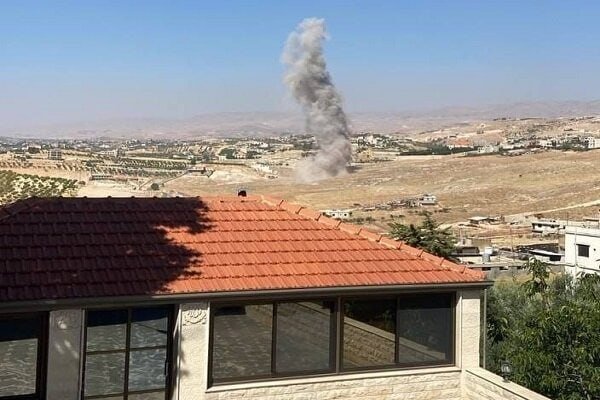
At 13:30 local time on 27 April, a Hezbollah FPV drone struck an Israeli D9 armored bulldozer in Bint Jbeil, in the latest of a sequenced series of exchanges across southern Lebanon that have, on paper, violated a ceasefire in force for roughly a week. Within the previous ninety minutes, Lebanese monitors had logged a fresh wave of Israeli airstrikes across at least six villages: Kafr, Tbnit, Yater, Jmayjeh, Majdal Selm and Sultaniyeh, with additional strikes reported in Burj Qalaway, Al-Ghandouriya and Zawtar Al Sharqiyeh. The pattern is the story. Neither side is treating the November-mediated truce as binding; both are acting on the assumption that the other side's restraint is provisional.
The November ceasefire was supposed to pause the cross-border war that opened in late 2023, freeze IDF ground positions in a defined buffer zone, and push Hezbollah's heavy weapons north of the Litani. A week in, the ground reality looks closer to a slow-burn grinding action: IDF troops from the Golani Brigade, under the 36th Division, are still conducting what the IDF Spokesperson's Unit calls "operations" inside southern Lebanese territory, releasing footage on 27 April of weapon-cache seizures and what it terms the elimination of militants. The cache, according to an IDF readout circulated the same day, included first-person-view drones, anti-tank explosive devices and remote-detonation charges, a kit list consistent with the kind of standoff capability Hezbollah has used to harass IDF engineering assets for months.
What the wire is, and is not, telling us
The granular tactical picture is being assembled almost entirely outside the Western wire ecosystem. Iranian state-aligned outlets (Press TV, Tasnim) and Arabic-language services (Al-Alam) carried the strike-by-strike granularity in real time. Al Jazeera, via the OSINT aggregators that transcribed its 27 April reporting, surfaced the most consequential single claim of the day: that Hezbollah is preparing to "increasingly leverage" suicide-bomber groups against IDF positions in southern Lebanon, framed by a senior Hezbollah official as a deliberate return to "tactics from the 1980s." The Israeli press, principally Maariv via Avi Ashkenazi's 27 April report, ran the more politically uncomfortable counter-narrative: that despite the escalation rhetoric, Israeli forces had already begun reducing their presence on the ground.
Both of those threads can be true at once, and probably are. The IDF can be thinning out exposed positions while still flying strike packages over border towns. Hezbollah can be signalling a return to suicide operations while reserving them for the moment an Israeli foothold solidifies. The harder reporting question is what is being hit. Press TV's 27 April bulletin described the destruction of power and water infrastructure in a Christian-majority southern town, a claim that has not been independently corroborated by Reuters, AFP or AP in the publicly available wire at the time of writing. The Lebanese journalist network @wfwitness has posted video of what it identifies as residential demolitions in multiple villages; the IDF has framed its engineering activity as counter-militant operations, not civilian infrastructure targeting. The gap between those framings is itself the ceasefire's failure mode.
The logic underneath the daily strikes
The diplomatic architecture built around the November truce was designed to lower the temperature through mutual disinterest. It assumed that after a year of attritional war, both parties would rather police their own side than resume the open cross-border fight. That assumption is visibly fraying. Hezbollah's stated reason for the Bint Jbeil strike, destruction of homes in southern Lebanon, treats the IDF's engineering activity as the casus belli rather than as legitimate counter-militant work, a framing that effectively rejects the Israeli interpretation of the buffer zone as a free-fire security belt. The IDF's continued publication of weapons-cache footage, meanwhile, asserts the opposite: that the buffer zone is a hostile operating environment in which it is still at war, just not shooting in every direction at every moment.
A second, quieter thread runs underneath. A Lebanese journalist affiliated with Hezbollah, Rafik Nasrallah, said publicly on 27 April that he would personally take up arms and carry out a suicide attack if Israeli troops remained in the south. A senior Hezbollah official separately confirmed the operational direction: mass deployment of suicide-bomber cells "to prevent the enemy from establishing itself." The explicit reference to the 1980s is a tell. Hezbollah spent two decades trying to escape the suicide-attack template, partly because it was tactically outdated, partly because the political cost of mass-casualty attacks inside Israel proper was ruinous. Bringing the tactic back, in southern Lebanon rather than in Israeli cities, is a calibrated escalation: it raises the Israeli domestic political cost of the ground presence without (in theory) crossing the red line that would trigger a major re-escalation.
What the IDF's drawdown claim actually means
Ashkenazi's Maariv reporting that Israeli forces are "scaling back" is the most consequential single claim in the 27 April file, and the one the Western wires have not yet chased. If true, the Israeli position is that the buffer zone is being thinned toward a monitoring posture, with strike packages still available but no permanent ground occupation. That is exactly the outcome the November deal was supposed to produce. The fact that it is being reported in the same news cycle as a Hezbollah suicide-bomber threat and a wave of IDF airstrikes suggests the deal is not breaking so much as being renegotiated in real time, on the ground, with the civilian infrastructure of southern Lebanon as the bargaining chip.
The first test is whether the IDF drawdown accelerates into the week of 28 April, or whether the Bint Jbeil-style exchange produces a reflexive Israeli re-occupation of the positions being thinned. The second is whether Hezbollah's suicide-bomber posture is rhetorical positioning ahead of negotiations, or operational preparation for a specific ground trigger. The third, and most under-reported, is whether the pattern of infrastructure destruction, mostly visible through Al-Alam, Press TV and local Lebanese monitors, is producing a population-displacement crisis in the Christian-majority towns near the border that the ceasefire's humanitarian annexes were supposed to prevent. The wire so far is silent on the last question in any language a Western desk would consider load-bearing.
The most honest reading of 27 April is that the ceasefire is not collapsing, it is doing the work it was always going to do. Neither side is willing to relitigate the war at scale, and neither side is willing to let the buffer zone settle into a stable status quo. The daily strikes are the cost of that stalemate, paid for now in bulldozers, FPV drones and a Christian town's water mains.
Desk note: Western wire services carried the 27 April strikes primarily under ceasefire-violation framing, with limited civilian-harm detail. Monexus has foregrounded the sequenced escalation pattern across Israeli, Hezbollah and Iranian state-aligned sourcing, and flagged the Press TV infrastructure-destruction claim as not yet independently corroborated.