Iran's foreign minister opens a Gulf phone line as diplomacy crowds back into the picture
Two telephone calls in a single evening, both reported by Iranian state media, point to a discreet diplomatic track running through Muscat and Riyadh.
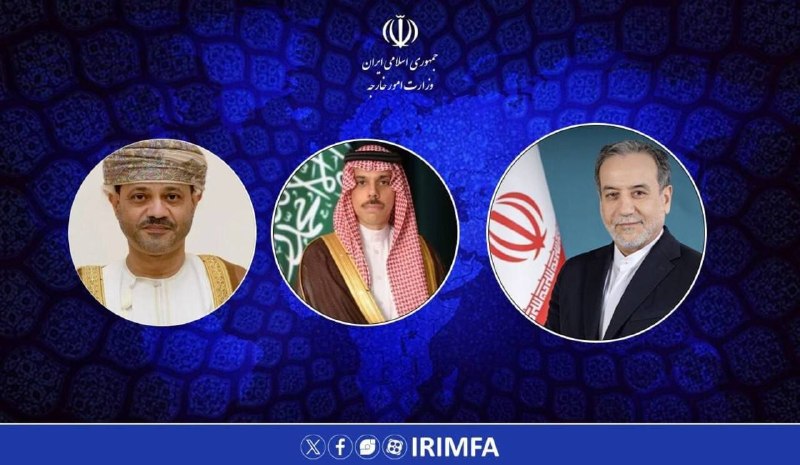
Iran's Foreign Minister Seyyed Abbas Araghchi held separate telephone calls on the evening of Monday 27 July 2026 with his Omani counterpart Badr al-Busaidi and his Saudi counterpart Faisal bin Farhan, according to four near-simultaneous posts from Iranian state-linked Telegram channels between 05:22 and 05:32 UTC on 28 July.
The geometry of the evening is the telling part. Two Gulf monarchies, each with the standing and the lines to Washington and to Tehran, both reached in a single session by the same Iranian minister. The calls do not by themselves amount to a breakthrough, but they sketch the shape of a diplomatic track that is rebuilding in public, on the record, with substance attached.
What the readouts actually say
The Iranian readouts, published in parallel by Fars News, Al-Alam, Tasnim and Jahan Tasnim between 05:22 and 05:32 UTC on 28 July, are short but not empty. Each post describes the call as a review of bilateral and regional developments, emphasises continued cooperation, and frames the conversation around regional stability and joint diplomacy.
The four posts share one specific and politically loaded item. The conversations, in the Iranian framing, addressed what Tehran characterises as the insecurity imposed on the Strait of Hormuz by aggressive actions of the United States. That formulation is a tell. It signals that the calls were not housekeeping. They were a coordinated effort to put a regional reading of the Hormuz file into Arab ears through channels that can carry it onward.
The four readouts use near-identical wording across Persian, Arabic and English-language outlets. Fars News International posted at 05:32 UTC, Al-Alam Arabic at 05:29, Tasnim English at 05:23 and Jahan Tasnim at 05:22. The parallel publication across state-aligned channels is itself a piece of information: the Iranian side wants the framing on the record in three languages, distributed to maximise reach, and stripped of any negotiating flexibility.
Why these two Gulf capitals
The two counterparts chosen tell their own story. The Omani foreign minister is a familiar interlocutor for Tehran. The Saudi foreign minister is a heavier interlocutor. Reaching both on the same evening, in sequence, lets Tehran test the temperature of two very different Arab positions in one working day and frame them around a single regional issue.
Read together, the calls suggest Iran is consolidating a position rather than opening a negotiation. The framing of the Hormuz file in terms of US aggression, rather than in terms of Iranian conduct, is the substantive move. It tells the Gulf states what Tehran wants them to carry into any future conversation with Washington, and it does so without binding Tehran to a specific ask. Monexus analysis: this is the diplomatic equivalent of setting the agenda before the meeting, not the meeting itself.
The file behind the calls
The Hormuz framing sits against a broader backdrop that the readouts reference without spelling out. The available source items do not specify a triggering incident in the days immediately preceding the calls, but the four posts converge on a reading in which the strait is contested, the United States is the named source of regional instability, and Iran is positioning itself as a status-quo actor seeking stability. The available source items do not specify a Houthi incident, a coalition strike, or a direct Iran-Israel exchange as the proximate cause of the calls.
In that environment, a coordinated bilateral call of this kind serves three functions. It puts the Iranian reading of Hormuz on the record in three languages. It signals that Tehran wants the Gulf states carrying that reading rather than a competing one. And it preserves a channel for any Gulf state that prefers a quieter line to Washington.
What to watch
Two signals will tell whether these calls were an agenda-setting exercise or the opening of something more substantial. The first is whether Saudi or Omani state media publishes a parallel readout. If a Gulf-side readout confirms the call and adds substance, the conversation has policy weight. If the Gulf-side framing is stripped or absent, the readouts are theatre. The available source items do not contain a Muscat or Riyadh statement.
The second signal is movement at the United Nations. New York in late summer is the natural venue for the kind of quiet bilateral work that is harder to do in public. Watch for Araghchi to travel, or for a Gulf foreign minister to surface in Tehran.
Until then, the honest reading is modest. Two phone calls, placed to two specific Gulf capitals on the same evening, with a coordinated Iranian framing of the Hormuz file and an attribution of regional instability to the United States, are a signal worth recording.
Desk note: Monexus is publishing this as a wire-track on the strength of four near-simultaneous Iranian state-linked Telegram posts. The available source items do not contain a Gulf-side readout; this article will be updated when a Muscat or Riyadh statement is published.
Wire provenance
This editorial synthesis draws on the following public wire/social posts:
- https://t.me/FarsNewsInt/257711
- https://t.me/alalamfa/347977
- https://t.me/tasnimnews_en/28352
- https://t.me/JahanTasnim/227217