Israeli strike on Al-Hakar area kills one in Deir al-Balah; same-day central Gaza toll harder to pin down
An Israeli strike on the Al-Hakar area south of Deir al-Balah killed one person and injured several others on 27 July 2026, according to Palestinian local and pan-Arab reporting circulated in the late-afternoon UTC window.
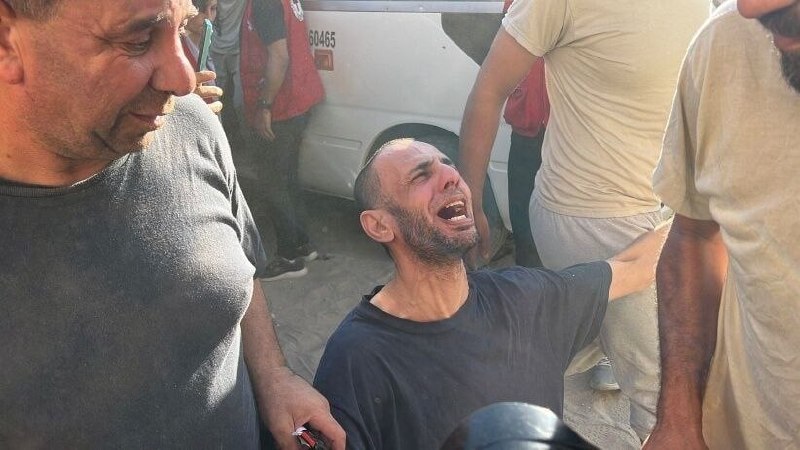
An Israeli strike on the Al-Hakar area, south of the city of Deir al-Balah in the central Gaza Strip, killed one person on 27 July 2026, according to Palestinian local reporting circulated in the late-afternoon UTC window.
The picture that emerges inside the first hour of coverage is consistent on the fatality and noticeably less uniform on the injury toll. Gaza Alanpa, a Telegram channel with on-the-ground reporting in central Gaza, posted at 17:15 UTC that "one person was killed and several others were injured after Israeli forces targeted a group of civilians in the Al-Hakar area, south of Deir al-Balah." A follow-up post from the same channel at 17:18 UTC framed the incident as a drone strike inside the city of Deir al-Balah itself. MintPress News, an outlet that consistently covers the war from a pro-Palestinian editorial vantage, ran a more urgent injury line on X at 17:28 and 17:44 UTC, putting the toll at "one confirmed death as of now & a large number of injuries." Al-Alam Arabic, the pan-Arab broadcaster, posted at 17:50 UTC that "a new Israeli raid targets a gathering of citizens in the Al-Hakar area, south of Deir Al-Balah in the central Gaza Strip."
Monexus assessment: the Al-Hakar strike is the most clearly sourced piece of casualty reporting in this window, but the wider Deir al-Balah toll for the day is more crowded than the five items reviewed here can resolve.
What the sources say, and what they do not
Across the five items, there is convergence on the basic event and divergence on the framing of the injury toll. Gaza Alanpa's two posts use "several others injured," consistent with single-digit to low-double-digit casualties as a tentative reading. MintPress News uses "a large number of injuries," which reads as a higher and less bounded figure and which the channel repeated across two posts ninety minutes apart. Al-Alam Arabic's urgent-format post does not specify an injury count at all, only that a gathering was targeted. The two readings on the injury side are not reconciled in the available reporting; reading them flat together risks a falsely precise number, while reading the lower estimate alone risks understating what the second source actually said. The honest characterisation is that one fatality is the only figure on which all cited sources agree, and that the injury figure is contested at the source level.
The institutional provenance of the casualty figure is not specified in any of the five items reviewed. The wire does not say whether the numbers originate with hospital staff in Deir al-Balah, with local journalists on the scene, or with a Gaza health ministry summary posted later in the day. Monexus has not independently verified the casualty figure beyond the cited channels, and any cross-checking against an independent hospital readout, the Gaza health ministry's daily summary, or wire-service reporting is not present in the five items reviewed for this article.
How the reporting chain works for this kind of incident
The five items reviewed form a recognisable pattern for a single afternoon strike inside central Gaza: a local Telegram channel (Gaza Alanpa) files first within the first twenty minutes, a sympathetic English-language outlet (MintPress News) reposts and amplifies the line on X with sharper injury framing, and a pan-Arab broadcaster (Al-Alam Arabic) rounds the coverage out with a generic urgent-format post. Each of those three layers has a different institutional relationship to the event. Gaza Alanpa is positioned closest to the ground in central Gaza and frames the incident as a drone strike on the city; MintPress is an English-language outlet with a pro-Palestinian editorial vantage and is the layer that introduced the "large number of injuries" phrasing; Al-Alam Arabic is the pan-Arab state-adjacent broadcaster that frames the incident as a raid on a gathering without specifying numbers. None of the five items reviewed carries an IDF Spokesperson briefing, an Israeli English-language outlet attribution of the strike to a specific operational target, or a statement from the Coordinator of Government Activities in the Territories on civilian evacuation in the immediate area. The available wire items do not specify whether the Israeli military has commented on the strike.
How Deir al-Balah fits the larger war
The geography of the strike matters as much as the casualty figure. Al-Hakar sits just south of the city of Deir al-Balah, in a governorate that has functioned for most of the war as the central pressure point where the bulk of the surviving Palestinian civilian population has been pushed. Northern governorates were largely depopulated in the war's earlier phase; Khan Younis in the south was the focus of the subsequent major ground campaign. Deir al-Balah and the surrounding camps, including the camps that line the coastal road, are where the war's operational tempo has been concentrated most recently because that is where displacement has concentrated the population.
Monexus assessment, structural reading: in plain terms, the reason one strike in Al-Hakar produces a news cycle is that Al-Hakar is no longer an outlier, it is the routine geography. Reporting at the granularity of a single news cycle produces patterns that are themselves the operational pattern: a strike, an hour-long local count, a pan-Arab urgent item, then another strike several hours later in the same governorate. The structural reading is that the war in its second phase is an attritional operation across a small and shrinking geography, and the casualty profile from any single afternoon is unrepresentative unless set inside the wider pattern. This article cannot set the wider pattern because the five items reviewed do not cover it; the wider pattern is the kind of thing that a broader wire sweep, including independent casualty trackers and hospital readouts from facilities in Deir al-Balah, would be needed to document.
What the next 48 hours will look like, and what they will not
The forward read is constrained in two directions. First, the institutional posture: the five items reviewed do not specify whether the Israeli military has announced a broader operation in the Deir al-Balah governorate, nor whether a ceasefire framework is in play. Monexus has no independent basis to forecast either. Second, the casualty line: the most natural reading of the MintPress injury framing ("a large number") is that the injury toll could revise upward as hospitals in Deir al-Balah admit the wounded and as local reporters file beyond the first hour; reading the Gaza Alanpa framing ("several") is that the toll may stabilise near the figure already cited. Monexus expects a clarification within 24 to 48 hours from independent hospital reporting or from the Gaza health ministry's daily summary, neither of which is in the wire reviewed here. The question worth watching is not whether the Deir al-Balah toll rises, but whether independent reporting allows a single coherent number to be pinned to any specific strike on any specific afternoon.
Desk note: Monexus framed this strike using the five source items reviewed. The piece does not assert Israeli operational intent beyond what the sources justify, and it does not assert a single casualty figure beyond noting that the cited sources converge on one death and diverge on the size of the injury toll. This publication preserves MintPress News's "a large number of injuries" framing as the higher-bound reading and Gaza Alanpa's "several" as the lower-bound reading rather than averaging or selecting between them, and it states plainly that the Israeli military's posture on this specific strike is not present in the sources reviewed. Where adjacent-strike reporting on Deir al-Balah exists outside this cluster, Monexus has flagged it without importing its casualty figures, since the target, the timing, and the source provenance differ from the Al-Hakar incident.
Wire provenance
This editorial synthesis draws on the following public wire/social posts:
- https://t.me/alalamarabic/490344
- https://x.com/MintPressNews/status/2081798007041962147
- https://x.com/MintPressNews/status/2081793986424127493
- https://t.me/gazaalanpa/24424
- https://t.me/gazaalanpa/24423