Ukraine swaps its top general after days of street pressure
President Zelenskyy dismissed Commander-in-Chief Oleksandr Syrskyi on 21 July 2026, naming Major General Mykhailo Drapatyi to lead the Armed Forces after several days of protest in Ukrainian cities.
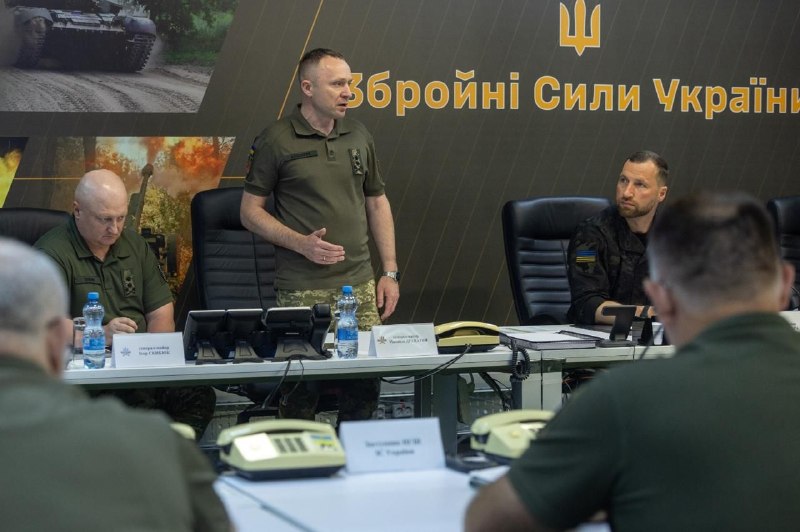
At 19:40 UTC on 21 July 2026, the War Front Witness channel posted a one-line flash: President Volodymyr Zelenskyy had dismissed General Oleksandr Syrskyi as Commander-in-Chief of the Armed Forces of Ukraine and appointed Major General Mykhailo Drapatyi to replace him. Within twenty minutes the same news, in almost identical wording, was on the channels of noel_reports, RN Intel, OSINT Live and Megatron Ron. By 20:09 UTC Drapatyi was on the record himself, thanking Zelenskyy "for his trust," the defence minister for support, and the Armed Forces "for a new stage of service." The change had been rumoured for less than an hour before it became fact.
The speed of the announcement, and the public thanks that followed it, were not the whole story. Deutsche Welle's reporting on the same day ties the dismissal directly to "days of protests in Kyiv and other Ukrainian cities calling for the removal of commander-in-chief Oleksandr Syrskyi." In other words, this was not a quiet rotation. It was a civilian-pressure-driven reset at the top of a country at war, executed inside a single news cycle, with the streets already conditioning the outcome before the presidential decree was visible.
A change at the top, in plain sight
The mechanics were unusually transparent. The OSINT Live channel, citing RBK-Ukraine, framed Drapatyi as the incoming chief at 19:48 UTC, more than ten minutes before the formal announcement posted on War Front Witness. RN Intel carried the story twice within six minutes: first as "unconfirmed reports," then as confirmation. By the time noel_reports published Drapatyi's own statement of thanks, the political fact and the personal acknowledgment were already paired in the same feed.
That sequence tells the reader something about how wartime Kyiv now communicates. Telegram channels operating close to the presidential office and the general staff moved in lockstep with the wire services. Drapatyi's thanks to Syrskyi were not boilerplate. They were an implicit signal that the rotation was framed as institutional continuity, not repudiation: the new chief publicly credits the man he replaces. The framing matters for morale, and for the European capitals tracking the change.
The street pressure that preceded the decree
Deutsche Welle's headline does the work the wire would normally bury in paragraph six: the dismissal followed protests. Ukrainian cities had been demanding Syrskyi's removal. The scale, the exact demands and the organisers are not specified in the items available to this publication. What is specified is the causal order. Protest first. Dismissal second. Statement third.
That order is itself the news. Senior military commanders in a country fighting a full-scale invasion are not normally moved by street demonstration; rotation is supposed to be a strategic choice made behind closed doors. Here, the public square set the timetable. The risk for Kyiv is obvious. If civilian pressure can remove one commander-in-chief, it can remove another. The risk for an embattled general staff is equally clear: operational planning now has to account for an additional, unpredictable variable.
What changes, and what does not
Drapatyi arrives as a known quantity to the Ukrainian defence audience. The Telegram items identify him by his current rank (Major General) and thank Zelenskyy and the defence minister in the same breath. What the available sources do not specify is his prior command record, his doctrinal preferences, or his relationship with the brigade commanders who have spent four years learning how to fight this particular war. A new commander-in-chief does not change the front line on the day the decree is signed. It changes who decides where the reserves go, how mobilisation is sequenced, and which territorial compromises, if any, are tolerable.
What also does not change is the premise the country is operating under. Ukraine is the invaded party. Russia is the aggressor. Syrskyi's removal does not alter that, and the protest movement that helped force it did not, in the items available to this publication, argue otherwise. The dispute was over how the war is being fought, not over whether it should be fought.
Stakes, and what to watch next
Three things are worth tracking in the days ahead. First, whether the General Staff publishes any doctrinal signal, a change in rhetoric on mobilisation, on fortifications, on brigades identified as underperforming. Personnel changes without doctrinal change are rotation; personnel changes with doctrinal change are reorientation. Second, whether the European and American capitals, who have spent the last year calibrating aid packages against Syrskyi's specific requests, see continuity or rupture. Third, and most delicate, whether the street pressure that produced this result recedes or whether it now treats Drapatyi as the next target.
What remains genuinely uncertain, and the sources do not resolve it, is the substantive critique that drove the protests. Deutsche Welle confirms the existence of demonstrators; it does not enumerate their demands. Without that ledger, the rotation is intelligible as event but not yet as argument. The next forty-eight hours will tell whether Drapatyi inherits a manageable reform agenda or an open-ended one.
This publication treats the rotation as a wartime command change driven by domestic political pressure, not as a foreign-policy reversal. Ukraine's Western alignment and its right to defend its territory are not in dispute in the source material; the dispute was over military leadership.
Wire provenance
This editorial synthesis draws on the following public wire/social posts:
- https://t.me/noel_reports
- https://t.me/megatron_ron
- https://t.me/rnintel
- https://t.me/osintlive
- https://t.me/wfwitness