Trump's Lebanon pivot and the Iran arithmetic
At the White House on 21 July 2026, Donald Trump posed for cameras with Lebanon's president and told reporters that Tom Barrack is Lebanese. Hours later he told the same room that Iran would take 20 to 25 years to rebuild. Both lines came from the same podium, and the contradiction is the story.
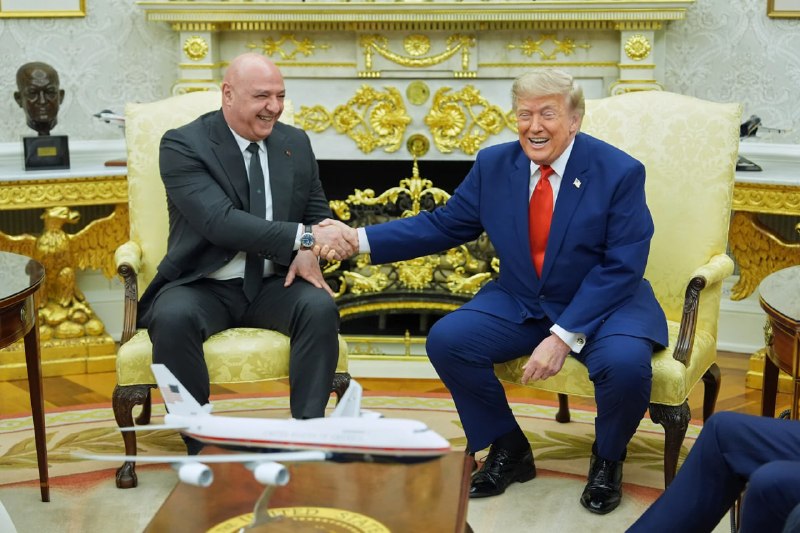
At 15:30 UTC on 21 July 2026, Donald Trump stood next to Lebanon's president in the Oval Office and delivered a sentence that did no diplomatic work at all. "It's a great pleasure to be with the President of Lebanon, who's highly respected in this country and actually long beyond this country," the US president said, before pivoting to his ambassador. "Tom Barrack Is Lebanese," he added, as though the fact of his envoy's ancestry were itself a foreign-policy credential. Twenty-five minutes later, at 15:53 UTC, the same podium carried a harder message, this time aimed east: "There are no signs that Iran is ready to stop fighting." By 16:01 UTC the arithmetic had been made explicit. "If we left right now, it would take Iran 20 to 25 years to rebuild. We are not leaving right now."
Three sentences, one afternoon, and the entire US Middle East playbook for the second half of 2026 laid out in miniature. Lebanon gets the soft-pedal courtesy of an ancestral joke. Iran gets a clock. The two are not separate files; they are the same file, viewed from two ends of a corridor that runs from Beirut to Tehran.
The Lebanon show, and what it isn't
The optics matter, because Lebanon optics rarely matter in Washington. A sitting US president publicly claiming ownership of a Lebanese-American envoy is the kind of gesture that reads as warm, even folksy, in translation. It is also a tell. Barrack, the Trump-appointed special envoy, has spent the past year trying to thread a needle between Hezbollah's residual state presence, a fragmented Lebanese army, and a banking sector that has been functionally insolvent since 2019. He is a fixer, not a peacemaker, and the president's invocation of his ethnicity was a signal to the room that the channel of communication runs through family ties rather than through formal Lebanese state institutions.
That matters because the formal Lebanese state, as represented by the visiting president, has very little to deliver. There is no ceasefire to broker, no prisoner file to close, no border demarcation to ratify. What there is, is a slow-motion effort to keep the country from sliding back into the kind of multifront collapse it avoided by accident in 2024. The White House meeting was not a peace process. It was a holding action.
The Iran arithmetic
Three minutes after the Lebanon photo-op ended, a reporter put the obvious question: if Iran is not ready to stop fighting, what is the plan? Trump's answer, delivered at 15:57 UTC, was the administration's most candid description yet of the damage calculus. "We are degrading them at levels that nobody thought was possible. They're being degraded really seriously. They did slip something through in Jordan, and…" The sentence trailed off, but the framework was already on the record. The US is not pursuing a decisive strike. It is pursuing a depreciation, the slow grinding-down of an adversary's capacity to project force, with the explicit admission that some attacks will land in spite of the campaign.
The 20-to-25-year rebuild figure is the load-bearing claim. It implies that the United States intends to stay in the region long enough for an entire generational cycle of Iranian rearmament to be foreclosed. That is not a negotiating posture. It is a horizon. The phrase "we are not leaving right now" is the closest a serving US president has come in this term to declaring an open-ended garrison commitment, and it was delivered off the cuff, in a press spray, without a single line of prepared text behind it.
Why both messages land on the same day
The temptation is to treat Lebanon and Iran as separate desks. They are not. The Lebanese state is the southern flank of the Iranian axis. Hezbollah's reconstitution budget, whatever remains of it, flows through Beirut's banks and Beirut's ports. A Lebanese government that can hold itself together, even at the current low level of functionality, removes one vector of Iranian pressure. A Lebanese government that cannot hold itself together hands Tehran a free forward position. The Trump administration's decision to photograph itself with the Lebanese president on the same afternoon that it announced an indefinite Iran timeline is therefore not a coincidence. It is sequencing.
This is also where the standard Western framing of "Trump the dealmaker" breaks down. There is no deal on offer that Lebanon's president can sign and Iran cannot void. What is being offered instead is duration. The US message, compressed into an afternoon, is: we will outlast you, we will degrade you, and we will keep the southern shore of your sphere of influence just stable enough that you cannot use it. The 20-to-25-year line is the price tag.
The contradiction left standing
There is one obvious tension the day's briefing did not resolve, and it is worth naming. The president claimed Lebanese-American kinship as a credential, then described an indefinite US military presence aimed at the regional patron of Lebanon's most powerful armed non-state actor. The Lebanese president, seated beside him, did not visibly flinch. That composure is itself a fact worth tracking, because it suggests Beirut has already priced in the trade: quiet on the southern border, tolerance of Israeli overflight, and banking-sector forbearance from Washington, in exchange for not being treated as an Iranian asset. Whether that price is sustainable through Lebanon's next electoral cycle is the open question, and it is the one the press spray was designed not to answer.
What remains uncertain is whether the 20-to-25-year rebuild figure is an estimate or a threat. The administration offered no methodology, no intelligence citation, and no comparison class. Iranian reconstruction capacity after the 1980-88 war was faster than that; reconstruction capacity after the 1991 Gulf War was slower. The number is doing rhetorical work, not analytical work, and that is the tell. The plan, insofar as one exists, is to keep the metronome running and let the compounding damage do the talking. The Lebanese visit was the soft instrument; the Iran line was the hard one. Both came from the same mouth, on the same day, in the same room.
Desk note: Monexus has framed the 21 July White House spray as a single integrated signal rather than two unrelated stories, on the strength of the timing and the explicit degradation language used by the president himself. Wire coverage has tended to split Lebanon and Iran into separate ledes; the structural read is that they are one policy.
Sources
- https://t.me/wfwitness/1421
- https://t.me/wfwitness/1422
- https://t.me/wfwitness/1423
- https://t.me/wfwitness/1424
- https://t.me/wfwitness/1425
Wire provenance
This editorial synthesis draws on the following public wire/social posts:
- https://t.me/wfwitness/1425
- https://t.me/wfwitness/1424
- https://t.me/wfwitness/1423
- https://t.me/wfwitness/1422
- https://t.me/wfwitness/1421