Spain's parade and the BBC's rout: the day after the 2026 World Cup
La Roja returned to Madrid on an open-top bus less than 24 hours after lifting the trophy in a 1-0 final win over Argentina, while back in Europe the BBC's 9.7m average audience relegated ITV to also-ran.
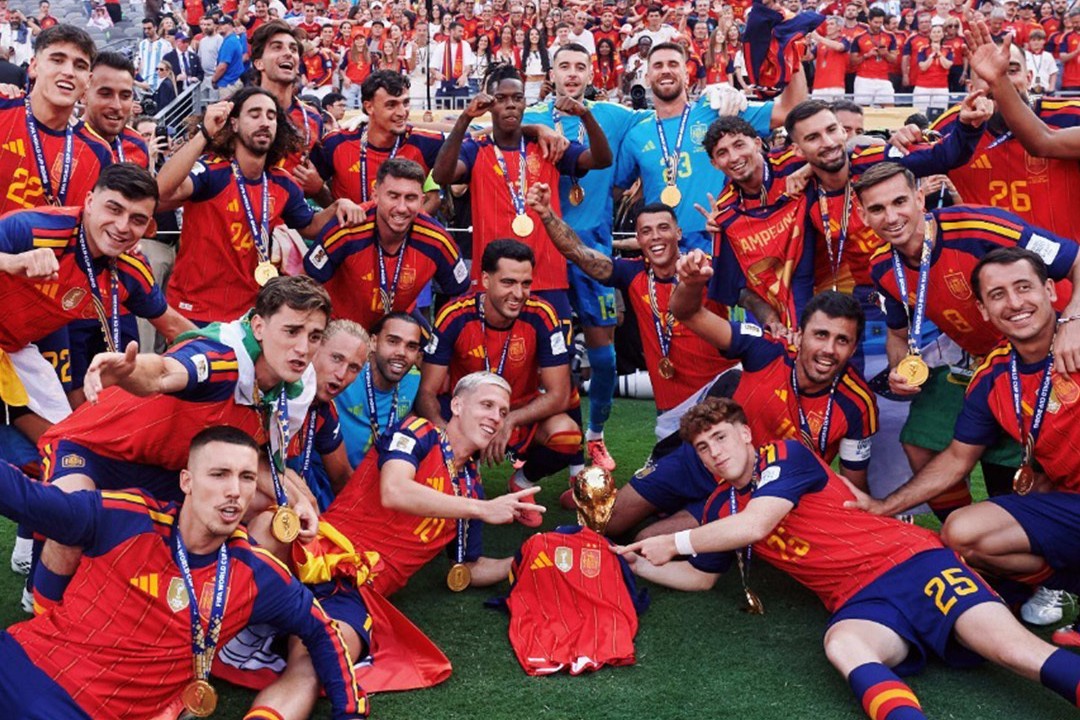
Less than twenty-four hours after Luis de la Fuente's side beat Argentina 1-0 in extra time, Spain's World Cup-winning squad climbed onto an open-top bus in Madrid on 21 July 2026 and rolled through the capital in front of supporters who had waited a generation for this. The route was short, the sun was high, and the mood, by every visual cue, read more like a national exhale than a parade. France 24's overnight footage showed the team reuniting with fans in the centre of the city on the morning after the final, the trophy held aloft at the front of the bus.
That image is the easy one. The harder one is what the broadcast numbers say about who got to watch the moment, and how lopsided that audience has become. According to figures first published on 20 July, the BBC pulled an average audience of 9.7 million for the final, roughly four times what ITV managed on its sister broadcast, and a margin comparable to the public broadcaster's lead four years earlier in Qatar. The argument in British pubs and on British timelines right now is not whether Spain deserved it, but whether the public-service answer to who shows a final has become so structurally inevitable that the private challenger no longer shows up as a competitor at all.
The Madrid morning
The Spanish capital awoke to a transformed cityscape. According to a France 24 dispatch published in the early hours of 21 July UTC, La Roja's players arrived back in Spain and were driven through central Madrid aboard an open-top bus, with the route lined by supporters who had gathered overnight. The report framed it as a reunion under twenty-four hours after the final whistle, with head coach Luis de la Fuente and his squad saluting the crowd at the bus's open top. Reuters, in a parallel wire filed the same morning, confirmed the celebratory tone but pointed to a quieter contrast: Argentina's squad, beaten in the final in extra time, received a markedly more muted welcome, with several key players still abroad on club duty at the time of the report.
The asymmetry is real, and not just an artefact of scheduling. Argentina's depth in Europe means that even a final appearance can disperse a squad across four or five training grounds within a day of the trophy lift. Spain, by contrast, returned home as a tighter unit. The open-top bus is a Spanish habit in these moments, but the level of crowd density along the route, in the seconds captured on rolling news, was clearly elevated by the trophy itself. A final win on home broadcast timelines always produces a louder welcome than a final loss abroad; what distinguishes this reception is its scale.
The figure nobody can ignore
The broadcast story runs in parallel, and it is the more durable one. The BBC's 9.7 million average for the final, reported in UK media on 20 July 2026, restored a gap that had briefly looked narrower in the run-up. ITV, which shared rights to the tournament under the long-standing UK rotation, finished the final with around a quarter of the BBC's peak audience and roughly a quarter of its average. Studios have been dissected, pundit line-ups compared line by line, and the format choices on each side debated, but the structural explanation is duller, and the structural explanation is the one that matters: the BBC's reach into UK households is, on the nights that matter, simply deeper than any pay-TV competitor's. The relative margin looks similar to Qatar 2022, which points to a long-run feature of UK viewing rather than a one-tournament accident.
The geopolitical subtext is that free-to-air public broadcasting, in a market that has splintered across streaming, retained the ability to gather the country in one room for a single scheduled event. That is a fact with implications beyond sport: it is the same fact that makes the BBC an essential emergency-information broadcaster during crises, and the same fact that makes it politically uncomfortable to reform. The World Cup final did not prove the BBC's relevance. It just reminded viewers how rare the gathering power has become anywhere else.
What the Global South audience saw
A second broadcast story, less commented on in the European press, is the one playing out across Latin America and West Africa. Argentina's run to the final, and the way the team was received on return, was followed by audiences with skin in the game that the European schedule did not prioritise. The Reuters report on 21 July flagged the asymmetry directly: where Spain's parade was a national occasion scripted for maximum noise, Argentina's was a fragmented affair, the squad scattered between European clubs, the homecoming stitched together across time zones.
For audiences in Buenos Aires, São Paulo, Lagos and Nairobi, the World Cup is not a single broadcast event but a relay race between rights holders across hemispheres. The images coming out of Madrid this week will dominate European and Spanish-language headlines, but the football, the result, and the squad's reception belong to a bigger audience map, one in which Spain's homecoming gets the photographs and Argentina's quieter return gets the think pieces. Neither is wrong. The contrast is the story.
The counter-narrative on ratings
The dominant framing in UK media is that the BBC won and ITV lost. The counter-read, present in trade coverage of the tournament, is that any UK shared-rights package is, by construction, a soft carve-up: ITV knows it will not win the final head-to-head, and books its commercial rate around a known ceiling. The fact that the BBC's lead looks similar to Qatar suggests the gap is structural rather than editorial. Reading the figures as a story about punditry, studio design, or scheduling choices is, by this logic, mistaking the venue for the building.
The more durable question is what happens after this tournament, when rights move into the next cycle. If public-service broadcasting has retained gathering power in a streaming era, the value of that power at auction has risen even as commercial reach has narrowed. That is the read the trade press is likely to settle on. The room is bigger than the room the BBC filled; the question is who is invited to it next.
What to watch
Two dates will sharpen this story before the season turns. Spain's federation is expected to confirm an official reception at the Palacio de la Zarzuela, on a date usually signalled within a week of the trophy lift, and the UK rights cycle for the next men's tournament will move through consultation papers before the end of 2026. Neither will settle the underlying argument, which is whether public-service broadcasting remains the natural venue for shared national moments or whether streaming has finally caught up.
What remains genuinely uncertain, and the source material does not resolve, is how the La Roja squad's open-top route compared in raw crowd numbers to the previous two Spanish winners. The Argentina reception, by contrast, is well documented as muted, but the absence of key players abroad means the homecoming was a partial event by definition. These two data points will soften in a week, the way they always do, into photographs and a single headline. The more uncomfortable question, what kind of broadcaster keeps a country in one room for ninety minutes of football, will outlast them both.
This article used figures from BBC and Reuters reporting and on-the-ground coverage from France 24; Monexus paraphrased rather than reproduced wire copy, and noted where the source material is silent on specific comparisons.
Wire provenance
This editorial synthesis draws on the following public wire/social posts:
- https://reut.rs/4ptVIBk