Spain top the FIFA rankings as Euro 2025 trophy hunt fades into off-season arithmetic
La Roja take the No. 1 spot in the July FIFA rankings after a Euro 2025 run that turned a generation of Spanish talent into the sport's dominant force. Norway were the biggest climber.
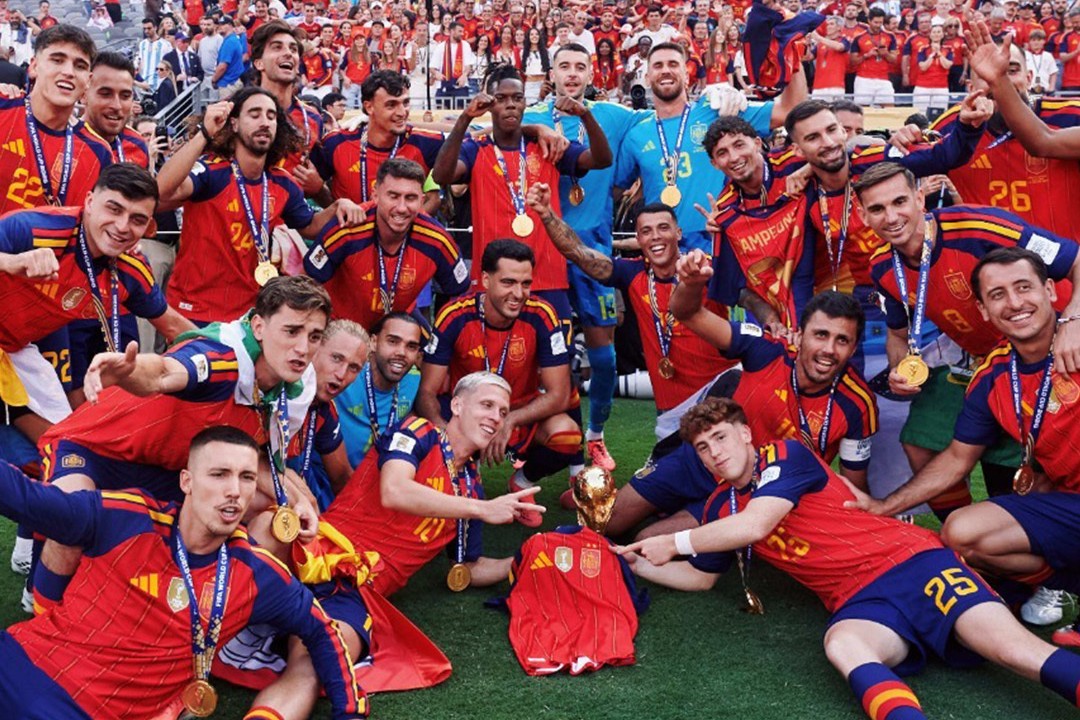
Spain sit at No. 1 in the FIFA men's world rankings published on 21 July 2026, the federation's website confirmed, with Norway confirmed as the period's biggest climber. The change at the top formalises what the European Championship in Switzerland already showed: Spain's run to the title in a tournament dominated by established superstars was not a one-off but a structural shift in the men's international order.
The practical question is what the new ranking actually buys La Roja, beyond the symbolic. A No. 1 designation feeds directly into seeded status for the World Cup draw, sets the tone for friendly invitations, and gives the Spanish football federation a fresh lever in negotiations over venue, scheduling and commercial terms. It also resets the conversation around Luis de la Fuente's squad, whose average age at Euro 2025 sat in the mid-twenties, as one built to cycle through another tournament cycle rather than peak and retire.
How Spain got there
Spain took the trophy in Switzerland on 20 July 2025, completing a tournament that the defending champions treated as a coronation rather than a defence. The wire reporting at the time noted that the squad blended Champions League regulars at the biggest clubs with a younger Spanish-domiciled core who had come through La Fábrica and the Basque and Andalusian academies, with the final victory extending an unbeaten run that now stretches back more than two years.
Norway's surge into the top tier has a simpler explanation: Erling Haaland finished the qualifying cycle as the continent's leading scorer, and the points swing against middling opposition compounded. Norway were the biggest climber in the July release, per the FIFA update covered by the Daily Nation, while Spain overtook the previous occupant of the top spot on the strength of the European Championship win.
The selection problem at the top
Rankings released between tournaments tend to flatter the champion and quietly punish anyone resting players in friendlies. The trap for Spain is the same one that caught France after the 2018 World Cup and Argentina after the 2022 edition: managing minutes on stars who play 50-plus club matches a season, then keeping the supporting cast sharp enough that the drop-off when a key midfielder is rotated does not become a story.
De la Fuente's staff face a deeper tactical question too. The Spain that won Euro 2025 asked opponents to defend wide, then punished the second line through quick combinations and a centre-forward who could both pin and spin. That template is already being studied. By the time the 2026 World Cup qualifying window closes, the question will not be whether Spain can repeat, but whether the rest of the field has built the specific counters needed to slow them.
What the new ranking does not fix
Norway's climb is the headline subplot, but the structural story sits with the sides that have not moved much at all. The July list, as reported by the Daily Nation, shows that the middle of the European game remains tightly bunched, with the gap between fifth and fifteenth measured in tens of points rather than hundreds. That compression is the byproduct of Nations League expansion and a friendlies calendar that has crowded out genuine test matches, both of which flatter opponents who show up, play, and lose narrowly.
A second-order problem is what the rankings actually measure. The FIFA men's formula weights results over a rolling four-year window, with recent matches weighted more heavily, and adjusts for the strength of opponent. The system rewards consistency over drama, which is why Spain's climb looks more orderly than the on-pitch impression of the European Championship suggested. The counter-narrative, heard occasionally in the Spanish press, is that FIFA's algorithm is too friendly to sides with deep squad rotation options, because they can compete across more matches at a higher average level.
What to watch next
The first proof point is the September international window, when UEFA Nations League fixtures return and Spain will face a draw against opponents who have had a full summer to prepare. The second is the World Cup seeding band, which FIFA will set using the rankings published shortly before the draw. Seeding matters not just for the group-stage path but for the bracket half a side lands in from the round of 16 onwards, and the difference between being band one and band two in a 48-team field is non-trivial.
The longer-term test is whether Norway can hold. Haaland-driven climbs tend to flatten when the qualifying cohort weakens, and Norway's Nations League draw will determine whether the points bank keeps compounding or starts bleeding. For Spain, the arithmetic favours holding the top spot into the World Cup year if the rotation question is handled cleanly. The trophy is already theirs. The ranking is what they do with the afterglow.
Desk note: Monexus treated the Spain-No. 1 line as a structural football story, not a federation press release. The framing rests on the Euro 2025 tournament outcome and the Daily Nation's reporting of the July rankings update, with the seeding and Nations League implications drawn out for a reader who tracks the off-pitch mechanics.
Wire provenance
This editorial synthesis draws on the following public wire/social posts:
- https://en.wikipedia.org/wiki/FIFA_Men%27s_World_Ranking