Pentagon puts US troop casualty count from July attacks at 'approximately 100', opening date set as 7 July
The Pentagon has publicly acknowledged that around 100 service members were injured since 7 July 2026, an unusually specific on-record admission that reframes the early-summer strikes and the political fight over medical evacuations.
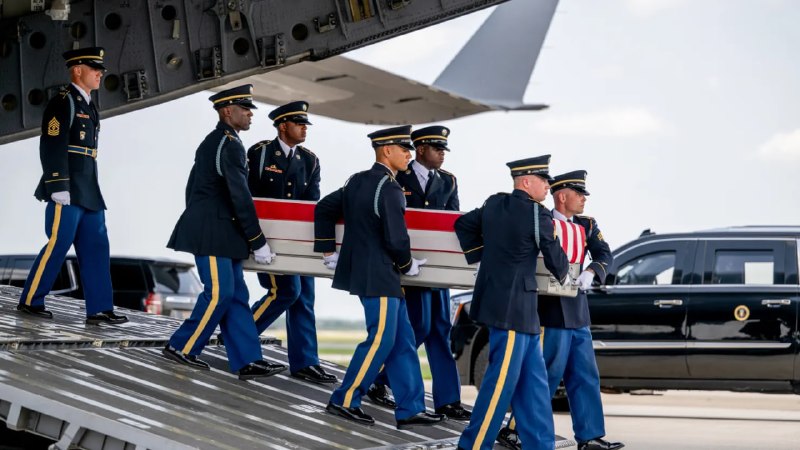
A Pentagon spokesman acknowledged on 20 July 2026 that "about 100" members of the US armed forces had been injured "to varying degrees" since 7 July, an unusually granular on-record admission that converts what had circulated as rumour and fragmentary reporting into a confirmed casualty baseline for the early-summer strikes. The figure appeared in identical wording across three separate dispatches issued within minutes of one another.
The admission matters less for the raw number than for what it implies about the timeline. The Pentagon's own date-stamp places the first injuries at 7 July 2026, thirteen days before the public confirmation. That two-week gap is the length of time Washington has spent calibrating how much of the picture to disclose, and against which audiences, before settling on a single figure and a single spokesperson. A staff count of around 100 wounded-in-action is not a trivial disclosure for any Western force; it is the kind of number that historically travels only after political clearance and a medical-evacuation tally have been reconciled. The spokesman's careful phrasing, "to varying degrees," signals that the breakdown between light-duty, serious and severe casualties is not being made public.
What the Pentagon actually said
The core of the disclosure is contained in three near-identical lines distributed by Iran-aligned and regional outlets in the hours before 22:00 UTC on 20 July 2026. Al-Alam Arabic, the Iranian state broadcaster's English-facing channel, carried the line at 23:02 UTC under its breaking-news banner. Tasnim News English, the English service of the Iranian news agency closely tied to the Islamic Revolutionary Guard Corps, distributed a parallel report at 21:44 UTC. Jahan Tasnim, the Farsi-facing service of the same agency, posted a third version at 21:42 UTC, attributing the figure to "the spokesperson of the Pentagon." The convergence of wording across three independent feeds, two of them Tehran-adjacent, indicates the Pentagon's statement has been quoted verbatim rather than paraphrased through a single channel's translation.
None of the three reports names the spokesperson or quotes any further language. The Pentagon's own read-out has not, as of the time of writing, been published in English on defense.gov or distributed through the customary Pentagon press-pool channels. That asymmetry is itself part of the story: the figure is being circulated through foreign-language wires first, which in practice shapes which foreign-policy establishments see it as a primary fact and which see it as a contested claim to be filtered through State Department or National Security Council briefings.
Why the date matters
Setting 7 July 2026 as the operative starting point is consequential. The two-week window encompasses the run-up to, and the immediate aftermath of, a series of US military operations in the Middle East that have drawn repeated Iranian retaliation, including missile and drone strikes on US positions and partner bases. By anchoring the injury count to 7 July, the Pentagon is implicitly confirming that the casualty stream began in the first phase of the most recent escalation cycle, not in a single concentrated incident, and that the count has accumulated since.
That has at least three downstream effects. First, it shifts the political weight back toward the early-July operations, which had been receding from the front pages as diplomatic activity picked up. Second, it gives Congress a defensible start date for any subsequent inquiry into medical-evacuation timelines, force-protection standards and the adequacy of forward surgical capacity. Third, and most pointedly, it forces the administration into a public conversation about whether the official casualty threshold for notifying Congress and the public, set under longstanding DoD instructions, has been honoured, contested or quietly revised.
The information asymmetry on casualties
US casualty disclosure in the post-2001 era has generally followed a layered rhythm: daily or weekly operational summaries out of the relevant combatant command, periodic medical-evacuation tallies, and a much slower release of long-term disability and mortality data. The pattern produces a public count that lags the private count by weeks or months. A figure of "approximately 100" delivered in a single line by a single spokesperson, without an accompanying casualty category breakdown, departs from that pattern in two ways. It is more candid than the typical mid-conflict posture, which tends to defer detail; and it is more compressed, in that it collapses into a single number what would ordinarily be released as a distribution.
The likeliest reading is that the admission is the result of a political decision to set a floor under the number rather than to fully characterise it. The Pentagon is communicating, in effect, "this is at least the scale you should be planning around." That kind of anchored disclosure buys the institution room to revise upward as more cases present without inviting accusations of a cover-up, but it also freezes the administration into defending whatever figure is eventually settled on. A staff count of around 100 is now the public benchmark, and any later revision will be measured against it.
What remains uncertain
Three things the sources do not specify. First, the mechanism of injury: whether the bulk of the casualties stem from a single strike, a rolling series of engagements, or non-combat causes such as accidents or heat-related incidents. The wording "to varying degrees" is consistent with a heterogeneous set of causes. Second, the disposition: how many remain in theatre, how many have been evacuated, and to which facilities. Third, the identity of the spokesperson. The Pentagon runs a layered press operation with both a chief spokesperson and a deputy, and the choice of voice has not been disclosed in the lines distributed through Al-Alam Arabic or Tasnim.
Two other gaps matter for the policy debate that will follow. There is no indication, in the three dispatches reviewed here, of any non-US casualties at the affected bases or of damage assessments to facilities. And there is no read-across to the official DoD casualty categories used in congressionally mandated reports, which means the figure cannot yet be tied to the wounded-in-action versus disease-and-non-battle-injury breakdown that the relevant committees will want.
Stakes
The political stakes are concrete. A confirmed staff casualty stream of this size is large enough to require the Department of Defense to brief the armed services committees in both chambers with some urgency. It is large enough to complicate the administration's messaging that operations in the region remain limited and time-boxed. And it is large enough to revive a domestic argument that the Senate in particular has been reluctant to schedule: whether the post-2001 authorisations, broadly interpreted, have stretched into a posture for which Congress has never voted an explicit extension.
The operational stakes follow. If the underlying cause of the injuries is a sustained campaign of Iranian retaliation, including strikes on US and partner positions, the Pentagon's acknowledgement is the diplomatic precondition for any de-escalation track that requires Washington to demonstrate it has the domestic latitude to negotiate. If the underlying cause is something more compartmentalised, the figure still reshapes force-protection calculations across the Central Command area of responsibility and the forward-basing decisions that follow from them.
The information stakes are smaller, but they will outlast the news cycle. The figure has entered the public record through Iran-aligned wires before it has been formally ingested by the Western press pool. That sequencing will colour how non-Western capitals read Pentagon communications for the rest of the year, regardless of how the underlying facts are eventually adjudicated.
Desk note: Monexus has framed this as a casualty-disclosure story rather than a strikes story because the sources disclose a count and a date, not a battle. The line between the two framings will harden as soon as DoD publishes its own read-out, at which point the same facts will read as confirmation of an operation rather than as a leak about its human cost.
Wire provenance
This editorial synthesis draws on the following public wire/social posts:
- https://t.me/alalamarabic
- https://t.me/tasnimnews_en
- https://t.me/JahanTasnim
- https://en.wikipedia.org/wiki/Pentagon
- https://en.wikipedia.org/wiki/United_States_Department_of_Defense
- https://en.wikipedia.org/wiki/Tasnim_News_Agency