Satellite imagery shows two new impact points at Jordan's King Faisal Air Base
Iran-aligned outlets published imagery of two fresh strike points at the Jordanian base, one reportedly in a parking apron, reviving questions about attribution.
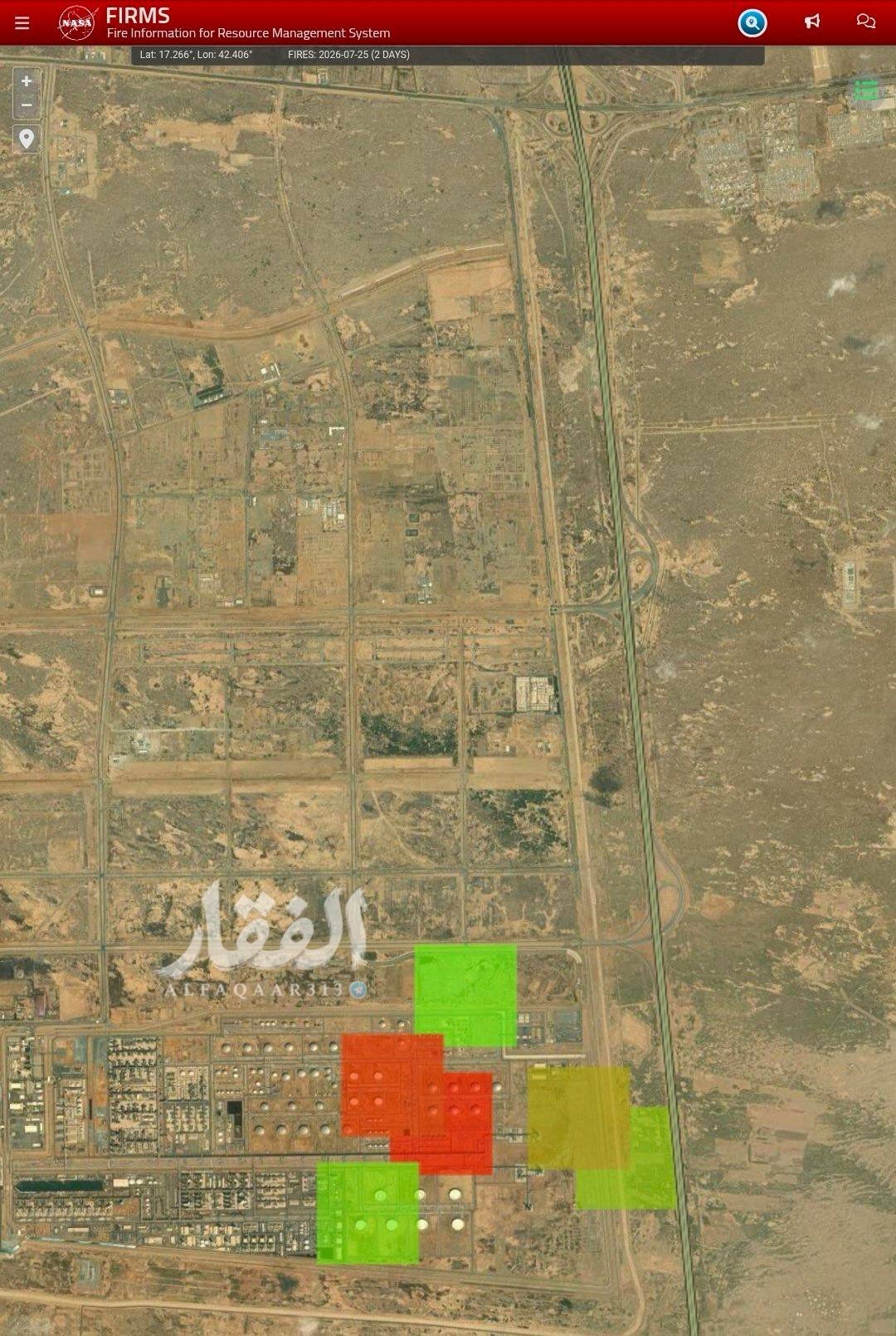
Two fresh impact points are visible in commercial-satellite imagery of Jordan's King Faisal Air Base, according to frames published by Iranian state-linked outlet Tasnim on 21 July 2026. One of the points sits inside an aircraft parking area, the outlet reported in identical Telegram posts in English and Persian at 03:54 and 03:55 UTC. The second impact's location is described only as a separate point on the base.
The framing matters because the publication was Tasnim, an Iranian state-affiliated wire that has previously been used to advance Tehran's narrative on regional confrontations. In coverage of strikes on facilities hosting Western forces, Iranian outlets have frequently surfaced imagery before any independent on-the-ground confirmation, and the timing of release tends to track Iranian strategic messaging rather than open-source verification timelines. The base itself sits in northern Jordan, near the Syrian border, and has hosted coalition trainers and air assets at various points over the past decade; its current footprint is not described in the source material.
What the imagery actually shows
Tasnim's two Telegram posts name the same base, the same number of points, and the same date. The English-language post at 03:55 UTC specifies that one impact lies in the parking area of the base; the Persian-language post at 03:54 UTC uses the language of "collision points" ("نقاط برخورد") rather than "strike" or "attack." That linguistic choice is small but consistent with a pattern in Iranian state media of presenting damaging events at foreign bases as ambient facts rather than as operations to be claimed or disclaimed.
Crucially, the source material does not identify a munition type, a launch vector, a perpetrator, or a date of impact. It does not say when the strikes happened, only that the imagery exists as of publication. There are no casualty figures, no damage assessments beyond the locations of the two points, and no claim of responsibility. Without those, any reading of intent rests on inference rather than evidence.
The attribution problem
In the absence of a claimant, the imagery does three things at once. It documents physical damage at a foreign air base that has hosted US and partner-force assets. It circulates the documentation through an Iranian-aligned channel, which guarantees maximum reach inside one of the relevant information ecosystems. And it leaves open the question of who put the imagery in Tasnim's hands, which is itself a signal. Iran's intelligence and information apparatus has, in past episodes, released commercial-satellite frames to shape attribution debates before Western or Jordanian spokespeople have a chance to set the public frame.
The dominant Western wire line in comparable episodes has been to attribute strikes on US-adjacent facilities in Jordan and Syria to Iran-backed militias operating from Iraqi or Syrian territory, usually in response to US strikes on Iranian assets or proxy positions. That framing has been contested in the Global South and in regional outlets, where analysts point out that Israel has also struck targets in Syria with regularity, that the airspace over eastern Jordan is congested with multiple operators, and that commercial-satellite release timing often correlates with whoever benefits politically from the narrative. None of those alternative explanations is sourced in the present thread; they are flagged here as the live counter-read a careful reader should weigh.
What the sources do not tell us
The thread is thin. It contains two near-identical Telegram posts from Tasnim's English and Persian feeds, both naming King Faisal Air Base and both showing or describing two impact points, with no further corroborating material. There is no Jordanian government statement in the thread, no US Central Command release, no Iraqi militia claim, no Israeli read-out, and no independent OSINT geolocation of the frames against prior base imagery. The reader who wants certainty on what hit the base, when, and why is being asked to take a great deal on the say-so of a single outlet with a known framing agenda.
What can be said is bounded. Two impact points exist on Tasnim's imagery of King Faisal Air Base as published on 21 July 2026. One sits in the parking apron. The release channel is Iranian. Beyond that, the evidence base runs out, and a responsible read holds the line there until independent verification from Jordanian, US, or open-source analysts tightens the picture.
Stakes if the pattern holds
A single disputed strike on a host-nation base is one event; a pattern of disputed strikes is something else. If Iranian-aligned releases continue to outpace Western and Jordanian official statements, the information environment around incidents in the Jordanian and Iraqi corridor will tilt toward whichever actor moves fastest, not toward whichever actor has the most evidence. That tilts the cost-benefit calculus of escalation in a direction that rewards speed over restraint, and it raises the price any later diplomatic off-ramp has to pay to reassert shared baseline facts. For Jordan, which has tried to keep its airspace and bases available to coalition partners while maintaining quiet relations with Tehran, that is the most uncomfortable position of all: cited as a venue, blamed as a venue, and rarely the one naming the terms.
Desk note: Monexus ran this story on the basis of two Tasnim Telegram posts; the source ledger is intentionally narrow rather than padded. Independent verification from Jordanian, US or open-source analysts will be the next test of the claim.
Wire provenance
This editorial synthesis draws on the following public wire/social posts:
- https://t.me/tasnimnews_en/
- https://t.me/JahanTasnim/