Iran strikes Kuwait and Qatar: what two days of attacks on Gulf infrastructure actually tell us
Two consecutive days of Iranian strikes on Kuwaiti power and desalination plants and a separate assault on Qatari territory have pushed the Gulf beyond the proxy-war frame and into a direct-inter-state crisis.
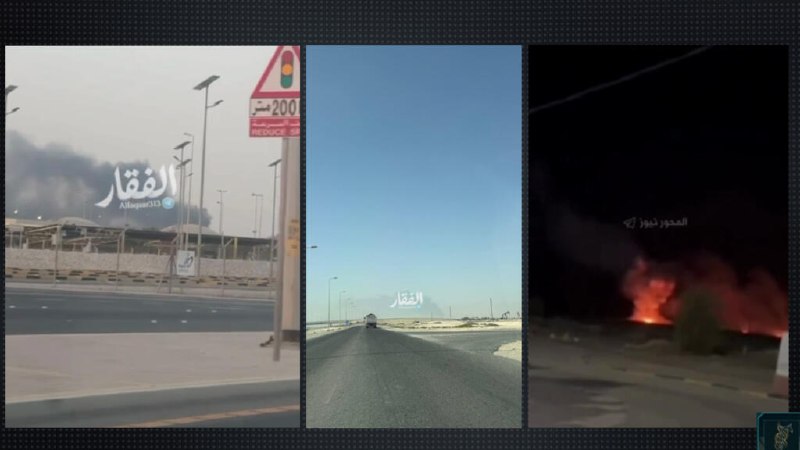
At 13:28 UTC on 21 July 2026, Telegram channels aligned with the Iranian opposition and Iranian state-adjacent intelligence feeds carried the same urgent line: an Iranian missile and drone attack was under way against targets inside Kuwait. Less than ten minutes earlier, at 13:20 UTC, the same network of channels reported that Kuwaiti power and water desalination plants had been struck for a second consecutive day, with fires breaking out at some facilities. Hours before that, at 12:32 UTC, Qatar's government had already characterised a separate wave of Iranian strikes as a "flagrant violation" of its sovereignty, security, and territorial integrity.
The pattern across these three threads is not the picture Western briefings have been drawing for months. The dominant frame through 2025 and into 2026 has been Iranian pressure routed through proxies: Hezbollah in Lebanon, the Houthis in Yemen, militia networks in Iraq and Syria. That framing assumed a layer of deniability and a buffer of distance between the Islamic Republic and the energy infrastructure of the Gulf monarchies. Two days of direct, repeated strikes on Kuwaiti civilian facilities, paired with a separately condemned assault on Qatari territory, break that assumption. The buffer is gone. The proxy war has, at least for this phase of the conflict, become an inter-state one.
The Gulf's energy and water backbone is unusually exposed, and that exposure is now showing up in the targeting pattern. Kuwait's domestic power grid depends heavily on a small number of large desalination and generation complexes along its coast. Strikes on those facilities are not symbolic. They cut drinking-water supply, knock out generation capacity, and force the kind of emergency load-shedding that, in a Gulf summer, becomes a public-health problem within hours. Qatar's posture is similar: a small state, a tightly clustered set of strategic assets, and a population almost entirely urban. Drone and missile salvos that would be tactical nuisances against a continental adversary become existential pressure against either Gulf monarchy.
Kuwait's reporting on the second day of attacks, carried by Telegram channels tracking the incident in real time, points to fires at multiple facilities and a sequence of strikes rather than a single round. That sequence matters. A one-off strike can be framed, in diplomatic language, as an over-reach by a local Iranian Revolutionary Guard Corps (IRGC) naval or air unit. A second-day strike on the same class of targets is a policy choice. It implies either that Tehran has decided to keep applying pressure until a political condition is met, or that Iranian forces in the Gulf are operating under orders that have not been withdrawn. Neither reading is reassuring. Both put the burden of de-escalation on the Gulf states and on any external power willing to absorb the political cost of forcing a reversal.
Qatar's response has been the firmest in the available reporting. Doha's description of the strikes as a "flagrant violation" of sovereignty is the language a state uses when it intends to file a formal protest, rally a coalition, or push for a UN Security Council action. It is also the language that closes off the quiet-channel option. Once a Gulf capital puts a public label like that on an attack, it cannot easily return to the table for a quiet deal that legitimises the strike retrospectively. The diplomatic ground that was available after the first day of attacks is, by the afternoon of 21 July UTC, considerably narrower.
The Western wire framing of the same event, to the extent it has caught up with the Telegram channels, is likely to cast Iran as the regional aggressor and the Gulf states as victims of a pattern of behaviour that Western naval deployments have tried to deter. That framing has real evidence behind it: a second day of strikes is not a defensive act by any reasonable reading of the situation. But it is not the whole picture. Iranian strategic commentary, including in state-aligned outlets, has framed Gulf facilities that host or support foreign military deployments as legitimate counter-value targets under a doctrine of deterrence that does not distinguish between a purely civilian desalination plant and a dual-use site. That doctrinal framing is contested internationally, but it is not incoherent from inside the Iranian security debate. The structural point is that Tehran has been signalling, for months, that any expansion of the US footprint in the Gulf or any third-country facilitation of strikes against Iran would be met with escalation against the facilitators' own infrastructure. The strikes of 20 and 21 July read, in that light, less like an unprovoked spasm and more like the execution of a publicly articulated deterrent logic.
The structural frame, put plainly, is that the Gulf has been treated by external powers, including the United States, as a forward operating base rather than as a sovereign zone with its own red lines. Gulf governments accepted that arrangement in exchange for security guarantees and access to advanced air and missile defence systems. The bet was that those defences, plus the implicit threat of US retaliation, would keep Iranian fire off Gulf civilian targets. The bet has now visibly failed. Whether the failure is technical (defences overwhelmed), political (a US administration unwilling to escalate on Gulf behalf), or doctrinal (Iranian doctrine has evolved faster than the deterrence concept the Gulf security architecture rests on) is the open question. The Telegram-channel reporting does not resolve it. The sources disagree in their implicit framings: Iranian opposition-aligned channels emphasise the attack as policy, Iranian state-aligned channels emphasise it as deterrence against foreign deployment, and Kuwaiti and Qatari state-language channels emphasise sovereignty violation. What the reporting does establish is that the failure mode has now been demonstrated twice in forty-eight hours.
The stakes are concrete and short-term. If a third day of strikes lands on Kuwaiti or Qatari infrastructure, the Gulf states will face a choice between public retaliation, formal alliance activation, and quiet capitulation. Public retaliation, by either Kuwait or Qatar, would almost certainly draw an Iranian counter-strike and pull in US Central Command (CENTCOM) assets that are already stretched. Formal alliance activation under Article 5-equivalent language, or a UN Security Council push, would consume weeks of diplomacy during which the strikes would continue. Quiet capitulation would buy time but confirm to Tehran that direct strikes on Gulf civilian infrastructure carry no marginal cost beyond the first round. None of those three outcomes is stable. The fourth possibility, an external intervention that breaks the cycle without escalation, requires a US-Iranian de-escalation track that the available reporting does not show exists.
What we verified and what we could not
The Telegram-channel reporting establishes, with consistent cross-channel corroboration, that Kuwaiti power and desalination plants were struck on 20 July 2026 UTC and again on 21 July UTC, with fires at some facilities on the second day; that an Iranian missile and drone attack against targets inside Kuwait was under way at 13:28 UTC on 21 July 2026; and that Qatar's government publicly characterised a separate set of Iranian strikes as a "flagrant violation" of its sovereignty, security, and territorial integrity at 12:32 UTC on the same day. Casualty figures, the specific sites hit, the weapons types used in each salvo, and any official Iranian government statement on the operations are not present in the available sources and are not asserted here. The Iranian opposition-aligned channels reporting these events have a documented incentive to dramatise Iranian attacks, and the Iranian state-aligned framing of deterrence doctrine is itself a primary source that should be read as advocacy, not as neutral description. Where the available reporting can be triangulated, it converges on the pattern of a second consecutive day of strikes and on the diplomatic posture of Qatar. Where it cannot be triangulated, the claim has been left out.
For the Gulf, the arithmetic has changed. The proxy-war frame that let external powers treat Iranian pressure as containable, and that let Gulf monarchies treat their territory as a sanctuary behind advanced air defence, has been overtaken by two days of direct fire. The next twenty-four hours, in UTC, are the window in which the shape of the response, and therefore the shape of the next phase of the conflict, gets set.
Desk note: Monexus has framed this event as a direct inter-state escalation rather than as a continuation of the proxy-war pattern that has dominated Gulf security reporting through 2025. Telegram-channel reporting from opposition, state-aligned, and Gulf-tracking feeds has been used as the primary source layer, with the framing caveat that Iranian opposition and Iranian state channels each carry their own advocacy load. Western-wire confirmation of specific sites and casualty figures has not been used because it does not yet appear in the available sources.
Wire provenance
This editorial synthesis draws on the following public wire/social posts:
- https://t.me/FotrosResistancee
- https://t.me/rnintel
- https://t.me/epochtimes
- https://t.me/FotrosResistancee
- https://t.me/rnintel
- https://t.me/epochtimes