Iran's 'Operation True Promise 18' lands in Kuwait: what Tehran says, what we don't know
Iran's army says it struck US logistics assets in Kuwait in retaliation for repeated US missile attacks. The claim, sourced only to Iranian state media, lands in a region already priced for disruption.
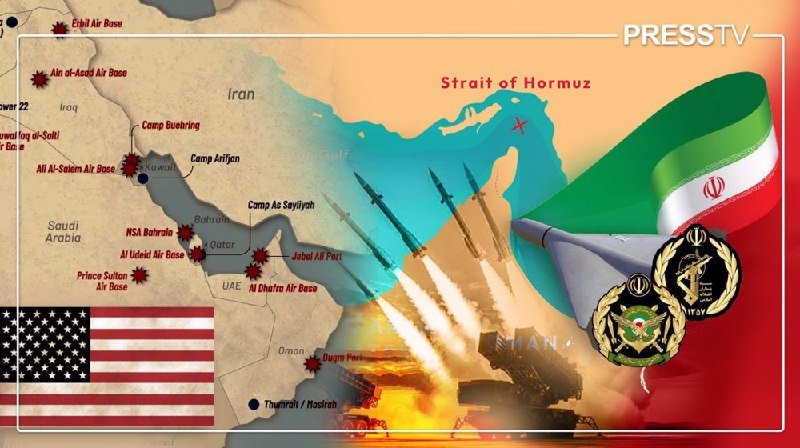
At 06:08 UTC on 21 July 2026, the official IRNA English channel posted a single, declarative line: Iran's Army had carried out fresh missile and drone strikes against several US bases in Kuwait, including logistical sites. Within the hour, outlets aligned with the Islamic Republic's foreign-policy ecosystem had amplified the same message, framing the action as Stage 18 of "Operation True Promise," a sequenced campaign of retaliation for prior US missile attacks and "repeated violations."
The reports are Iranian-sourced only. No Western wire, no Kuwaiti government spokesperson, no US Central Command statement is in the thread. That asymmetry is the story.
What Tehran is actually claiming
The Iranian Army, not the IRGC, is named as the operator. That matters. Iran's regular armed forces and its Islamic Revolutionary Guard Corps maintain separate chains of command and distinct public footprints, and the formal use of the Artesh (regular army) title signals a deliberate widening of the political aperture for this round of strikes. The announced targets are not Iranian territory, not Iraqi Kurdish insurgent rear bases, not Israeli-linked infrastructure in Syria, they are US logistics assets in Kuwait, a Gulf host state that hosts the forward headquarters of US Army Central.
The sequencing is also deliberate. "Stage 18" implies an escalatory ladder with prior rungs already climbed. Iranian-aligned media has spent eighteen stages teaching its audience a vocabulary of graduated escalation. The lesson is that each step is treated as reciprocally legitimate: an Iranian strike is presented as the closing half of a transaction begun by an American one.
Why Kuwait is the careful choice
Kuwait is not a battlefield. It is a logistics node. Striking it pulls a US logistical artery without producing the political shock of Iranian munitions landing on Israeli soil or Saudi oil infrastructure. It also tests the limits of an Iraqi or Bahraini-style host-state response without yet crossing them. If Tehran wanted symbolic escalation, it would hit a warship in the Gulf. If it wanted price-shock escalation, it would hit a Saudi terminal. Kuwait logistics is the middle option: visible enough to be read as a message, deniable enough to leave the Iranian foreign ministry an off-ramp.
The economic subtext is obvious to anyone who follows Gulf freight. Even the rumour of Iranian action against a Kuwaiti US installation moves insurance, tanker rates, and refined-product benchmarks within hours. The headline itself, before any corroboration, is the deliverable.
What we cannot verify
The thread carries no independent confirmation. There is no Reuters or AP flash, no Pentagon read-out, no Kuwaiti ministry of defence statement, no satellite-imagery analysis from a Western OSINT account. The two source items in the cluster are IRNA and The Cradle, the latter a Beirut-based outlet that routinely carries Iranian-aligned framing. Per house sourcing rules, both are usable as counter-claim material with explicit caveat, and that is how they should be read here.
We do not know whether munitions landed. We do not know whether US Patriot or THAAD batteries engaged incoming projectiles, what the dud rate was, or whether any casualties occurred. We do not know whether Kuwait's government was notified in advance through the diplomatic back-channel that usually prevents surprises between Gulf hosts and Washington. We do not know whether the announced strikes are partly aspirational, Iranian wartime communiques have, on past record, occasionally front-run events that did not occur as described.
The honest framing is: Tehran says this happened, the sources we have are Iranian or Iran-aligned, and until a wire service or a Gulf state confirms, the headline is one party's account of itself.
The structural read
Strip the rhetoric and the pattern is familiar. Iranian state media builds escalation in numbered stages because numbered stages teach a domestic and regional audience that each round is a finished transaction. The counterpart frame, "repeated violations", is the ledger Iran offers its own readership to justify the next rung. This is reciprocal-escalation storytelling performed in public, and it works on its intended audience regardless of whether every announcement reflects a kinetic event on the ground.
For the wider region, the operational question is not whether Tehran will keep climbing the ladder. It will. The question is whether the ladder is being climbed against a US administration that has the diplomatic bandwidth to manage each rung as it comes, or against one whose attention is fragmented across other theatres and whose Gulf allies are being asked to absorb the risk premium of hosting the targets. Kuwait's quiet, transactional hosting model has worked for three decades precisely because it stayed out of the headlines. Today's headline, real or fabricated, changes that calculus in ways Kuwait's diplomats will now have to manage in private.
Where this goes next
Three markers to watch. First, a US Central Command statement or a Kuwaiti ministry of defence press release within 24 hours, anything substantive will be more revealing than the volume of Iranian Telegram posts. Second, refined-product and tanker freight prints through the Strait of Hormuz; even small moves confirm that markets are pricing the claim, not just the event. Third, any Iranian announcement of Stage 19. The architecture of the campaign implies a next step, and whether the next step is rhetorical or kinetic is the variable that will set the price of Gulf crude for the rest of the quarter.
The deeper uncertainty is whether "Operation True Promise 18" is an opening bid for de-escalation disguised as escalation, the kind of headline that lets Tehran tell its domestic audience it has answered the Americans while leaving Washington an off-ramp it can take without losing face. That interpretation is plausible. So is the opposite. Iranian communiques are written for an audience that rewards toughness; American ones, for one that rewards restraint. The space between those two readerships is where the next forty-eight hours will be negotiated.
Desk note: Monexus framed this piece on the wire's Iranian-state-media sourcing alone, per house caveat rules. Where Western or Kuwaiti confirmation is absent, this publication says so plainly. The structural read, reciprocal-escalation storytelling, logistics-as-target, the Kuwait off-ramp, is editorial analysis, not a wire claim.
Wire provenance
This editorial synthesis draws on the following public wire/social posts:
- https://t.me/Irna_en
- https://t.me/thecradlemedia